@LeadingLearner
Archive for
What Should We Look for in Senior Leaders?
This post was prompted by #SLTchat which has started to become part of my Sunday evening preparation for the week ahead. It gets my mind back on the job and allows me to pick up a whole number of ideas through rapid fire responses to key questions of the day.

About three to four years ago I changed both the information requested about colleagues applying for a leadership role and the style of the response. The reference request is built around a document called “Rush to the Top” from Hay Group – it is well worth a read. A full copy of the leadership reference request form is attached at the end of this post and you are welcome to download and use all or any part of it .
The part specifically focussed on leadership is the second table. I’ve not only used it for references but also as part of a self reflection exercise for potential senior leaders on a number of courses I have been involved in. There are a series of different elements which I have split up and commented on below.
Impacts Positively on Outcomes, Systems & Process and Others
 I’m looking for a senior leader who is a credible teacher, someone who has a positive impact on the academic or vocational outcomes on the students in their class. It is difficult for a senior leader to expect high standards from their team and others across the school when they cannot deliver themselves.
The administrative and management skills are linked to efficiency and trust around day to day issues. Whilst someone may be able to achieve good outcomes in their own rather idiosyncratic and disorganised way this does not transfer to leading a team. The team requires an element of clarity, coherence and consistency if they are going to deliver for the students. I don’t take this to seeking someone with a high level of OCD but I need to avoid the person who can’t organise the proverbial in a brewery or who undermines systems and processes through not meeting deadlines. On the management side I want someone who will effectively set up sensible and necessary systems and processes that bring a sense of order to the areas that they are responsible for.
Emotionally Intelligent & Resilient
 Next comes a section which is seeking information about a candidate’s emotional intelligence and emotional resilience. As leaders, if we want staff to follow us, we must be able to influence them. This is not about a Machiavellian or underhand approach rather the ability to convince people about the direction of travel and how we can get there. As leaders we don’t need to get it right all the time – people in my experience are pretty forgiving particularly if you acknowledge when you have messed up or over egged the pudding – but they do expect you to empathise with their situation and show the necessary self-control when making decisions and taking the school forward. I don’t want people without the necessary emotional intelligence leading at any level within the organisation. The ability to empathise and show the necessary self control all starts with your own self awareness and I’ve blogged about this before (Who Do You Bring to Leadership?). These are the four critical emotional intelligences for leaders and I want to know, from people who currently work with you, how you behave in these areas.
Finally, in this section, a person’s emotional resilience and their response to the stresses and strains of leading is vital to elicit. It’s no good appointing a person who is likely to buckle or fold when it comes to a defining or key moment – everyone expects senior leaders to stand up and be counted when the going gets tough. To be honest this equally applies to middle leaders.
Thinks Creatively, Deals with Complexity

These next few are key if the person appointed is going to be successful as a senior leader – we need creative problem solvers, who can deal with complexity, prepare themselves for current and future challenges and who are ready to go.
We often don’t recognise and reward the different thinkers in education, we tend to like conformity. However, I’m looking whenever possible for a senior leader as well as a senior manager. I’m interested in people who can take a problem, which maybe we’ve been grappling with for years, and look at an innovative way to solve it. The best of these people go beyond thinking outside the box, to not even accepting the box is there – they are the Belbin “plants”. When given a difficult problem in a team meeting (or interview situation) how many different solutions do you normally come up with? Too many meetings I’ve sat in go something like this – problem is posed, someone suggest a solution, which is supported by some and criticised by others, but you have to either implement it or do nothing as there are no other suggestions on the table. Sound familiar?
The ability to deal with complexity, see the bigger picture and manage the tensions between different competing demands is important for leaders. At a senior level you need people who can make connections between disparate parts and weave them into a coherent picture for others to see. If it is a simple issue the senior leader or leadership team shouldn’t be spending too much time on it – make a decision and get on with it. The person who is important to avoid here, unless you are convinced they can learn and learn rapidly, is the “I am my position” person, for example, the head of department who thinks it is their job to fight their corner even when it clearly damages the whole. The very best middle leaders bring a perspective not a position, these are the people who can operate best at a senior level.
A middle leader who is ready to step in to senior leadership (“potential” is a very difficult thing to define and notoriously fickle) is likely to be someone who simply can’t walk past a “situation”, always heads towards the problem and just can’t stop themselves leading. The most successful senior leaders I’ve worked with always had these tendencies.
What you are doing in your current role and how you are doing it is the critical preparation for senior leadership – this always comes out in interview, are you behaving like a senior leader now?
PRP – “We’re in the Wrong Jungle!”
I once read that part of the art of leadership is making sure you’re in the right jungle. The analogy goes that, whilst people may be working hard chopping their way through the jungle and transversing difficult terrain, it is the job of the leader to climb the tallest tree and not simply check that people are travelling in the right direction but that they are in the right jungle.

The current discussions, debates and arguments about Performance Related Pay is “wrong jungle”. I don’t want to just measure teachers, I want to help them improve and collectively we should be focused on improving the system. I’ve blogged about this before, “Improving Teaching Not Just Measuring It”. We must manage the tension between holding people accountable and developing them – it was always thus. Too much of one without the other becomes attritional or easy street.
So instead of simply focussing on PRP we need to stand back and look at how we could use the new flexibilities in pay policies to help shape an even higher performing profession – increasing the professional capital must be the key driver in our decision-making. The latest STPCD lays down the law but to borrow a biblical flow we need to move from the law, to the prophets and gradually introduce wisdom. It’s time for some prophetic voices.
If you want to read a great post on PRP look at John Tomsett’s “This much I know about … Performance Related Pay for Teachers.”
In terms of the challenges for September 2013, the writing of a new Pay Policy is at the front of many people’s minds. The main changes seem to centre around:
- Teachers moving up the pay range based on performance rather than experience with annual assessments of their performance
- Pay ranges being introduced rather than nationally agreed pay points
- Removal of threshold
- No longer needing to match a person’s existing salary when a member of staff moves from one school to another
- Introduction of Leading Practitioners
Underpinning the PRP approach is the belief that offering individual schools or hard federated schools/multi-academy trusts greater flexibility to use a “carrot & stick” approach will improve education. My view is that this is simply “bonkerooney”.
Pay ranges rather than nationally agreed pay points won’t deliver World Class education. The process of isomorphism will tend, over a very short time, to move all things back to a point. There is no value in being out of step for long just watch how petrol prices in an area move up and down together.
The ability to remove threshold assessment is misleading as we now have threshold every year.
Not recognising the experience teachers have developed and the enhanced professional capital, which is gained exponentially in the early years, undervalues them significantly.

The one nugget of gold in the whole sorry mess is the introduction of Leading Practitioners. How many leading practitioners do you want on your staff – one, five, ten or every teacher a lead practitioner? For me it’s a no-brainer but how do we help all teachers became lead practitioners?
There are a number of different paths we could travel but here’s a few to give you some food for thought.
THOUGHT ONE
Hargreaves & Fullan (2012) stress the importance of increasing the human capital within the profession by attracting the top graduates with high emotional intelligence and moral commitment. These graduates will soon be coming out of university with debts in the region of £50,000. We should remove M1 from the main scale and start all new staff on M2 with them staying on M2 for their first two years. The cost would be £2,105 over two years including on-costs.
THOUGHT TWO
Between three to five years after colleagues join the profession far too many increasingly capable and highly committed people leave the profession. Same again but remove M3 and M5 but when a teacher moves from the proposed M2 to M4 s/he remains on it for two years and likewise when moving from current M4 to M6. The costs are £2,384 and £2,484 respectively including on-costs. Simply offering slightly more pay won’t necessarily stop this but it will indicate how much we value people. There is an added bonus that the required PRP decisions only need to be made every two years:
- More time to collect the requires evidence for senior leaders
- Half the number of PRP decisions each year and give leaders time to do things that have a greater impact
- Halve the number of times anxious and worried staff wait to receive news about whether they have met their PRP objectives or not.
I know budgets are squeezed but managing a budget of £6 million each year the opportunity to find approximately £1,000 per annum, for each member of staff on the main scale, is not beyond our ability. Imagine the cost of not doing this – failing to attract the best staff and not retaining those we have. The cost will be part offset through savings on adverts at the very least.
THOUGHT THREE
If we are going to use the principles of highly effective summative assessment we need to ensure that are assessments are distributed, synoptic, manageable, trusted and extensive. The later, extensive, requires that all important aspects are covered – the obvious list has already been given by the Department for Education but what about a teacher’s contribution to his/her own professional development (required to move from M2 to M4), contribution to another person’s development (required to move from M4 to M6), involvement in research & development around pedagogy, work as a form tutor or engagement in extra-curricular provision. The contribution teachers, and other staff who work in schools make, is both extensive and varied.
“IT’S A SYSTEM THING”
Decisions about what to include and what not to include in Pay Policies for September 2013 will give staff a very clear message about are underlying beliefs and how much you value teachers. Are you a buy them cheap, stack them high or you get what you pay for kind of leader? Teachers aren’t daft, they know that these freedoms are not going to lead to massive pay rises but they will expect to be treated with fairness, justice and valued for the knowledge, experience and expertise they bring. I’m sure certain people reading this blog would categorise me as a liberal, lefty, guardian reading softy who just wanted to pay teachers something for nothing. I’m not but I do want the absolute best staff to work with the young people at St. Mary’s and I wonder whether we will be bold enough to put together a radical element in our policy to make this happen.
I’m not sure whether my “thoughts” are particularly good or bad but in some ways that is not the key issue. The worrying thing is that we will soon have a fragmented approach to pay, terms and conditions. If we want every child, in every class, in every school to have a fantastic education then we need to act as a system. Be wise when putting this year’s Pay Policy together and make sure it speaks of your values and beliefs – remember I cannot hear what you say because what you do shouts so loudly in my ears.
The follow up blog post, with the College’s draft Pay Policy in, is “A Silver Lining to the PRP Cloud?”
Who Do You Bring to Leadership?
Ten years ago I was fortunate to experience the Leadership Programme for Serving Headteachers. It was an excellent programme. I still remember the impact of the Iceberg Model and subsequent discussion around motives and traits. Continue reading
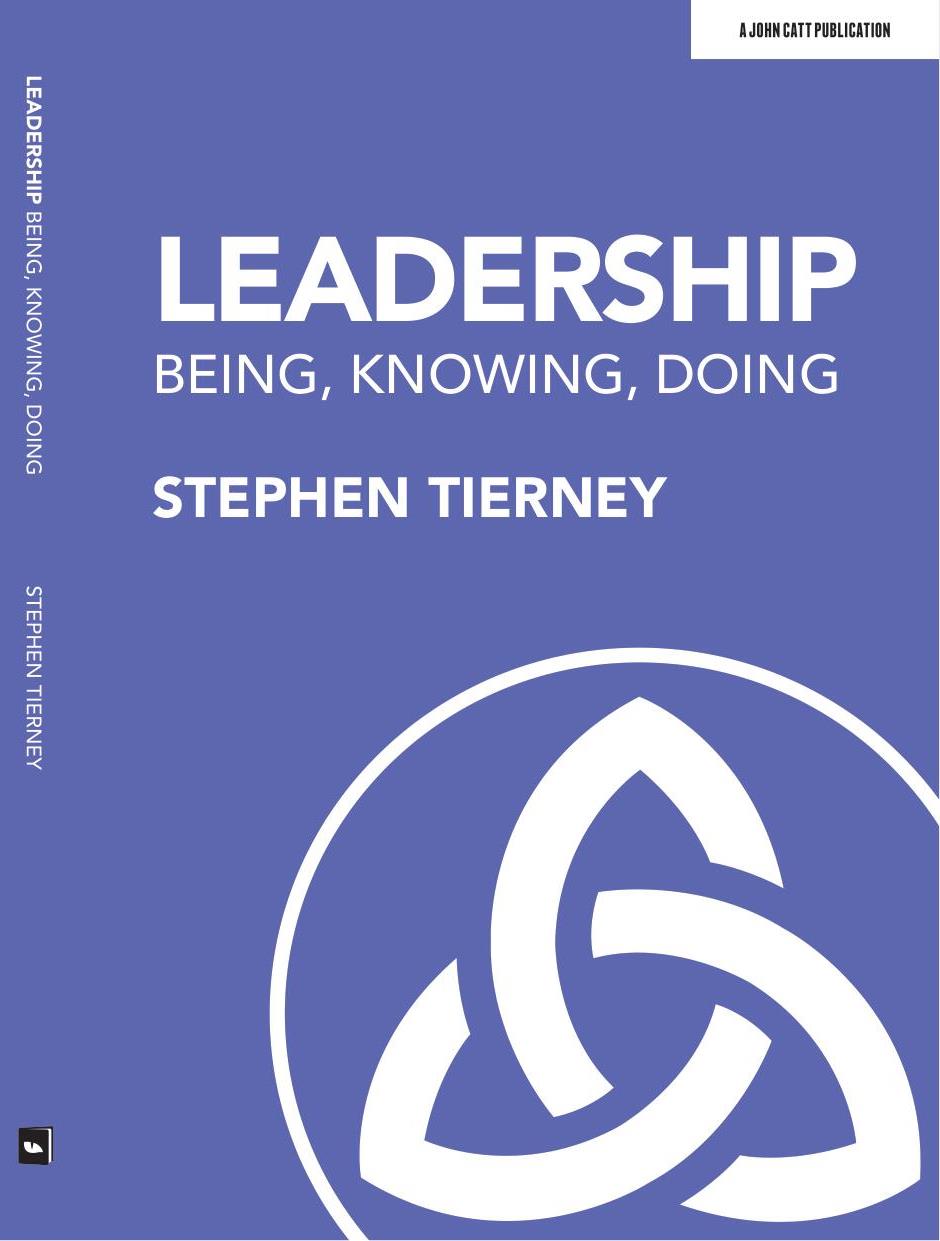
Leadership: Being, Knowing, Doing (New Book)

Liminal Leadership

COPYRIGHT LICENCE

@LeadingLearner by Stephen Tierney is licensed under a Creative Commons Attribution-NonCommercial-NoDerivatives 4.0 International License.
Based on a work at www.leadinglearner.me.
 @LeadingLearner