@LeadingLearner
Archive for
Next Step to Outstanding
In a previous post “Consistently Good to Outstanding” I described my views about outstanding teaching following interviews with a number of teachers at St. Mary’s Catholic College, Blackpool who had been consistently graded outstanding in lesson observations.
I finished with these thoughts:
- Outstanding is not simply doing more good things it’s doing different. It involves a mindset shift.
- Absolute clarity of how knowledge and understanding are vertically integrated in your subject and helping students to work at a conceptual level. The teacher needs to be working there first.
- Keeping the lesson plan “loose” so that you can respond to the learner as s/he makes their learning visible to you at the beginning, during and end of lessons.
The following table and the thinking behind it attracted quite a bit of interest:
|
Grading |
Learning Gains |
Lesson structure |
Focuses On |
| Satisfactory (RI) |
Loose |
Tight |
The activities |
| Good |
Tight |
Tight |
The lesson plan |
| Outstanding |
Tight |
Loose |
The learner |
I’ve set myself the challenge of trying to develop a CPD programme to help teachers move from good to outstanding “#OutstandingIn10+10”.
I want to put a note of realism in here, this is not about producing outstanding teachers but rather helping them take the next step on an evolutionary journey. Working with teachers who have consistently been graded as good, and are utterly frustrated that they have never got the coveted outstanding lesson grade, I want to see whether in twenty weeks (10+10) they can achieve an outstanding lesson with a bit of structured support.
This blog and the process is fraught with problems, I’m going to acknowledge them but move on regardless. They cannot be allowed to paralyse me into no action. Dylan Wiliam has spoken about the need to have six observers cross referencing their judgements to gain a level of reliability in grading lessons by observation. This makes sense but isn’t a reason for not supporting colleagues, I just need to recognise the process is far from perfect.
The actual notion of taking a continuous variable, think of this as measuring the quality of a lesson from 1-100, but then treating it as a discontinuous variable, only four grades – inadequate, requires improvement, good and outstanding, is clearly madness. If you think about the difference between a lesson that is just good compared to one at the top end of good it is far greater than that between a top end good lesson and one that just makes outstanding. I acknowledged this but staff still deserve help and support to become better teachers. To not help and support is even greater madness.
Some scientists suggest the process of evolution is very dynamic, that is, there are significant periods of relatively slow evolutionary changes followed by short periods of dynamic change. What I want to try to produce is one of these short periods of dynamic change that will then require an extended period of slow evolutionary change. The first outstanding lesson observation is followed by the long, hard years of deliberate practice that leads to consistently outstanding teaching and then the outstanding teacher whose work is reflected in the outstanding outcomes of their students.
Ross McGill’s blog post #GoodinTen – Requires Improvement CPD Programme is the starting point for my work. I’m currently enjoying doing some collaborative work with Ross and I’m of the age that it makes me smile to think you can collaborate with someone who is not in the same room as you! I’m also going to try my first bit of collaborative blogging by later on asking for suggestions to add to a CPD programme.
Outstanding Teachers Think Differently
Absolute clarity of how knowledge and understanding are vertically integrated in your subject and helping students to work at a conceptual level.
The graphic below is my attempt to capture the thinking of outstanding teachers. They focus on the learning first and foremost.

Starting with the big picture they have absolute clarity about where they want the learning to go. They often work backwards from this point to identify the key learning points for students, the “stickability” bit. You can read more about this, “So what is #Stickability? by @TeacherToolkit and @Head_StMarys” (@head_stmarys is my original twitter handle that I now use only for school tweeting). To emphasise this point about the teacher being totally clear about the learning I have included a section on challenging learning gains, breaking this down into: knowledge and understanding, subject procedural skills and attributes & skills of a learner. These will be familiar to staff at St. Mary’s and I would recommend that you look at the SOLO Taxonomy as a way of organising your thinking about knowledge and understanding. All of our outstanding teachers referred to it as a tool they use. Two blog posts that might help are:
- Redesigning Classrooms: Using SOLO to Increase Challenge
- Redesigning Classrooms: Spreading & Embedding the SOLO Taxonomy
Whilst this seems rather pedantic it will form a key part of the programme. Teachers must be absolutely clear about the gains in learning they are seeking as an outcome of their teaching until this is second nature for them. It is for outstanding teachers.
Outstanding Teachers Work Differently
Keeping the lesson plan “loose” so that you can respond to the learner as s/he makes their learning visible to you at the beginning, during and end of lessons.
The next section looks at making students’ learning visible. Teachers need to be clear about what success looks like for students who are making the required gains in learning and so do the students. This requires a teacher to think through both success criteria and some very efficient ways of seeing what students’ had learnt. Their assessment techniques were very simple, unobtrusive and permitted the lesson to keep flowing.
QUICK RANT: I want to start a national campaign to get rid of traffic lights in Assessment for Learning. I wasn’t a belligerent or awkward student rather I was pretty compliant most of the time. However, with five minutes to go to break, and a game of football with my mates to look forward to, the idea I would ever give anything other than the “green light” would be ridiculous. Risk an amber or red and be invited to stay behind for further explanations, no chance!
The last bit is to look at the flow of the lesson, not too detailed as you may need to change the plan or go through various elements at a different pace to what you expected. Outstanding teachers focus on the learner and respond to their learning.
Pedagogical Toolkit
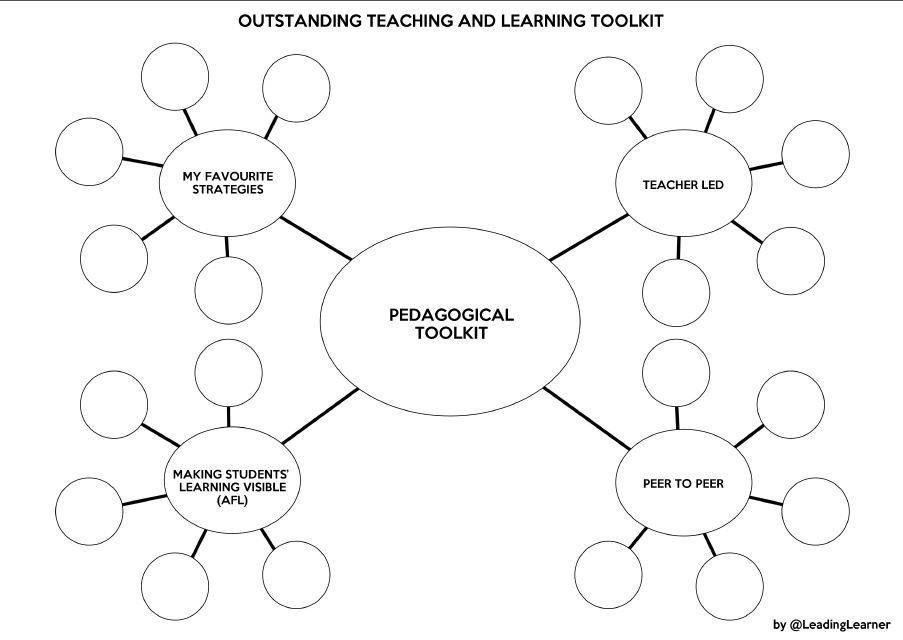
This is deliberately blank. Outstanding teachers keep the lesson plan loose. Just a few simple branches about possible different strategies: teacher led, peer to peer (group or pair work, on-line collaboration, peer assessment), favourite strategies and crucially ways of making students’ learning visible. Nothing prescriptive, nothing required just great pedagogy of their choice.
It is important to recognise that outstanding teachers have honed their skills through deliberate practice. I’m wondering whether they possibly use fewer strategies than good teachers but use them much more effectively. A key part of the CPG Programme #OustandingIn10+10 must be teachers choosing effective, proven strategies to work an and hone through effective practice.
#OutstandingIn10+10
The first ten weeks of the CPD programme is going to involve some shared lesson observations, facilitated sessions around the thinking behind and the use of the two simple tools above and starting to practice the methodology with one chosen class.
Since I’m hoping to work with three teachers, my intention in the second ten weeks is to get them to work as a teacher learning community to support each other on their evolutionary journey.
I’m hoping to possibly do some collaborative work with Ross, @TeacherToolkit, to customise the planner and pedagogical toolkit so it may be more widely used and also to pull on his experience of the #GoodInTen CPD programme to build this one in more detail. He may be too busy but here’s hoping.
I want to include a series of blog posts that teachers involved in the programme will be required to read to extend their thinking. I have mentioned a few above and others in the “Consistently Good to Outstanding” and have started a list:
- Tom Sherrington (headguruteacher) Great Lessons 7: Agility
- Chris Hildrew (Chris Hildrew) Progress In My Classroom. How it is Made and How I Know It
- Alex Quigley (HuntingEnglish) Becoming a Better Teacher by Deliberate Practice
I would be interested in your help and thoughts about what other blog posts you would suggest are included. There is going to be some great stuff out there I simply haven’t seen or have seen and forgotten. Please leave me a comment. If a lot of people leave suggestions I simply won’t be able to include them all but if you wanted to replicate the CPD programme in your own school then you can obviously chose the posts yourself.
If you would like a copy of the planner or toolkit please find the link below:
Outstanding Teaching and Learning @LeadingLearner
I’ve now turned this into a CPD Programme #OutstandingIn10Plus10.
Letters to Staff
Ever since I became a headteacher, back in September 2000, I have written to staff at some key points in their time at St. Mary’s. I always worry that the letters are beginning to be a bit mechanistic in nature as what I write hasn’t changed. However, this is because what I want to say hasn’t changed over the years either:
- Welcome, this is where we are heading and what is important to us.
- Well done, first years are challenging but you’ve come through.
- Thank you for the contribution you have made.
I started letter writing to staff when I worked as Head of Science at De La Salle in St. Helen’s. There were still a few De La Salle brothers working at the school when I arrived and they dedicated themselves and their lives to young people. Brother Nick wrote to me before I started including a picture and pen portrait of my new form plus an article or two on the importance of relationships. I’ve never forgotten the letter nor the importance of relationships in schools.
Welcome
Whilst at De la Salle I first came across the letter from a Boston headteacher who has been the victim of a concentration camp. It was a reflection during a staff liturgy and I found it so powerful I ended up having a bit of an emotional moment.

The main body of my letter reads:
Working with young people requires a true sense of vocation. At St. Mary’s we aim to challenge all young people to use their talents to the fullest within a caring Catholic community. The letter from the Boston Headteacher, who had experienced the horrors of a concentration camp, touched me deeply when I first read them.
Dear Teacher
I am the victim of a concentration camp.
My eyes saw what no-one should witness:
Gas chambers built by learned engineers;
Children poisoned by educated physicians;
Infants killed by trained nurses;
Women and children shot and burned by high school and college graduates.
So, I am suspicious of education.
My request is:
Help your students become more human.
Your efforts must never produce learned monsters, skilled psychopaths, educated Eichmanns. Reading, writing and arithmetic are important only if they serve to make our children more human”.
Helping young people grow up and develop fully as a human being must always be our central goal. This demands that we channel our efforts into the personal development of the young people we walk with, nurturing their faith and transforming them through the learning opportunities we provide. I will always judge our actions as a college against these demands.
The challenge to help young people grow in wisdom, the ability to make good and enriching decisions in their life for themselves and others, is a central core of Christian education. When leading one of the SSAT leadership courses I often refer to this letter from the Boston headteacher and emphasise the need to know core values and in which direction you are leading other. Education without developing a young person’s moral compass can be a dangerous vision.
Well Done
This graphic is wonderful and shows the bumpy ride a Newly Qualified Teacher can have. Whilst being referenced to an NQT it also speaks of the dynamic that more experienced staff may have when they move to a new school.

The end of any first year in a job is a good time to reflect, learning curves tend to be at their steepest when things are new. It’s important that we congratulate and celebrate with teachers and other staff a job well done. The reflection below often reconnects a teacher to why s/he came into teaching and strengthens the sense of vocation and anticipation for challenges ahead.
I wanted to write to you, at the end of your first year at St. Mary’s, to thank you for all the hard work you have done on behalf of our young people. The reflection “A Teacher” reminds us why we took up our vocation. There often seems to be a sense of tiredness at the end of a year or frustration at things that have not quite been done. Leave these thoughts behind you and think of the young people at St. Mary’s whose lives are richer for you being here.
A Teacher
I am a Teacher
I was born the first moment that a question leaped from the mouth of a child.
I am the most fortunate of all who labour.
A doctor is allowed to usher life into the world in one magic moment.
I am allowed to see that life is reborn each day with new questions, ideas and friendships.
An architect knows that if he builds with care, his structure may stand for centuries.
A teacher knows that if he builds with love and truth, what he builds will last forever.
I am a warrior, daily doing battle against peer pressure, negativity, fear, conformity, prejudice, ignorance and apathy.
But I have great allies: Intelligence, Curiosity, Parental Support, Individuality, Creativity, Faith, Love and Laughter all rush to my support.
And who do I have to thank for this wonderful life I am so fortunate to experience,
But the parents for entrusting me with their greatest contribution to eternity, their children.
And so I have a past that is rich in memories.
I have a present that is challenging, adventurous and fun because I am allowed to spend my days with the future.
“I am a teacher ….. and I thank God for it every day”
John W Schlatte
Have a great summer and a refreshing break.
Thank You
At the end of a career or when moving to a new job in another school teachers often look back at the things they haven’t done or are not perfect with a slight sense of regret or disappointment. We are funny people us teachers, accentuating the positive in the young people we serve is balanced by accentuating the deficiencies in ourselves. Someone once said to me, “Stephen, leave perfection to God, you are just called to do your best.”
I want the staff who are moving on and given good service to our students to know that their best efforts are massively appreciated and were good enough. Bringing everything to completeness and fulfilment was always beyond us and we must recognise and accept this.
I am writing on behalf of the Governors to thank you for your work at St. Mary’s Catholic College. The attached reflection “Planning in the Kingdom” reminds us of the small part we play in the in implementing the master’s plan.
PLANNING IN THE KINGDOM (A Prayer by Oscar Romero)
It helps, now and then, to step back and take the long view.
The kingdom is not only beyond our efforts, it is even beyond our vision.
We accomplish in our lifetime only a fraction of the magnificent enterprise that is God’s work.
Nothing we do is complete, which is another way of saying that the kingdom always lies beyond us.
No statement says all that could be said.
No prayer fully expresses our faith.
No confession brings perfection, no pastoral visit brings wholeness.
No program accomplishes the church’s mission.
No set of goals and objectives includes everything.
This is what we are about.
We plant the seeds that one day will grow.
We water seeds already planted. Knowing that they hold future promise.
We lay foundations that will need further development.
We provide yeast that produces effects far beyond our capabilities.
We cannot do everything, and there is a sense of liberation in realising that.
This enables us to do something and to do it very well.
It may be incomplete, but it is a beginning, a step along the way, an opportunity for the Lord’s grace to enter and do the rest.
We may never see the end results, but that is the difference between the master builder and the worker.
We are workers, not master builders, ministers, not messiahs.
We are prophets of a future not our own.
I hope the letters are well received, a number of staff thank me each year for writing to them. For some it is the first time they have received a note from their headteacher. I hope you’ve also enjoyed the reflections and pass them on to others.
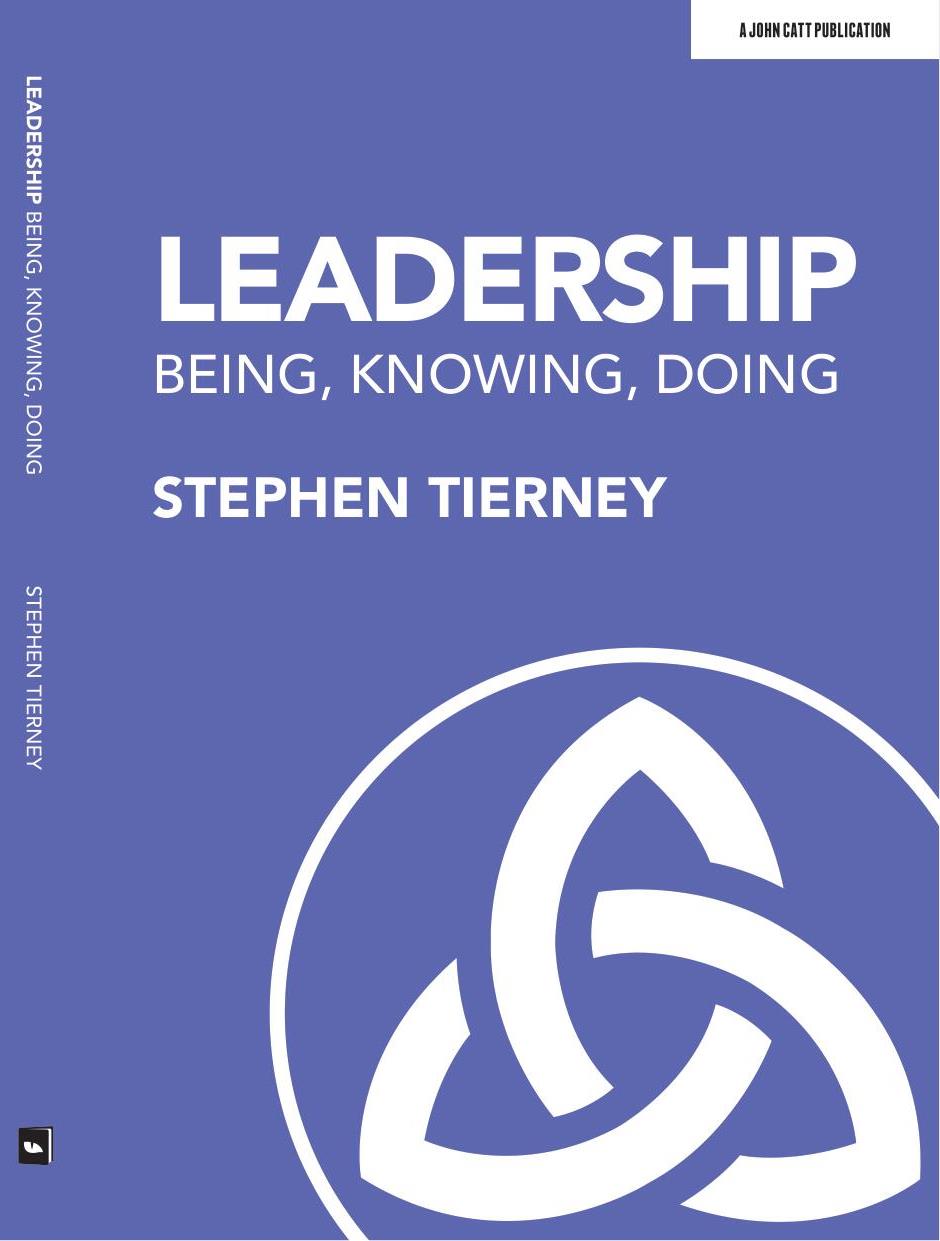
Leadership: Being, Knowing, Doing (New Book)

Liminal Leadership

COPYRIGHT LICENCE

@LeadingLearner by Stephen Tierney is licensed under a Creative Commons Attribution-NonCommercial-NoDerivatives 4.0 International License.
Based on a work at www.leadinglearner.me.
 @LeadingLearner