@LeadingLearner
Archive for
Blogging Barons & Heineken Tweeters
I have been a teacher for 26 years, a Headteacher for 13 years, and at the age of 49, this much I know … John Tomsett writes some great blogs. His partner in crime at Huntington School in York, Alex Quigley also writes a mean blog. As a scientist I consider the world of blogging very unfair as these English teachers, and there are quite a few about in the blogosphere, have a significant advantage as they are on home ground and write with such ease and flow. They are definitely blogging barons.
I’ve been blogging for one hundred days and decided to write this post to give thanks and praise for the world of blogging. I started a blog after joining the SSAT Vision 2040 group as it was one on the things expected of people in the group. Starting from a very low base, in fact base zero, I needed to upskill very quickly. In the car bringing my son back from university I asked him what a blog was – I told you I started from a very low base. With his usual encouraging and supportive manner he said, “Don’t worry dad it won’t really affect you.” However, after explaining my predicament he gave a brief explanation and suggested I looked up WordPress.
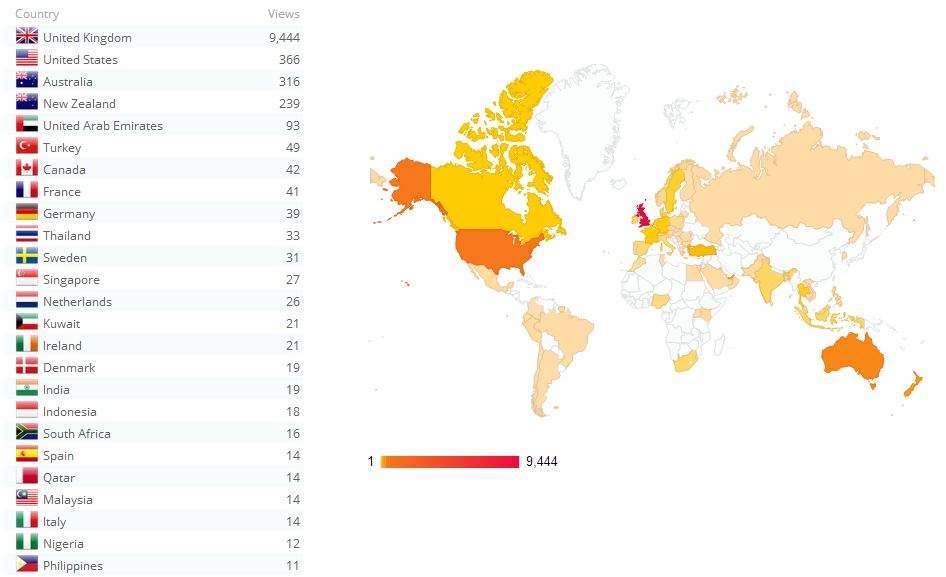
One hundred days later, with 23 posts and soon to be 24 posts to my name I am enjoying blogging. There have been just under twelve thousand views of the various posts on the blog site. I’m uncertain that the Google image searches for a jungle picture which end up at the post on “PRP: We’re in the Wrong Jungle” should really count. Posts have been viewed in seventy seven countries across the globe but clearly the whole of Central Asia and Africa have got better things to do and making a breakthrough in Greenland is proving rather elusive.
The first really Blogging Baron I came across was Tom Sherrington and his “Great Lessons” posts set a frighteningly high bar. I shared them via e-mail with all staff at the school. Other Blogging Barons I’ve come across include Keven Bartle, Pragmatic Education, TeacherToolkit, Chris Hildrew and the very bubbly Teachertweaks. I’ve recently come across LearningSpy who writes some pretty serious stuff. There are loads more for me to yet discover and I’m sure I will over the coming months and years,
As many people have commented blogging makes you sequence and sort out your thoughts. However, from a different angle, as my head is already like a box of frogs, getting a continual stream of thoughts and reflections from bloggers tends to spark off new ideas and trains of thought. Staff live in continual fear of what madness I will discover next from the Blogging Barons I follow and have yet to discover.
I posted a fun blog on “Who Do You Bring to Leadership?” which is based on a Mr Men theme the weekend before Mr Gove decided to launch an unwarranted and outrageous attack on the use of Mr Men, in the teaching of History. A blog on the SOLO Taxonomy received a positive and affirming reply from @arti_choke who I noticed was from New Zealand. I decided to do a nice little note back commending our antipodean bretheren, Prof John Hattie and Pam Hook, for their great work only to receive the response back, “I am Pam Hook”. I’m sure I’ve been called many things in my time but my most recent post was referred to in another post identifying me as one of three ladies and the headmistress of a school. In Blackpool “difference makes no difference” and the blogging world can provide you with a laugh or two.
I’m now aimlessly rambling but that is the beauty of blogging. I write and publish about the things that interest me and capture my imagination. No-one would publish my posts but that’s OK because I can now do it myself. People read them if they want to or can flick off them if they don’t hit the mark. I’ve no idea why “Consistently Good to Outstanding” has almost topped my list of posts and poor old “Masterchef III: Great Food” went down like a lead balloon. I’ve also no idea what “Home Page/Archives” is all about either.

Heineken Tweeters, are probably not the best tweeters in the world – this distinction falls to the Carlsberg tweeters – but they can reach parts other tweeters can’t. I soon worked out that if you want your blog read then tweeting is one way to alert people to it. I know it sounds daft but I didn’t realise, when I first started blogging, that people would be directed to your posts from Google or other search engines or via links from other posts but they can. It’s been a revelation to me.
Thanks to anyone and everyone who has ever tweeted or retweeted one of my posts I really do appreciate it. The blog counter has been sets spinning by @TeacherToolkit, @headguruteacher, @johntomsett and @GuardianTeach. I’m definitely OCD and so like to check the numbers on my phone often – I think if my long suffering wife ever decided to kick me out she will cite my mobile phone as the third party in our relationship! It’s interesting to just reflect on the potential power that the Heineken tweeters will have on information flow over the coming years, not good or bad, just is. I have 977 978 followers which is a mix of students, parents and teachers or those interested in education. There is a part of me, the OCD part, which wonders whether I should separate out my twitter activity so I have one account for parent and student information and another for my blogging activities. Any thoughts?
Twitter is interesting as I’m sure that it helps build social capital and there is an odd kind of affinity between people who have probably never met except in the ether. At the first meeting of the Vision 2040 Group, I said hello to a number of people introducing myself as Stephen, because that’s my name. As we chatted which school we came from was an obvious part of the small talk. I mentioned St. Mary’s and the response was, “Oh, you’re @Head_stmarys”. It’s odd to be known by your twitter handle but I now find myself doing the same.
Twitter bedazzles, bemuses and befuddles me all at the same time. I only follow forty seven tweeters and struggle to keep up with them so goodness knows how you follow a thousand or so people. When I find out how I promise to follow more tweeters. Tweeters make me smile and theirthought launches a thousand more.
I’m a blogger who tweets and the combination of the two is now my greatest source of CPD. Off now for a cup of tea with my blogging widow – the 21st Century version of the golfing widow.
Consistently Good to Outstanding
Reading Ross McGill’s blog post #GoodinTen – Requires Improvement CPD Programme got me thinking, his posts often do. As a school we have been consistently good, for the past decade, with increasing amounts of outstanding reported in each consecutive Ofsted Inspection but we are stuck at good. Good with many outstanding elements still equals good. The quality of teaching has got better and better, over the years, with more outstanding teaching observed through our formal lesson observation programme. However, we have teachers who have consistently been graded as delivering good lessons and they are utterly frustrated at not yet having achieved a “coveted” outstanding grade. They are also stuck at good. Continue reading
Vision 2040: Learners at the Centre III
It is a big enough challenge helping our students to become independent learners but this is no longer enough. We need to take them further so they can develop into interdependent learners. In our model of the 4Cs learner we strive to move from Independent Confident Learners, covered in Learners at the Centre II, to Interdependent Co-operative, Connected and Creative Learners. As I’ve said before this is part reality and part vision, we still have a long way to travel before all our students are interdependent learners. However, if Vision 2040 is to be realised the interdependent learner will be at the heart of education.
In a fantastic symposium led by Professors Guy Claxton & Bill Lucas, What Kind of Teaching for What Kind of Learning?, the following draft principles were proposed:
Eight Principles of Expansive Teaching and Learning in Schools (For Discussion)
- Schools are the foundation for a lifetime of learning
- There are a set of wider life and learning skills which need to be deliberately cultivated in the context of the curriculum and beyond
- What learners believe about themselves matters and a ‘growth mindset’ is both a powerful motivator and a predictor of success
- Parents and the wider community have a significant role to play in pupil’s learning at school
- When teachers actively continue their own learning and model this in their classrooms learners achieve more
- Learning works well when it builds on pupils’ prior experiences, is authentic, has clear and stretching goals and is undertaken in an environment full of formative feedback with many opportunities for reflection
- Learning requires opportunities to develop emotionally, socially and practically as well as intellectually, individually and with appropriate theoretical grounding and understanding
- Learning is learnable and improves when learners have a set of metacognitive strategies which they are able to use confidently in a range of contexts.
Whilst these are challenging enough for schools I believe by 2040 we will need to replace schools as the foundation of a life time of learning with learners as the foundation of a lifetime of learning. Schooling will be insufficient, we will need to create educated and interdependent learners capable of learning throughout their lifetime. Now, more than at any other time in history, learners are able to capture and share knowledge quickly and easily and develop their understanding using the internet. Teachers and peers may still remain the main source of learning in schools particularly for core subjects but there is the potential for highly personalised learning, niche community learning beyond that. Imagine a day when students of all ages have study periods to pursue their own personalised, niche projects and learning.
The three elements of the 4Cs Learner below all have “attributes” linked to them which are part of the 5Rs – Traits & Attributes of Effective Learners and so I won’t repeat this in each section. The pictures below, taken from my brain, can be seen in a more dynamic presentation at the link here.
CO-OPERATIVE LEARNER

The 4Cs Co-operative Learner is socially and emotionally literate and Kagan competent. Thanks to Peter Rubery, headteacher of The Fallibroome Academy, who I always found hugely generous in sharing ideas and practice, who introduced me to Co-operative Learning and the power of Kagan structures on a train back from London.
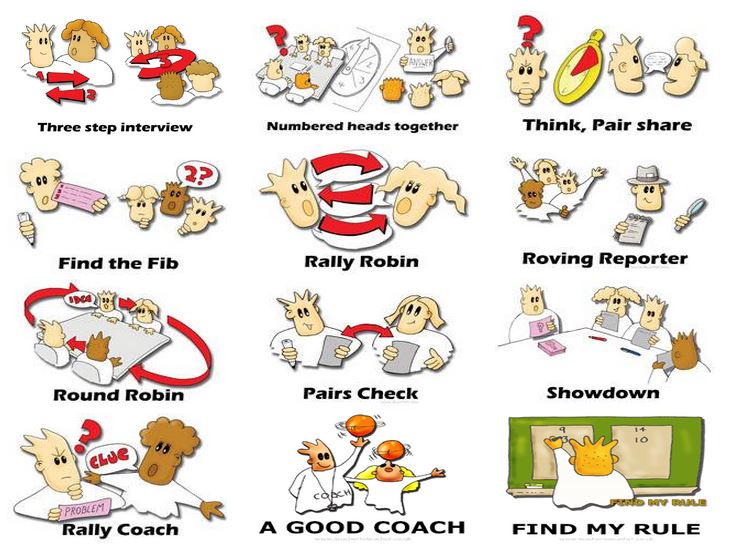
I have enjoyed using the Kagan structures – simple ways of getting pairs and groups of people working together in a structured way – with a large group of over a hundred adult learners and seen them used very effectively to transform interactions in a classroom. There is a danger that they can be overused and it is vitally important that people keep the structures pure. As ever the decision making skill of the teacher, when to use and when not, is all important. If you want to find out more information have a look at the website www.t2tuk.co.uk. The structures help students develop the skills of co-operation and learning together.
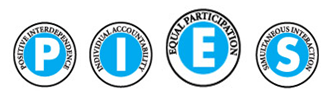
The principles of Co-operative Learning (PIES) were the first thing we were taught as a staff – when you set students a learning activity, to work on in pairs or as a group, is the activity fit for purpose and structured appropriately? Would they say to their partner or group members,
“I cannot complete this task and learn from it without your help and support?”
“I need to keep focussed because I may be the one explaining our thinking or outcome”
“It’s great that no one can monopolise the task or discussion (hogs) and no-one can sit back and do nothing (logs), we are all taking part.”
“We can all engage at the same time, no sitting waiting around or day dreaming here.”
This peer to peer learning as one aspect of practice in developing the interdependent learners we will need as part of the process and outcome of education in 2040.
CONNECTED LEARNER
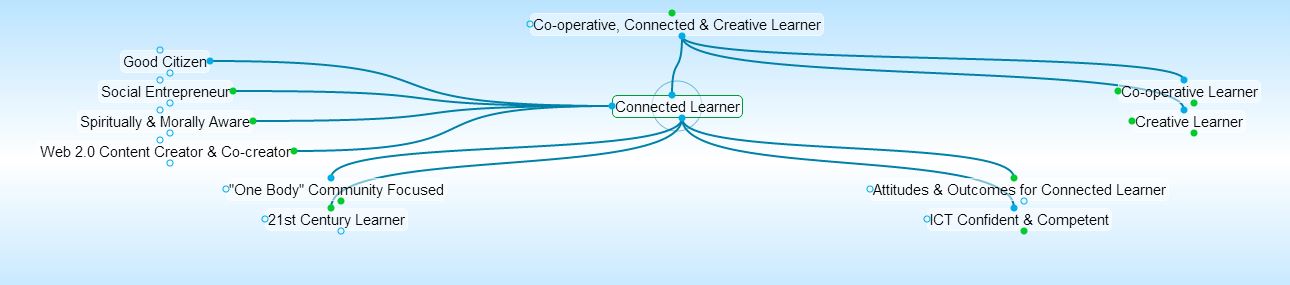
The Connected Learner obviously looks at skills required and outcomes linked to the digital world but also builds on our Catholic ethos of being “One Body” with a community focus – local, national and international.
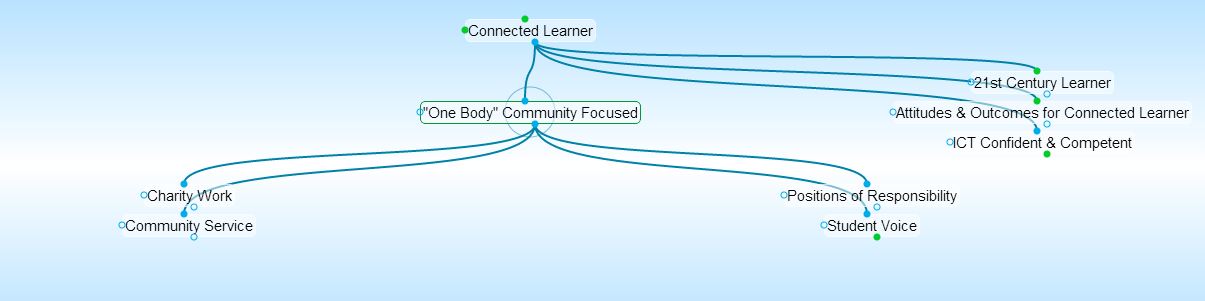
Our students engage with issues of social justice with great enthusiasm and generosity. For us community service, positive action and fundraising are matters of justice not choice. The fundraising varies from a focus on three schools in Ghana, to a variety of local charities, to individual named children & pensioners (obviously not their real names) who are bought presents at Christmas by the students and distributed by local charities or parishes. The positive action also extends to working with children from a local special school, bespoke stand alone projects, St. Vincent de Paul Society and so the list goes on. This is an important part of our student’s education in a global society and my experience tells me that are happier doing something about injustice rather than talking about it.
The second element involves the use of new technology which is increasingly a challenge for all schools. I’m not going to revisit it here as @JohnTomsett covered the issues in his comprehensive blog “This much I (don’t) know about the future of ICT in Schools”.
What we do know is that the megatrends in technology have been towards personal ownership of devices, mobile usage and cloud technology. However, in schools we still build rooms containing desktop machines with huge storage on site which is sometimes inaccessible from outside. The odd trolley of laptops is thrown in but without any ownership too often become damaged. John’s concern about spending £170,000 per annum on ICT is real. Maybe this was possible in the good times but in times of financial constraint schools are not funded to provide mobile devices to all students.
Our own approach, fortunately supported by BSF, has been to flood the school with wireless capability and look to each student having their own laptop which is funded by parents as part of a voluntary scheme – parents are invited to be part of the laptop scheme with a suggestion of £12 per month donation and a reduction to £6 for subsequent children from the same family or those entitled to Pupil Premium. Individual cases are always looked at but the overwhelming majority of parents see it as great value for money. About 70% of students are involved in the scheme and the income is approaching £100,000 per annum, with nearly all year groups involved. This money is used to buy a laptop for students on entry to the College with a new device in the middle of Y9 and on entry to Sixth Form. The scheme is now self-financing and sustainable. The biggest issue or frustration for parents is whether we are using them enough in class and when we don’t use them enough students then don’t bother or forget to bring them in. I’m sure within a number of years we will have moved to a Bring Your Own Device (BYOD) style of scheme. The greatest digital divide over the next decade will be the “can do” and “cannot do” rather than the “have and have nots”.
Getting teachers to find ways to incorporate ICT in lessons so that it actively enhances learning is a real challenge and long journey, we are still journeying and just keep taking the next step. However, the years to come are bound to see us buy devices for students that are currently not yet on the market, see a greater integration of technology and learning and provide more opportunities to genuinely use technology to enhance and personalise a student’s learning rather than simply use technology more often with no real purpose. Students will need to be increasingly skilled and understand what they are doing in the digital world, their use and misuse of social media sometimes shows a worrying naivety and lack of real understanding.
CREATIVE LEARNER

There are a number of elements of the Creative Learner. I’ve blogged about the Project Based Element before stressing the need for real rigour and not PBL Lite. Project based learning provides students with a controlled environment in which to develop the skills required for enquiry based, self-directed learning that is at the heart of a more personalised education.
This links to the development of divergent thinkers. As a nation we have some of the most creative people on Earth (I know I’m biased) with the opening and closing ceremonies of the 2012 Olympics being a celebration of this creativity. The education system must play a part in developing this creativity. We need to think about the development of this divergent thinker in all our subjects not just pretend it belongs to a limited number of “Creative” subjects. The opportunity for students to use their knowledge and understanding to explore open ended tasks through projects like STEM Club all builds the problem solving skills used at work and in life in general.
SUMMARY
The elements of the 4Cs Learner – Confident, Co-operative, Connected and Creative – overlap, integrate and are mutually supportive. If you want to see an example of the connected, co-operative learner have a look at this great blog from @ICTEvangelist on Student Digital Leaders. I find it inspiring as it gives a coherent structure for the power of peer to peer learning (with a bit of support thrown in for teachers) in the digital world. Key to development of the 4Cs Learner is the time spent on metacognition and exploring, identifying and honing the skills used in learning and as a learner. These skills are powerful and transferable. Just imagine a class room where all students possessed them.
The 4Cs Learner is not the model but a model of a learner developed specifically at St. Mary’s but pulling on good practice we have seen elsewhere. There are other great models available. The most important thing is for teachers and schools to have a model of a learner that they explicitly develop over time.
Chris McShane, Headteacher of Winton Community Academy recently included in a blog post from the Headteachers’ Roundtable the idea that:
“Subject knowledge was the DNA of teaching and learning in the 20th century we need to rewrite the DNA for the 21st.”

I would like to build on this idea:
- Subject knowledge and the understanding that is derived from it will be a fundamental part of the DNA of teaching and learning in 2040
- The other strand of the DNA double helix represents the subject procedural skills and habits of mind we utilise in our teaching and students’ learning.
- The complimentary base pairings that hold the helix together represent the learner (in our case the 4Cs Learner) who must be explicitly developed by all teachers.
It is the whole structure, knowledge, understanding, subject skills and learner skills that are all key, no-one part of the structure is greater than the whole, despite various arguments put forward by some in education. Our DNA gives us life and allows us to produce new life. It is at the heart of our uniqueness. The educational DNA of this century, running through our schools, must put the learner, who’s explicitly developed, at the centre of their own education as part of their learning and to help them create new more personalised learning themselves.
If you want to understand the thinking behind my direction of travel in this post, please read Learners at the Centre I
Leadership: Being, Knowing, Doing (New Book)

Liminal Leadership

COPYRIGHT LICENCE

@LeadingLearner by Stephen Tierney is licensed under a Creative Commons Attribution-NonCommercial-NoDerivatives 4.0 International License.
Based on a work at www.leadinglearner.me.
 @LeadingLearner