@LeadingLearner
LeadingLearner
Ofsted Get it Right for Once … Oh No They Didn’t
There was a real sense of delight in Andrew Old (@oldandrewuk) blog post, just before Christmas, “A Christmas Miracle – Ofsted Get it Right for Once”
I hope I’m right in inferring from the various twitter conversations that Andrew has long been campaigning for appropriate recognition, within the Ofsted framework, of high quality lessons that are teacher led and more “traditional” in nature. I’ve read a number of his posts based on Ofsted reports promoting the alternative view.

Ofsted Subsidiary Guidance p.18 & 19 – January 2014
The amendment seems eminently sensible but this is not simply about teachers talking more but how teachers can enhance students’ learning through strategies such as direct instruction and better mediate students’ understanding through high quality input and questioning.

I wondered about whether to write this post or not as there is the real danger of appearing as the pantomime villain. In no way do I want to denigrate the work that Andrew Old and other colleagues have done in securing the amendment within the Subsidiary Guidance but I simply don’t think Ofsted have got it right yet.
Why Have All These Different Grades?
The table below was produced from data presented at a recent ASCL Conference summarising the inspection of one in seven secondary schools for Summer Term 2013. This is a huge number of inspections and a very substantive database. Note the almost identical percentages for overall effectiveness, achievement and the quality of teaching, now taken as over time which effectively equates to examination results as a proxy for achievement.

The much more positive gradings for Behaviour & Safety have been met with the following response from Ofsted in the latest Subsidiary Guidance (highlighting obviously mine):

Ofsted Subsidiary Guidance p.19 – January 2014
I read this quite simply as make sure the Behaviour & Safety grade is the same as the rest, Leadership & Management will surely follow. The one interesting thing for the future is that inspectors are now expected to comment separately on behaviour and safety with the lower grade dictating the overall grade for the section. For example, safeguarding is good but behaviour requires improvement produces a “requires improvement” grade overall.
You have to question why five different grades appear in the report, when in essence the Achievement grade drives the whole process and there is now going to be even greater alignment of grades than ever before.
Outcomes Nationally, Safeguarding Locally
This post is not an argument for no accountability, in an earlier post, Reflections of an Apprentice 2040 Visioner, I accepted that as an education system we had deserved Ofsted because we failed to accept fully our responsibilities for educating, to a sufficiently high standard, all young people. To mis-use a quote from Andy Hargreaves, the point at which we failed to accept our responsibilities as a profession was the point that Ofsted stepped in to hold us accountable. However, the perverse and now corrosive impact of Ofsted has long since stopped serving a purpose and a different Accountability framework is needed.
The new “Progress 8” measure in secondary schools and end of Key Stage 2 tests have the potential to spawn a whole new industry in “data dashboards”. Ofsted’s role should be limited to scrutiny of a school’s outcomes, which at a secondary level has already been given as: one grade above expectation in the Progress 8 measure meaning no inspection visit the following academic year and more than half a grade below expectation means prepare the room for the inspection team!
Safeguarding needs to be dealt with at a local level on an annual basis with a simple “effective safeguarding” or “not effective safeguarding” outcome. The latter would lead to a monitoring plan and on-going checks until safeguarding was judged effective.
Separate to the desktop exercise on Progress 8, we need regional teams, operating within a national framework, but separate from Ofsted composed of highly experienced and well regarded HMIs and Lay Inspectors who have two areas of responsibility:
- Ascertaining and reporting on the practices, systems and approaches in highly achieving schools as part of the knowledge network that seeks to capture and share the best our education system has to offer. The visit to a school may last a week to really get underneath what works with the “knowledge”, from across a number of schools, collated into reports and shared as suggested below.
- Working with schools who need to raise the achievement of their students. No judgements, no flying visits but a shared responsibility for helping ensure all students’ life chances are enhanced through a long term commitment to working together.
I would like to nominate @MaryMyatt and @Heatherleatt – their blogs show an immense amount of common sense and balance – to lead on this but I’m biased.
A national minimum benchmark needs to be set about what is acceptable and the system needs to work to ensure all schools reach this standard within a five to ten year time period, at which time the bar can be raised. Genuine improvements in learning and standards need to be reflected in improved examination outcomes – no artificial raising, lowering or maintaining of pass rates. Remember the 100 metres hasn’t got shorter, people are just running it faster and the same can be true in education.
When Will Ofsted Get it Right?

Oftsed will get it right when they stop inspecting teaching, behaviour and leadership & management. What amounts to a total of three days in a primary school (two inspectors for one and a half days) or about seven in a large secondary school doesn’t provide sufficient evidence to make far reaching conclusions that can sometimes damn or laud a school inappropriately. The idea that inspections produce typical behaviour, from school leaders, teachers or students, just isn’t right and the snapshot is too blunt an instrument in terms of teaching and behaviour to continue to be used.
Issues of teaching and behaviour are for determination by schools not Ofsted. A school’s approach to these will impact on Achievement which should be monitored nationally and schools held accountable. Don’t forget students and parents will make judgements about the quality of teaching & behaviour in a school every day so there isn’t exactly a shortage of accountability on these issues.
My 2014 advice to Ofsted is simple, “Oftsed when you are in a hole, stop digging!” It’s time for a new approach.
If you want a slightly more light-hearted perspective on Ofsted why not try Auld Land Syne #Ofsted Style by @TeacherToolkit and make sure you listen to the irrepressible @RachelOrr in fine voice.
Tom Sherrington’s view of Ofsted I wholeheartedly agree with and you can read it as part of his post, Taking Stock of the Education Agenda: Part 2.
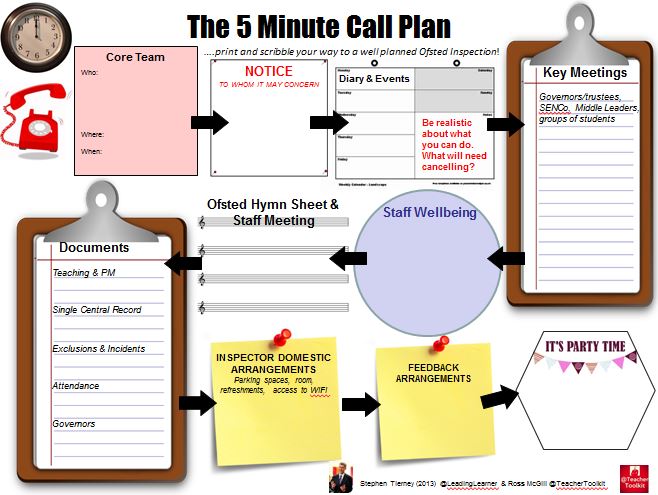
However, if you are expecting that call someday soon there are some Ofsted Resources here that you might find useful, that is, until the revolution comes, brothers and sisters.
Heather Leatt’s blog is also a valuable source of information as is Clerk to Governors.
Give Thanks, Don’t Worry …. And Rest
It’s 2:30 p.m. on the last Friday of the Christmas Term. The students have all gone home, we have said our goodbyes to three staff – one moving to Dubai, another who has been promoted to head of department and another who has secured a permanent post at a university – enjoyed end of term mince pies, Christmas cakes and drinks, before the usual staff wacky races exit of the car park.
I am about to move into my most effective period of headship this term. There is only myself, a few office staff, the site supervisors and cleaners on site. I feel that I am now at last in control, the ship is running smoothly on a steady course and I’m about to enter my Efficient Zone, so … Let us give thanks.
Give Thanks
When I look back at the term, we have much to give thanks for and many people to thank. We moved into the final phase of our new secondary school building, which is absolutely fantastic, whilst at the same time welcoming a full Year 7 year group and good numbers into Lower Sixth. At a time of falling numbers this is something of a relief as well as something to give thanks for. To make sure I kept busy, we’ve also bedded in a brand new senior leadership team structure which will take us on the next stage of our journey and advertised the Headship at St. Mary’s.
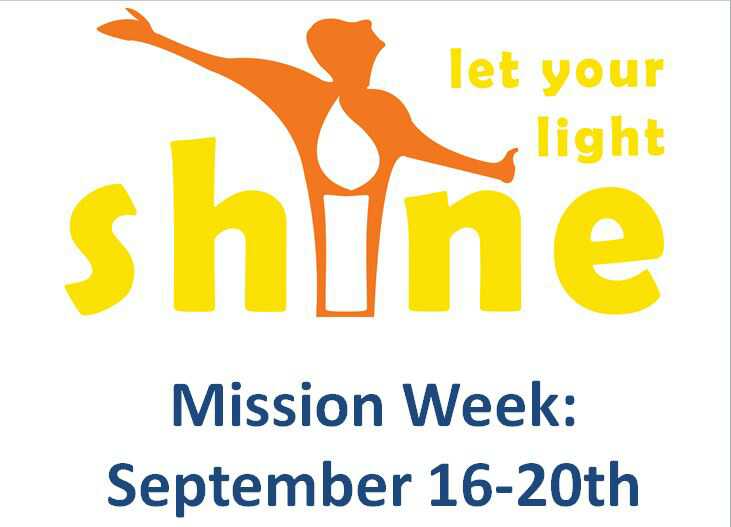
We’ve held a Mission Week, as part of the Year of Faith, introduced a new programme for parents and students that allow them to see behaviour and attendance in real time via a web based interface, staged “Joseph the Musical”, worked hard in lessons and played hard across a whole variety of different sports.
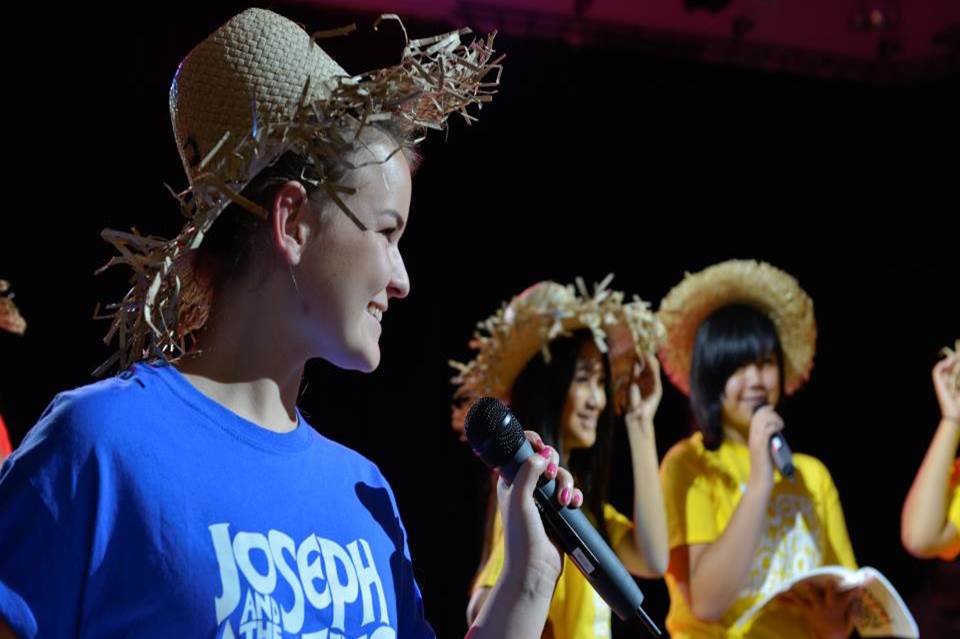
Joseph the Musical
Staff have given tirelessly of their time implementing a new curriculum into Year 9, fewer subjects for more time, and are busy writing a curriculum to put some rocket fuel into the level of challenge at Key Stage 3, as well as working with students in Key Stages 4 & 5 to prepare them for forthcoming examinations. We’ve survived the November early entry debacle, entering nearly the whole cohort for GCSE English but delaying Maths until the summer, assisted by the good nature and co-operation of our Year 11 students and the dynamism of our English Department.
The students at St. Mary’s and their parents are very generous and funds have been raised for the Philippines (£1,192), CAFOD (£1,020), Mission Week (£362), a Year 7 fun run to support partner schools in Ghana (£1,877) and local charities and families including an incredible £3,276 in the last three weeks during Advent.
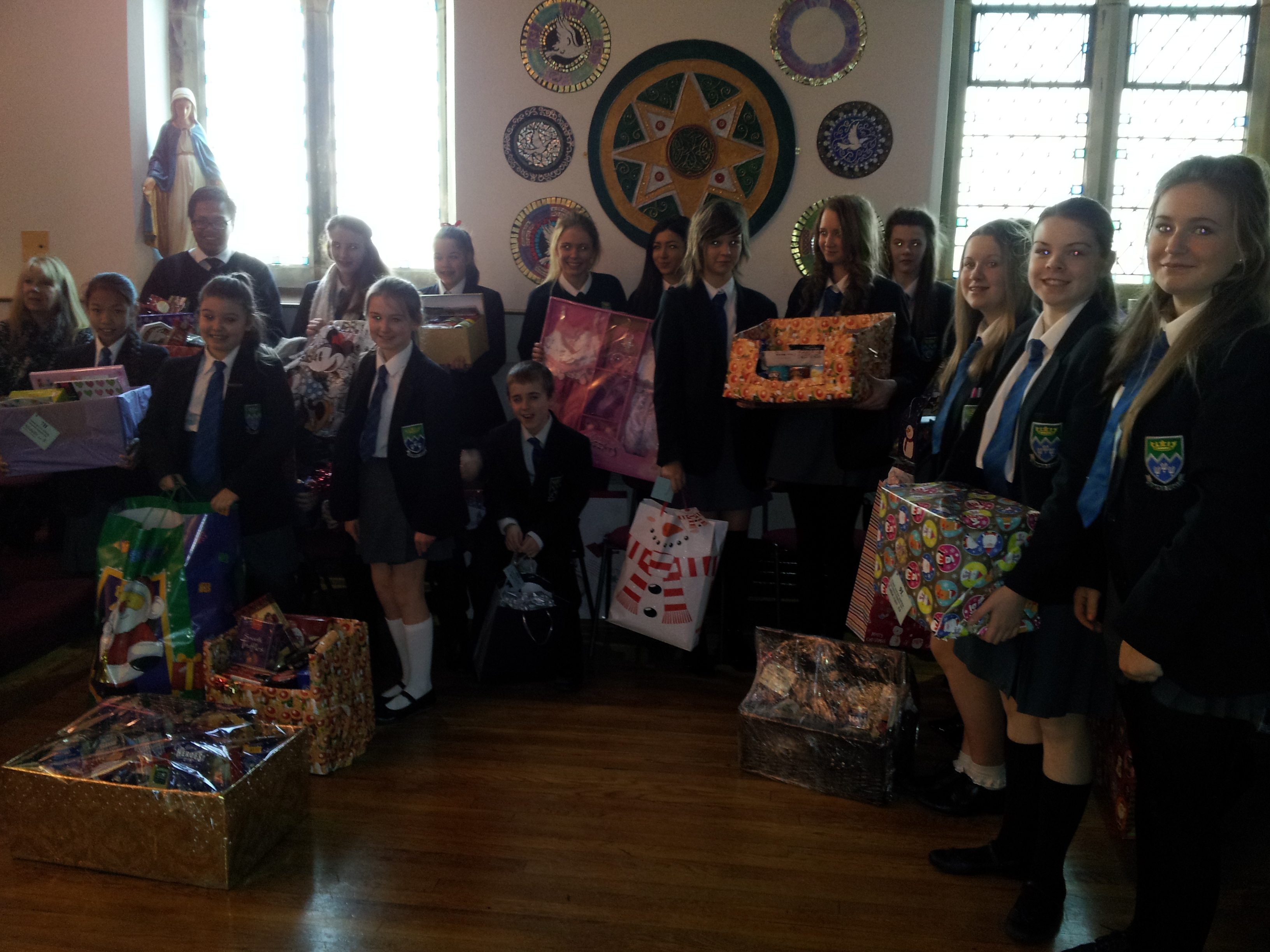
Presentation of some of the gifts brought for children & the elderly
In my new role as Executive Headteacher, it was fabulous to see Christ the King get a richly deserved “Good” in all categories from Ofsted and continue to oversee their new school being built, on what will be our shared site by next Summer. They work with some of the most disadvantaged children and families found in Blackpool which makes their success even more striking. Their Key Stage 1 Nativity Play was great as was the one I attended at St. Bernadette’s Catholic Primary School last night.

Christ the King Nativity Play – Key Stage 1 December 2013
These Nativity plays always make me smile and congratulations to the primary school teachers and support staff who put so much effort into making these events so special. The plays take me back to when my own children were little and proudly wore tea towels on their heads. I have much to give thanks for.
This selfless work goes on in schools up and down the country. What has happened in your school or classroom this term that has given you “life and hope?” What would you give thanks for and who have you thanked?
I know as a Headteacher I should thank people more. I also know no matter how many times and how many people I thank it would simply not be enough. This is not to say I shouldn’t work harder at saying “thank you”, it just recognises that the brilliant work done in schools is so immense, overwhelming, outstanding. Thank You.

Connor Read 8H – Winner of Christmas Card Competition
Don’t Worry
At the end of what has been a long term it is very easy to look back with a sense of regret about what you have not done or what you wish you had gone better. I wonder whether it is part of our collective psyche as teachers. Many schools RAG rate (Red, Amber & Green) various documents from improvement plans to lists of data on students’ progress – do you look at the red or the green first? My eyes are always drawn to the “Red” but maybe it’s time to focus a bit more on what is going well and the lessons we can learn and transfer from this.

Caitlin Starkie 8S – Winner of Christmas Card Competition
Christmas is a time of hope. I hope I will find the time…, I hope I will be a better headteacher …, I hope I will actually get round to writing my SEF (I really must) … are all the wrong kind of “hopes”. These are not bad things in themselves and to aspire to be more I think is extremely positive. However, we sometimes set perfection as a goal and then berate ourselves when we fall short. “Leave perfection to God”, someone once told me, “you are just called to do your best”.
If you are a Newly Qualified Teacher, you are probably on your knees – don’t worry we all were, it’s just for some of us our NQT year was so long ago we can’t remember it! You may never learn, on the job, at this pace again in your career, first years are manic. I hope you’ve had a great first term. If not don’t worry, take time this Christmas to recover, reflect on what you would like to change, then start the new term with some serious intent – first years are for learning, we all had to.

Emilia Taraszkiewicz 8E -Winner of Christmas Card Competition
If you are spinning the plates of work, family and Christmas then that is too many. I’m a workaholic, or at least my long suffering wife keeps telling me, but even I’m going to zip up the work bag and not open it again until the new year. I am reliable informed that all the work will still be there when I open my bag again, so don’t worry no little elves or fairies will steal your work from you over the Christmas period. It’s time for family, friends and Christmas, they don’t always get much of a look in during term time.
…. And Rest
Cath (long suffering wife) will be hoping I take some of my own advice. I find it hard to switch off, things churn around in my head so I’ve taken to writing them down in notes and my phone so I can forget them without forgetting them, if you know what I mean. I’m going to have a work, blogging and twitter vacation for at least a week and maybe even more. It’s time to refill the reservoir. I get grumpy and grouchy when I’m tired and I’m sure this applies to others. It’s time to rest as well as enjoy the festive season.
Wishing you and your loved one a very peaceful and joyful Christmas and Happy New Year 2014.

Lucy Stuart 8B – Winner of Christmas Card Competition
N.B. If any of St. Mary’s Catholic College staff are reading this please resist the temptation to leave a witty comment along the lines “Oh dear, you must have been tired all this term then!”
Education for Wisdom
Last weekend a twitter debate started on Friday night between myself and David Didau, with various other people keen to express a view on whether the knowledge versus skills debate is a false dichotomy, which rolled onto Saturday involving Alex Quigley and Joe Kirby.
This post is not intended to shut down the knowledge versus skills debate, I couldn’t do that even if I wanted to. I’m happy for others to have the debate but I am in a different jungle and more interested in engaging in different debates. Education is for wisdom, not simply knowledge nor simply skills. Continue reading
Leadership: Being, Knowing, Doing (New Book)

Liminal Leadership

COPYRIGHT LICENCE

@LeadingLearner by Stephen Tierney is licensed under a Creative Commons Attribution-NonCommercial-NoDerivatives 4.0 International License.
Based on a work at www.leadinglearner.me.
 @LeadingLearner