@LeadingLearner
LeadingLearner
Letters to Staff
Ever since I became a headteacher, back in September 2000, I have written to staff at some key points in their time at St. Mary’s. I always worry that the letters are beginning to be a bit mechanistic in nature as what I write hasn’t changed. However, this is because what I want to say hasn’t changed over the years either:
- Welcome, this is where we are heading and what is important to us.
- Well done, first years are challenging but you’ve come through.
- Thank you for the contribution you have made.
I started letter writing to staff when I worked as Head of Science at De La Salle in St. Helen’s. There were still a few De La Salle brothers working at the school when I arrived and they dedicated themselves and their lives to young people. Brother Nick wrote to me before I started including a picture and pen portrait of my new form plus an article or two on the importance of relationships. I’ve never forgotten the letter nor the importance of relationships in schools.
Welcome
Whilst at De la Salle I first came across the letter from a Boston headteacher who has been the victim of a concentration camp. It was a reflection during a staff liturgy and I found it so powerful I ended up having a bit of an emotional moment.

The main body of my letter reads:
Working with young people requires a true sense of vocation. At St. Mary’s we aim to challenge all young people to use their talents to the fullest within a caring Catholic community. The letter from the Boston Headteacher, who had experienced the horrors of a concentration camp, touched me deeply when I first read them.
Dear Teacher
I am the victim of a concentration camp.
My eyes saw what no-one should witness:
Gas chambers built by learned engineers;
Children poisoned by educated physicians;
Infants killed by trained nurses;
Women and children shot and burned by high school and college graduates.
So, I am suspicious of education.
My request is:
Help your students become more human.
Your efforts must never produce learned monsters, skilled psychopaths, educated Eichmanns. Reading, writing and arithmetic are important only if they serve to make our children more human”.
Helping young people grow up and develop fully as a human being must always be our central goal. This demands that we channel our efforts into the personal development of the young people we walk with, nurturing their faith and transforming them through the learning opportunities we provide. I will always judge our actions as a college against these demands.
The challenge to help young people grow in wisdom, the ability to make good and enriching decisions in their life for themselves and others, is a central core of Christian education. When leading one of the SSAT leadership courses I often refer to this letter from the Boston headteacher and emphasise the need to know core values and in which direction you are leading other. Education without developing a young person’s moral compass can be a dangerous vision.
Well Done
This graphic is wonderful and shows the bumpy ride a Newly Qualified Teacher can have. Whilst being referenced to an NQT it also speaks of the dynamic that more experienced staff may have when they move to a new school.

The end of any first year in a job is a good time to reflect, learning curves tend to be at their steepest when things are new. It’s important that we congratulate and celebrate with teachers and other staff a job well done. The reflection below often reconnects a teacher to why s/he came into teaching and strengthens the sense of vocation and anticipation for challenges ahead.
I wanted to write to you, at the end of your first year at St. Mary’s, to thank you for all the hard work you have done on behalf of our young people. The reflection “A Teacher” reminds us why we took up our vocation. There often seems to be a sense of tiredness at the end of a year or frustration at things that have not quite been done. Leave these thoughts behind you and think of the young people at St. Mary’s whose lives are richer for you being here.
A Teacher
I am a Teacher
I was born the first moment that a question leaped from the mouth of a child.
I am the most fortunate of all who labour.
A doctor is allowed to usher life into the world in one magic moment.
I am allowed to see that life is reborn each day with new questions, ideas and friendships.
An architect knows that if he builds with care, his structure may stand for centuries.
A teacher knows that if he builds with love and truth, what he builds will last forever.
I am a warrior, daily doing battle against peer pressure, negativity, fear, conformity, prejudice, ignorance and apathy.
But I have great allies: Intelligence, Curiosity, Parental Support, Individuality, Creativity, Faith, Love and Laughter all rush to my support.
And who do I have to thank for this wonderful life I am so fortunate to experience,
But the parents for entrusting me with their greatest contribution to eternity, their children.
And so I have a past that is rich in memories.
I have a present that is challenging, adventurous and fun because I am allowed to spend my days with the future.
“I am a teacher ….. and I thank God for it every day”
John W Schlatte
Have a great summer and a refreshing break.
Thank You
At the end of a career or when moving to a new job in another school teachers often look back at the things they haven’t done or are not perfect with a slight sense of regret or disappointment. We are funny people us teachers, accentuating the positive in the young people we serve is balanced by accentuating the deficiencies in ourselves. Someone once said to me, “Stephen, leave perfection to God, you are just called to do your best.”
I want the staff who are moving on and given good service to our students to know that their best efforts are massively appreciated and were good enough. Bringing everything to completeness and fulfilment was always beyond us and we must recognise and accept this.
I am writing on behalf of the Governors to thank you for your work at St. Mary’s Catholic College. The attached reflection “Planning in the Kingdom” reminds us of the small part we play in the in implementing the master’s plan.
PLANNING IN THE KINGDOM (A Prayer by Oscar Romero)
It helps, now and then, to step back and take the long view.
The kingdom is not only beyond our efforts, it is even beyond our vision.
We accomplish in our lifetime only a fraction of the magnificent enterprise that is God’s work.
Nothing we do is complete, which is another way of saying that the kingdom always lies beyond us.
No statement says all that could be said.
No prayer fully expresses our faith.
No confession brings perfection, no pastoral visit brings wholeness.
No program accomplishes the church’s mission.
No set of goals and objectives includes everything.
This is what we are about.
We plant the seeds that one day will grow.
We water seeds already planted. Knowing that they hold future promise.
We lay foundations that will need further development.
We provide yeast that produces effects far beyond our capabilities.
We cannot do everything, and there is a sense of liberation in realising that.
This enables us to do something and to do it very well.
It may be incomplete, but it is a beginning, a step along the way, an opportunity for the Lord’s grace to enter and do the rest.
We may never see the end results, but that is the difference between the master builder and the worker.
We are workers, not master builders, ministers, not messiahs.
We are prophets of a future not our own.
I hope the letters are well received, a number of staff thank me each year for writing to them. For some it is the first time they have received a note from their headteacher. I hope you’ve also enjoyed the reflections and pass them on to others.
Blogging Barons & Heineken Tweeters
I have been a teacher for 26 years, a Headteacher for 13 years, and at the age of 49, this much I know … John Tomsett writes some great blogs. His partner in crime at Huntington School in York, Alex Quigley also writes a mean blog. As a scientist I consider the world of blogging very unfair as these English teachers, and there are quite a few about in the blogosphere, have a significant advantage as they are on home ground and write with such ease and flow. They are definitely blogging barons.
I’ve been blogging for one hundred days and decided to write this post to give thanks and praise for the world of blogging. I started a blog after joining the SSAT Vision 2040 group as it was one on the things expected of people in the group. Starting from a very low base, in fact base zero, I needed to upskill very quickly. In the car bringing my son back from university I asked him what a blog was – I told you I started from a very low base. With his usual encouraging and supportive manner he said, “Don’t worry dad it won’t really affect you.” However, after explaining my predicament he gave a brief explanation and suggested I looked up WordPress.
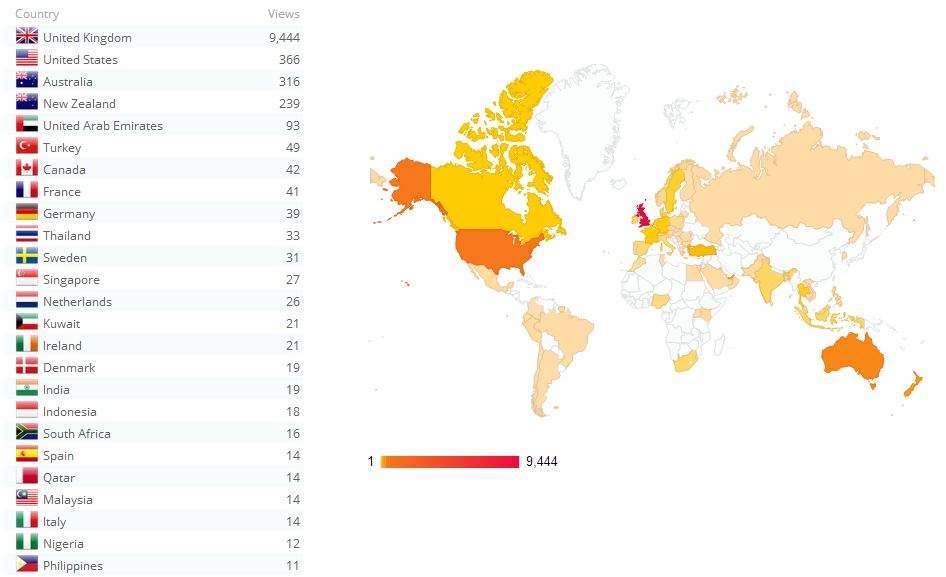
One hundred days later, with 23 posts and soon to be 24 posts to my name I am enjoying blogging. There have been just under twelve thousand views of the various posts on the blog site. I’m uncertain that the Google image searches for a jungle picture which end up at the post on “PRP: We’re in the Wrong Jungle” should really count. Posts have been viewed in seventy seven countries across the globe but clearly the whole of Central Asia and Africa have got better things to do and making a breakthrough in Greenland is proving rather elusive.
The first really Blogging Baron I came across was Tom Sherrington and his “Great Lessons” posts set a frighteningly high bar. I shared them via e-mail with all staff at the school. Other Blogging Barons I’ve come across include Keven Bartle, Pragmatic Education, TeacherToolkit, Chris Hildrew and the very bubbly Teachertweaks. I’ve recently come across LearningSpy who writes some pretty serious stuff. There are loads more for me to yet discover and I’m sure I will over the coming months and years,
As many people have commented blogging makes you sequence and sort out your thoughts. However, from a different angle, as my head is already like a box of frogs, getting a continual stream of thoughts and reflections from bloggers tends to spark off new ideas and trains of thought. Staff live in continual fear of what madness I will discover next from the Blogging Barons I follow and have yet to discover.
I posted a fun blog on “Who Do You Bring to Leadership?” which is based on a Mr Men theme the weekend before Mr Gove decided to launch an unwarranted and outrageous attack on the use of Mr Men, in the teaching of History. A blog on the SOLO Taxonomy received a positive and affirming reply from @arti_choke who I noticed was from New Zealand. I decided to do a nice little note back commending our antipodean bretheren, Prof John Hattie and Pam Hook, for their great work only to receive the response back, “I am Pam Hook”. I’m sure I’ve been called many things in my time but my most recent post was referred to in another post identifying me as one of three ladies and the headmistress of a school. In Blackpool “difference makes no difference” and the blogging world can provide you with a laugh or two.
I’m now aimlessly rambling but that is the beauty of blogging. I write and publish about the things that interest me and capture my imagination. No-one would publish my posts but that’s OK because I can now do it myself. People read them if they want to or can flick off them if they don’t hit the mark. I’ve no idea why “Consistently Good to Outstanding” has almost topped my list of posts and poor old “Masterchef III: Great Food” went down like a lead balloon. I’ve also no idea what “Home Page/Archives” is all about either.

Heineken Tweeters, are probably not the best tweeters in the world – this distinction falls to the Carlsberg tweeters – but they can reach parts other tweeters can’t. I soon worked out that if you want your blog read then tweeting is one way to alert people to it. I know it sounds daft but I didn’t realise, when I first started blogging, that people would be directed to your posts from Google or other search engines or via links from other posts but they can. It’s been a revelation to me.
Thanks to anyone and everyone who has ever tweeted or retweeted one of my posts I really do appreciate it. The blog counter has been sets spinning by @TeacherToolkit, @headguruteacher, @johntomsett and @GuardianTeach. I’m definitely OCD and so like to check the numbers on my phone often – I think if my long suffering wife ever decided to kick me out she will cite my mobile phone as the third party in our relationship! It’s interesting to just reflect on the potential power that the Heineken tweeters will have on information flow over the coming years, not good or bad, just is. I have 977 978 followers which is a mix of students, parents and teachers or those interested in education. There is a part of me, the OCD part, which wonders whether I should separate out my twitter activity so I have one account for parent and student information and another for my blogging activities. Any thoughts?
Twitter is interesting as I’m sure that it helps build social capital and there is an odd kind of affinity between people who have probably never met except in the ether. At the first meeting of the Vision 2040 Group, I said hello to a number of people introducing myself as Stephen, because that’s my name. As we chatted which school we came from was an obvious part of the small talk. I mentioned St. Mary’s and the response was, “Oh, you’re @Head_stmarys”. It’s odd to be known by your twitter handle but I now find myself doing the same.
Twitter bedazzles, bemuses and befuddles me all at the same time. I only follow forty seven tweeters and struggle to keep up with them so goodness knows how you follow a thousand or so people. When I find out how I promise to follow more tweeters. Tweeters make me smile and theirthought launches a thousand more.
I’m a blogger who tweets and the combination of the two is now my greatest source of CPD. Off now for a cup of tea with my blogging widow – the 21st Century version of the golfing widow.
Consistently Good to Outstanding
Reading Ross McGill’s blog post #GoodinTen – Requires Improvement CPD Programme got me thinking, his posts often do. As a school we have been consistently good, for the past decade, with increasing amounts of outstanding reported in each consecutive Ofsted Inspection but we are stuck at good. Good with many outstanding elements still equals good. The quality of teaching has got better and better, over the years, with more outstanding teaching observed through our formal lesson observation programme. However, we have teachers who have consistently been graded as delivering good lessons and they are utterly frustrated at not yet having achieved a “coveted” outstanding grade. They are also stuck at good. Continue reading
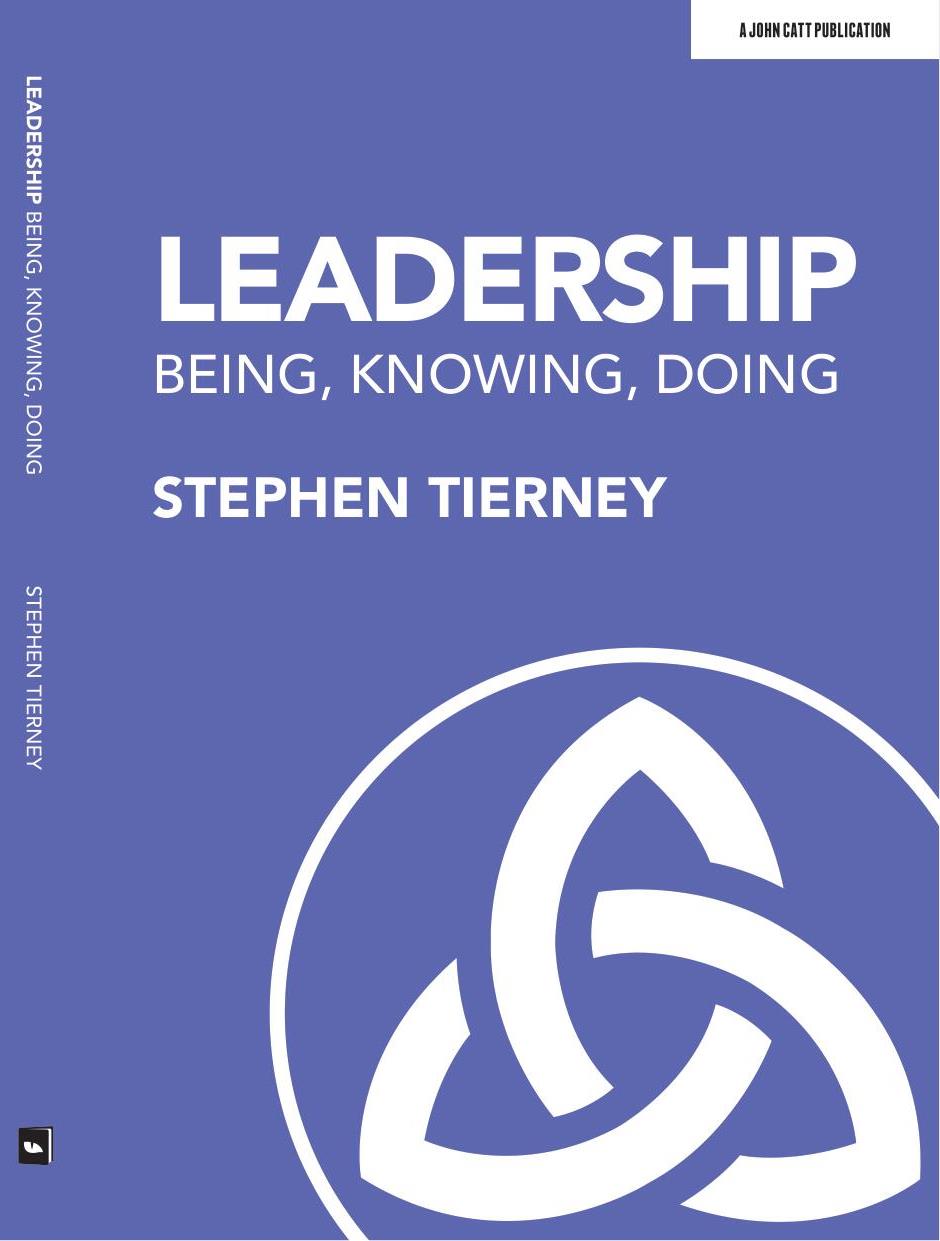
Leadership: Being, Knowing, Doing (New Book)

Liminal Leadership

COPYRIGHT LICENCE

@LeadingLearner by Stephen Tierney is licensed under a Creative Commons Attribution-NonCommercial-NoDerivatives 4.0 International License.
Based on a work at www.leadinglearner.me.
 @LeadingLearner