@LeadingLearner
LeadingLearner
Who Do You Bring to Leadership?
Ten years ago I was fortunate to experience the Leadership Programme for Serving Headteachers. It was an excellent programme. I still remember the impact of the Iceberg Model and subsequent discussion around motives and traits. Continue reading
Improving Teaching Not Simply Measuring It
This is a post largely based on an article written for SecEd and published on 2nd May 2013. I’ve added in a few more twitter suggestions to the the final “prayer” part (with thanks to Ross at @TeacherToolkit for advice on how you can do this) and also a link to a summary of our Teaching Improvement Programme, on which this article is based, can be found here:
Paper – Teaching Improvement Programme – April 2013
The Teaching Improvement Programme is an attempt to formalise a lot of good practice we have and ensure it is consistently applied across the College. It also has a new idea to us around Research & Development Communities.
As the saying goes, “you don’t make a pig fatter by weighing it”. At some point we must commit as individuals, schools and as a whole system to improving the quality of teaching and learning in a formative, consistent and holistic programme.
Everyone interested in education knows that “the quality of an education system cannot exceed the quality of the teachers in it.” The difference seems to be how best to achieve the desired outcome, of exceptionally high quality motivated teachers, and performance related pay simply won’t deliver this. The research evidence is pretty conclusive that teaching is a far too complex profession for performance pay to have a positive impact. Not only that but it has now agitated the teaching unions into industrial action and will cause a loss of the “discretionary effort”, which teachers and others working in schools give in such abundance and is crucial to a school’s success. Not deterred and keen to avert disaster we are working on systemising key aspects of developing teaching and learning, here are my four wishes and a prayer.
Four Wishes
1. Student Voice
We’ve used student voice before on a number of occasions in a rather hit and miss way. The programme we have now implemented is getting feed back, from students on twenty five different aspects of teaching and learning, at a whole school, departmental and individual teacher level. With a programme written by John Jenkins, one of the ICT teachers, and the use of Google Docs just over two thousand seven hundred responses were inputted by students over a three week period. At a whole school and departmental levels we can track impact in all twenty five areas and focus our CPD on specific areas. However, the real power of the data is at a teacher level. The information for each teacher is only available to her/him. Each teacher has been asked to identify an area of strength and become “expert” in it. As an expert they can provide support for any colleague who wishes to develop this area of their practice. Each teacher has been asked to focus on one area of her/his practice which needs to develop. This is about putting deliberate practice into action (see the piece on Deliberate Practice by @HuntingEnglish). The data collection will be repeated every six months so we can track progress. Everyone making small steps forward has a massive impact on the overall quality of teaching and learning. The first set of responses at a school level are below with a comparison to data collected via The Measures of Effective Teaching Project where the questions were identical or matched:

These are the responses from the first full Student Voice survey of Teaching & Learning. Questions that were taken from MET/very similar have corresponding Upper & Lower Quartiles from the MET 2010 Analysis
The first set of results are very encouraging with both the upper and lower quartiles for teachers at St. Mary’s being higher than the corresponding ones in the MET Project.
2. Innovation Fellows
For about five years we have given teachers the opportunity to work as Innovation Fellows for a two year period. Teachers apply for the position in about February/March each year giving an area of interest that they wish to research. The only criterion is that they must have an “outstanding” grade in one of their lesson observations. Each Innovation Fellow appointed has a reduction in their contact time from between one day a fortnight to one day a week giving them the capacity to do their work. The Innovation Fellow will lead a research programme first of all working on their own or in a pair and in the second year extending it to a department, learning house or other group. The Innovation Fellow also works alongside colleagues in the classroom in a coaching role to help further improve teaching & learning.
3. Formative Lesson Observation
How much do you honestly learn from someone observing your lesson? Time to think about flipping the observation process. This started with me observing a lesson alongside a trained Ofsted Inspector to moderate my judgement of lessons. Then I would moderate senior staff’s judgements and they in turn would moderate heads of department. What was soon apparent was the real value and richness of the conversations around what constituted high quality teaching & learning. This year I worked with each new member of staff, to the school, in pairs carrying out joint lesson observation. It is a real “light bulb” moment for teachers new to the profession to be able to dissect a lesson, in real time and understand the importance of viewing the impact of their teaching. I once stood next to a very talented teacher who just kept saying, “OMG I do that, OMG I do that …”. I think you learn a lot more by observing a lesson with a colleague experienced in lesson observation than you ever do being observed. We are going to use the Autumn Term to carry out paired formative lesson evaluations with all staff new to the school and any current member of staff who would like to. The only record kept will be a www.ebi (What Went Well, Even Better If – often used in formative assessment) set of bullet points that will be collated to identify good practice and areas for focus during CPD which we hold on Thursday afternoon from 3:00 – 5:00 p.m.
4. Research & Development Communities
This is a new idea for September 2013 that has engendered a lot of interest. A R&D Community can be set up to develop and embed best or emerging good practice within the College.
- A R&D Community can be used to take forward an idea, innovation or approach by a group of staff that will lead to improved standards of attainment, levels of achievement, student well-being or student personal development. A R&D Community can be set up by any member of staff.
- Each R&D Community must have a named leader who will be responsible for the community, its outcomes and leading a group of staff between 3-8 people in size.
- The lead member of the R&D Company will be given a period a fortnight reduction in contact time.
- The leader of the R&D Community must commit to knowledge capture and transfer at the college, local and regional level as required.
- Each R&D Company will request a number of “cover vouchers” which they could use to free/keep free company members for meetings/activities as appropriate up to their allocation. The cover vouchers will be redeemable through the College A&E process.
- Funding of £100 per person in the R&D Community will be made available to fund the community’s work.
- Funding will be released following the R&D Community’s idea and success criteria being accepted.
- Approximately half termly a voluntary meeting slot will appear in the calendar for R&D Companies that may be used if some/all of the company members wish to.
- Applications (see Appendix 2) can be submitted in April/May each academic year, but no later than two weeks before the late Spring Bank Holiday i.e. 13th May 2013 for this academic year, and the funds will remain in place for the following academic year.
- Student research and developers may be useful additions to the R&D Community.
- The first set of ideas can be found in the blog post on “Upside Down CPD”
If you’re interested in leading a R&D Community you should look at the following guide which will be really useful in shaping this the action research: http://educationendowmentfoundation.org.uk/uploads/pdf/EEF_DIY_Evaluation_Guide_2013.pdf
Alternatively the community might want to adopt a “Lesson Study Process” approach. More details may be found at: http://lessonstudy.co.uk/the-lesson-study-process/
And a Prayer …
This is a little more hopeful and long term but I would like to help the staff understand how powerful twitter, blog posts and a simple application or programme for capturing storing and organising online material that is of interest and use to you. Here’s how it works, get your self a twitter account and then put the twitter app on your phone so the two can synchronise with each other. Follow some people who may be of interest to you. There are loads to choose from but a few to start with are: @headguruteacher, @TeacherToolkit, @SSAT, @HuntingEnglish but there are lots of interesting people to follow.
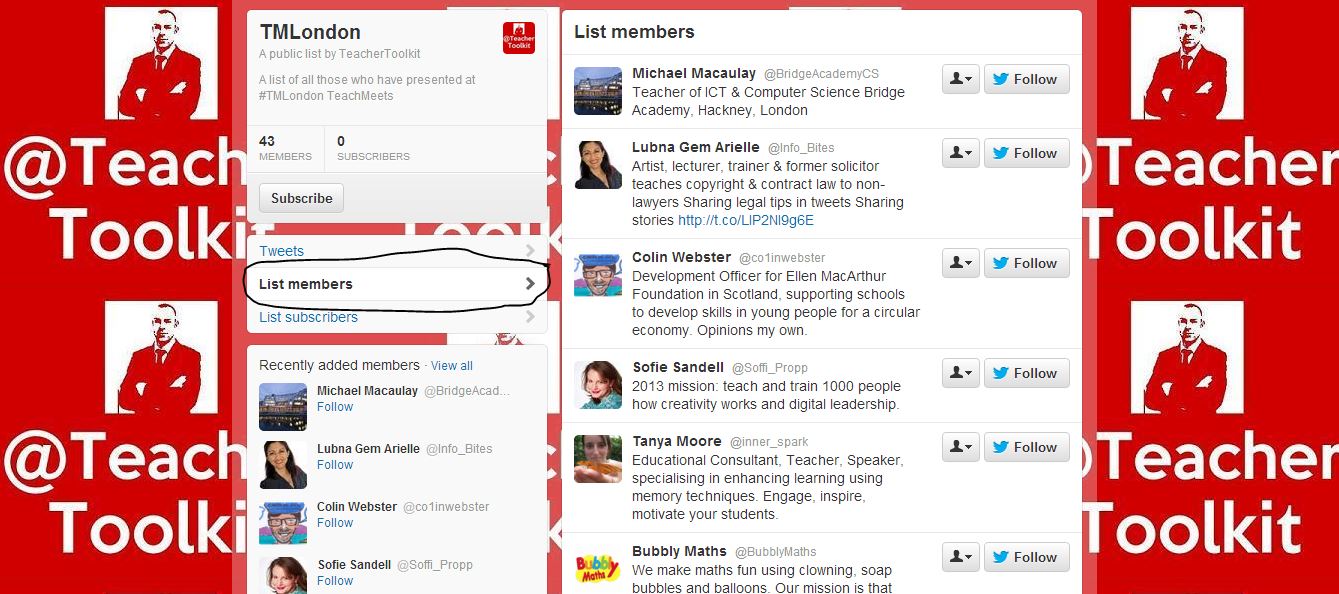
Another great one for teachers is @pedagoo. Ross McGill (@TeacherToolkit) suggested that it might be a good idea to look at some lists. This link is to @TeacherToolkit site and if you follow it then click on the “List Members” you will see a number of people who contribute to TeachMeet in London. Anyone you would be interested in following?
Other possible headteachers or leaders that I follow and find interesting include:
- @RosMcM
- @Carter6D
- @johntomsett
And if you want a guru or two I started with these:
- @alatalite (Alistair Smith – Learning to Learn Guru)
- @dylanwiliam (Assessment & Curriculum Guru)
- @SirKenRobinson (Creativity Guru)
- @HargreavesBC (Building Professional Capital Guru)
- @arti_choke (Pam Hook – SOLO Taxonomy Guru)
- @GuardianEdu (Upto date News)
Simply scan the tweets for useful information and links to articles that you might want to read. If you want to capture one of these articles, to read later or keep for future reference, then Pocket is a neat little app and very easy to use. As you get more advanced or depending on preference then Evernote or Diigo (PowerNote is the app for your phone) are different options to Pocket. As a short aside, I introduce Sixth Form students who are doing their Extended Project Qualification with me to use twitter, for research, and Diigo to store and organise any key information they find.
Now you have Martini CPD, any time, any place, anywhere professional development at your fingertips and convenience. You can use twitter to tap into some rich online content that is of interest to you and then start putting your own thoughts onto a blog. I’ve been using WordPress for just over a month and find it very easy to use.
To borrow a few phrases from the hugely successful London 2012 Olympics, Better Never Stops … so just take the next step.
Redesigning Classrooms: Spreading and Embedding the SOLO Taxonomy
In this set of posts about redesigning classrooms I want to look at some of the changes that teachers can incrementally make to their classrooms that may over time transform their practice. The first post about the SOLO Taxonomy can be found here:
Redesigning Classrooms: Using SOLO to Increase Challenge

Produced by Pam Hook (@arti_choke) http://pamhook.com/wiki/The_Learning_Process
SOLO first appeared as part of our CPD programme a number of years ago and all staff are familiar with it, however, a number of staff have started taking the use of the SOLO Taxonomy to new levels, spreading and embedding its use as they go. One of the interesting dimensions of the work is how staff are using the SOLO Taxonomy with students and explicitly developing their understanding of it and how to use it to increase the depth of the work they are doing. This post is a series of short inputs from staff at St. Mary’s
Art, Design & Technology Department – Student Friendly Success Criteria (Anna Johnson – HoD)
In the Art, D&T Department we are developing student friendly success criteria based on SOLO Taxonomy that allow us to identify ascending cognitive complexity in individual and collective student performance for understanding when mastering new learning. This will allow us to easily and reliably assess students’ progress.

Example of success criteria for students in Food Technology
The next step is to incorporate the 5 R’s using SOLO Taxonomy. We are also incorporating GCSE exam questions into Key Stage 3 lessons to allow students to demonstrate relational and extended abstract understanding.
RE Department – Developing the Learner (Phil Allan – HoD)
We made a decision to teach SOLO taxonomy discreetly to students in order to demythologise the whole concept. We used a card sort on topics familiar to the students (Blackpool FC and the X Factor) and they had to sort information into one of unistructural, multi structural etc.

Two different card sorts that were used to help students understand the different levels of complexity in the SOLO Taxonomy
The students grasped the idea immediately and were table to transfer these skills to recognise where a religious topic moved from multi-structural to relational or extended abstract levels. Our lesson planning was revolutionised by the success of this initial lesson as we then attempted to ensure that students learned some declarative knowledge (multi structural) early in the lesson and were then able to make the move to functional knowledge (relational/extended abstract).The level of challenge in lessons has increased markedly as each lesson requires students to think at a higher level at some point.
The lesson plan and a further exemplar can be found below:
SOLO template – blind man and the elephant model
Embedding SOLO in the English Department (Helen Stuart – Innovation Fellow)
When first faced with SOLO as, what seemed like yet another initiative to ‘get in the way’ of any actual teaching and learning, a sense of déjà vu, tedium and (if I am to be entirely honest) slight annoyance set in. However, it takes a brave teacher to admit when they’re wrong. In fact, SOLO has proven itself in my classroom time and time again to be an invaluable tool which is an accessible catalyse for students to: easily understand how ideas within the subject connect by forming real meaning of their learning; partake in cognitive demanding activities to achieve deep learning and appreciate the necessary strategies which are needed in order to unpack their skills.
I have found that by integrating SOLO into my planning, through the learning objectives and success criteria, students are more able to co-construct the lesson, using SOLO terms, as they actually become eager to achieve an extended abstract level of understanding within the lesson. The power of SOLO within their own learning instantly creates high challenge, due to a greater level of engagement, and students being able to, almost instinctively, identify their next step and maximise their conceptual understanding.
The “SOLO Taxonomy and Making Meaning Workbooks” (Hook & McNeill) are tangible resources within the learning environment which put SOLO into real practice (something I know myself and the department craved in order for an educational theory to become reality). The SOLO maps and rubrics within these texts have now become a staple part of English lessons, allowing students to select them as learning tools in order to scaffold their understanding. I also find an insightful activity for students, and me as their teacher, is to ask them to define the SOLO level of an activity and then challenge them to change the activity in order that it be classed as extended abstract, which they then complete. This activity also works well with forming questions on a given text, for example when analysing the writer’s purpose.
SOLO is one of those rare teaching acronym initiatives that actually works, in terms of: in a real classroom, with real students, to see real improvements in their metacognitive skills. Embedding SOLO within my own teaching has effortlessly led to more engaged, higher achieving, interdependent students who can lead their own learning…albeit to my surprise.

This is an example of the HookED SOLO Describe ++ Map that can be found in the “SOLO Taxonomy & Making Meaning Series. The books contain a number of different SOLO Maps and examples.
Essential Resources: (there are Australia, New Zealand and Rest of the World websites for Essential Resources as well) publishes some fantastic resources – “SOLO Taxonomy & Making Meaning” are a set of three literacy based books, two books that introduce “SOLO Taxonomy: A Guide for Schools” are two books that give you a great introduction to SOLO and finally one titled “Using SOLO as a Framework for Teaching” are all worthwhile.
Science – Use of Hinge Point Questions (One from me but not yet used in a real classroom)
SOLO Taxonomy can be used to produce increasingly complex hinge point questions. The final slide is taken from a video in which @eric_mazur is explaining how the Flipped Classroom works.
Students armed with a white board and a pen select the answer they think is correct. If a large majority of the students have the right response it’s probably best to quickly explain the answer to other students and then move on, don’t linger too long as most students won’t be learning anything. If the number of students getting the correct response is somewhere between 30-70% (Eric Mazur’s figures) then resist giving students the answer and get them to discuss it with each other – this can lead to some really great debates. If fewer then 30% of students have the answer you probably need to take a step back and revisit some earlier work as somewhere along the line their learning has a disconnect – can you prompt them forward to the next SOLO level without simply giving them the answer?
This series of slides is to help students learn about the expansion of solids when heated. This first slide just requires students to describe a series of events linked to the age old ball & hoop experiment. It would follow a demonstration of the experiment and is at a multi-structural level.

Hinge Point Q1 – Describe is at a multi-structural level
This second slide moves to a relational level in SOLO terms as students are required to explain what has happened. The slide contains the correct answer and a common misconception amongst students to really test their thinking.

Hinge Point Q2 – Explain is at a Relational Level
Finally it’s a move to the extended abstract with the students asked to hypothesise. This is a really tough ask which has baffled more than one Science teacher I have used the slide with.

Hinge Point Q3 – Hypothesise is at an Extended Abstract Level
If you’re not sure think about the answer to slide 2 and the particles on the edge of the hole in the middle. A “student model” is really useful here.
If you would like another way that SOLO Taxonomy is used at St. Mary’s to ensure we have rigorous and challenging Project Based Learning, please see the post below:
Leadership: Being, Knowing, Doing (New Book)

Liminal Leadership

COPYRIGHT LICENCE

@LeadingLearner by Stephen Tierney is licensed under a Creative Commons Attribution-NonCommercial-NoDerivatives 4.0 International License.
Based on a work at www.leadinglearner.me.
 @LeadingLearner