@LeadingLearner
LeadingLearner
First Hundred Days of Headship
A number of years ago I was asked to write a piece on my first hundred days of headship. It was a great opportunity to reflect on my well meaning incompetence, in the early days of headship, as I attempted to learn my “trade”. Learning as a headteacher can be a pretty exposed place. I’ve resurrected the piece and summarised it below. Continue reading
Redesigning Schools: Masterchef II – Great Menus, Great Food
In Redesigning Schools: Masterchef I – Mustard Seeds, Yeast & Salt, I attempted to lay down the challenge facing us as we attempt to redesign schools. We have the opportunity to take back control of the core business of learning in our schools and for our students. The SSAT’s Redesigning Schools Campaign may be the banner we can gather under.
“A bit like the parable of the mustard seed I have a sense that from small beginnings this movement (Redesigning Schools) will grow and grow until it becomes one of the mainstream educational groups of this decade. The use of social media is helping it reach beyond the physical group of people and out into a virtual world, the “yeast and salt” that produces massive effect far beyond its original being.”
Continuing the Masterchef theme, to become the eventual winner a chef will need to put together some great menus and deliver great food. This blog is concerned with the menu we offer and I’ll blog again soon about “Great Food”. A menu can be fixed or a la carte. So it is with the curriculum model that we offer our students. The extent of choice and personalisation differs from school to school, depending sometimes on curriculum philosophy and sometimes on circumstances.
Great Menu – The Curriculum Model: Setting the Scene
The Curriculum Model covers all aspects of the timetable constructed including: the subjects, time available to subjects, organisation of students into learning groups (pathways & classes) and the allocation of teachers and learning spaces. The main authority and primary decision makers are the headteacher and senior leaders. This is what I call macro-personalisation, the school may consult various stakeholders but ultimately controls the offer made to students and students make their choices within the limitation of what is offered.
Following a SSAT Think tank, led by Dylan Wiliam a few years ago, I went back to College and immediately redrafted the whole Curriculum Policy to make our principles more explicit. Following suggestions by Heads of Departmnets, the Curriculum Policy was written as a handbook for staff and the first section states, the Curriculum Model will:
- Ensure that all students have access to a balanced curriculum. Students will be increasingly able to personalise their curriculum through the process of informed decision making.
- Ensure that there is a high level of rigour by providing a subject based curriculum through which students can develop the “habits of mind” – powerful ways of thinking – associated with sustained engagement with the particular disciplines and subjects.
- Ensure coherence across subjects by implementing a series of dynamic days that enable staff and students to work at a cross-curricular and interdisciplinary manner. This will help students develop a broader understanding of the application of particular subjects within the World and the links between them.
- Ensure relevance for all students by ensuring there is high quality information, advice and guidance available to students and their parents at key transition points. Choices about what to learn will increase with the maturity of the learner and students must be aware of the consequences of their choices for themselves and their future engagement in society.
- Ensure focus through the development of students as learners along side the development of knowledge, understanding and skills.
We determined a number of disciplines that students would experience at Key Stage 3 and have a choice from at Key Stage 4 with even greater choice at Key Stage 5:
Disciplines at St. Mary’s
- Communication: English Language, English Literature, Media Studies & Modern Foreign Languages
- Design, Creativity & Technology: Art & Design; Design Technology; Enterprise; Photography; Music; Drama
- Humanities: History, Geography, Politics & Religious Education
- Information & Communication Technology
- Mathematics
- Physical Education
- Sciences: Biology, Chemistry, Physics, Applied Science & Astronomy
Students in Year 9 followed an accelerated pathway – complete a number of foundation subjects by the end of Year 8 and have a set of enriched GCSE opportunities studying Photography, Psychology, Astronomy or ICT alongside GCSE in French or Spanish before completing GCSE options for Key Stage 4 mid-way through Year 9. In the standard pathway students studied a large number of core and foundation subjects, the latter for a relatively small amount of time each, which is a fairly normal pattern in many English schools.
Additional Disciplines at St. Mary’s in Key Stages 4 & 5
- Social Sciences: Business Studies and Psychology
- Applied Learning: Computer Science; Health & Social Care; Travel & Tourism; Child Development; Construction; Hairdressing & Motor Vehicle
A number of years ago we introduced Dynamic Days, when students would spend a whole day focussed on one area of study which could either be subject based, for example, they proved really useful for English Controlled Assessments or Science Coursework in Key Stage 4 or thematic days, which produced some really rich, coherent learning into the curriculum, for example, a Holocaust Day in Year 9 or a Sexual Health Day in Year 10 alongside Rewards Days and Sports Day. In addition, this will be the third year we have run a Wonderful Week for eight hundred students in Years 7-10, during the second half of the Summer Term, with a whole variety of trips abroad, day excursions and on site provision. The focus is project based learning with students exploring a single theme for a week. It is a mammoth task of organisation but one of the highlights of the year. We are in the second year of a fortnightly timetable of three one hundred minute lessons a day, except for Thursday when we shorten them to ninety minutes to allow a weekly CPD session for teaching staff.
Moving Forward
With the scene set, how are we looking to move forward over the coming years? As mentioned in Masterchef I, external forces may restrict us but will never define us and we have looked at restructuring Year 9 and tinkered with Key Stage 4 options. The former is due to internally driven change with the latter responding to the proposals put forward as part of the “Secondary School Accountability Consultation”. The three touchstones in guiding my thoughts and decisions have been:
- Will the proposed curriculum help further our vision and is it congruent with our values?
- Would the curriculum be good enough for my children?
- Will the curriculum help keep the wolves away from the door?
Year 9
In Year 9 students tended to follow a similar curriculum pattern to Years 7 & 8 though some schools have looked to start their GCSE courses in Year 9 as either a series of “short, fat GCSEs” or as part of a three year GCSE course. Key Stage 3 is only three years long as students currently complete their compulsory education at 16 and they need two years for their GCSE, it’s as simple as that. Continuing to study a wide range of subjects for relatively short amounts of time tended to produce a balanced curriculum for students but limited a really rigorous study of the subjects. Opting for GCSEs too early can be a concern as students may not have the information and maturity to make life enhancing choices, however, giving students choice can help engagement and raise achievement as we tend to excel at things we enjoy doing. Both approaches have their merits but neither extreme quite suited us.
We are towards the end of a consultation with staff and about to consult with students and parents about a “limited” choice for students in Year 9 except for those in the Integrated Pathway. All students will follow: English, Maths, Science, RE, MFL, PE & PSHE. Then students will have a choice from two disciplines, Design, Creativity & Technology and Humanities, spending 10% of curriculum time on each and an open choice again with 10% of curriculum time available:

The last block is probably the most interesting as it gives students a real opportunity to move their curriculum in the direction of the aspirations and enjoyment. They can be a double linguist, take two humanities, two creative subjects or Computer Sciences. It’s not a limitless option for students and whether a subject can run or not will depend on numbers opting. Our hope is that it will also help teachers build relationships with their students, something that is close to our heart. No longer will teachers in foundation subjects be teaching large numbers of students for a short amount of time or operating carousels in which they no sooner get to know a students name than s/he moves on. This is an example of redesigning from the inside out, we do it because we believe it is in the best interests of our students.
Key Stage 4
In Key Stage 4 all students study GCSE English, English Literature, Maths, RE and two Sciences plus general PE and PSHE. For a number of years now we have provided two pathways for students to opt from: the General Pathway is a largely GCSE pathway and the Specialist Pathway has a day a week timetabled at Blackpool & Fylde College who deliver high quality vocational courses that we do not have the facilities or expertise to offer. Students travel directly to and from B&FC, for their day, removing the hassle of transport that these partnerships sometimes pose.
The recent “Secondary School Accountability Consultation”, a clever piece of political manoeuvring but also some sound educational thinking, left us with a little puzzle to solve. Whilst students had always been able to opt for the combination of subjects in the E-Bacc we had never forced any student to do so and had essentially ignored the E-Bacc as we felt it was an educational red herring.
Our bit of manoeuvring was to move from four “open choice” option blocks to three open choices with Option Block A producing the third E-Bacc subject alongside GCSE Double Science. Mission simply accomplished – though I’m not sure Julia, our Curriculum Deputy, would agree, as she now has the task of piecing this massive jigsaw puzzle together. The “Best 8” including English, Maths, any three E-Bacc plus three others measure should be satisfies so this will hopefully keep the wolves away from the door, it would be a good enough curriculum offer for my children (what about yours?) and doesn’t compromise our curriculum principles.

The specialist pathway was a bit more interesting as we decided that beyond GCSE Double Science and with the need for a full day a week available for students at the College insisting on another academic qualification, which suited the school but not them, was a step too far. These are great young people many of whom are massively skilled with their hands and we should allow them to flourish in that environment alongside their academic core of subjects. A very large majority will go on to vocational studies post-16 at Blackpool & Fylde College. Hopefully if you need a plumber, electrician or car mechanic in the future there will be one a fully trained one available. This may damage out “Best 8” point score as they will only have two of the E-Bacc subjects for the three slots but the enhanced points in other subjects may compensate for this, either way what we have offered seems right for the students.

Providing a great menu is only part of the Masterchef Challenge and part of the education we provide. We need to provide the right options for our young people and whether you are an academy who can legitimately ignore the National Curriculum or not you can be the masters of the curriculum offered to your students. With out extended lessons, dynamic days, wonderful week, curriculum pathways and option choices we have designed a curriculum that matches the needs of our different students. It is a challenge to walk through the curriculum minefield, managing the tensions, but take control, you know you want to. Secretaries of State will come and go but your Mission for young people remains. Masterchef III focussing on great food is about to be prepped.
Redesigning schools: Masterchef I – Mustard Seeds, Yeast and Salt
The dust is now settling on a great set of symposia organised by the SSAT on Redesigning Schools. A bit like the parable of the mustard seed I have a sense that from small beginnings this movement will grow and grow until it becomes one of the mainstream educational groups of this decade. The use of social media is helping it reach beyond the physical group of people and out into a virtual world, the “yeast and salt” that produces massive effect far beyond its original being.

All this talk of mustard, yeast and salt takes me to one of my favourite television programmes, Masterchef. It involves groups of contests competing to become the best chef by surviving and thriving through a series of increasingly complex challenges. My wife thinks I should go on Masterchef (she is absolutely lovely and very kind about my culinary skills) but I am simply a very good “recipe follower” and would be caught out by the first challenge, the Invention Test. This requires contestants to make a beautiful tasting dish, in one hour, having been given a whole series of different ingredients. The most successful chefs seem to be able to identify with absolute clarity what they want to produce, select the ingredients carefully and skilfully combine them to produce a mouth watering dish. Some poor contestants, either through stress, a lack of imagination or limited skills try to put nearly all the ingredients together into a totally weird and incoherent dish, which tastes awful, or produce something so simple that it fails to reach the exacting standards required.
Education is standing at a crossroads where the vision, skills and expertise of school leaders, teachers and support staff will all be required in abundance if we are not to go down the wrong road or into a series of dead ends. In an increasingly complex World the edicts of any one person, whether they are the Secretary of State for Education or the Chief Inspectors of Schools or whoever, will not be enough. We shouldn’t be either too damning of their efforts or too compliant in following their demands. I decided a long time ago that whilst we, as a school, may be restricted by our political masters, the school would never be defined by them.
Take two examples:
- The E-Bacc was for me always a fundamentally poor idea, though its possible root of greater rigour (as opposed to some people’s view that its root was all about one person’s 1950s grammar school style education) in students’ studies is commendable. However, the lack of congruence with our Christian root that sees the education we offer as helping students develop greater wisdom – the ability to make life enhancing decisions – also recognises that no subject has a monopoly on this; the one size fits all approach (it doesn’t); the restrictive nature of having to take one subject from each discipline (three sciences or two languages weren’t given credence unless you had GCSE History/Geography at grade C, goodness only knows why); dubious use of statistics and exhortations about learning from the high achieving educational jurisdictions in the World (the fact I put “high achieving jurisdictions” in a sentence doesn’t mean I have actually distilled the wisdom of the lessons learnt from these countries/states) and the simple wind up of excluding RE and English Literature which are both facilitating subjects in the Russell Group Report (not included in the list as they aren’t often specific entry requirements of degree courses but look at the small print under the facilitating subjects) meant it never featured in our curriculum. With the exclusive nature of the measure, if you didn’t get a grade C at GCSE in any one element you were not counted in the statistics, it was easy for the school to ignore. At Key Stage 4 any student who wanted to pursue subjects leading to the E-Bacc was able to do so, they always had been, but other students could opt for subjects that linked to their own aspirations, skills and interests. The approach pleased students, parents and staff. The E-Bacc did not restrict our curriculum offer to students and got no where near ever defining it.
- The latest proposals put forward as part of the “Secondary School Accountability Consultation” will restrict us but they will never define us and what we believe a high quality education looks like. The reason for this different view is simple, there is far more congruence with the proposals and our vision of what education should be. The proposal to move to a best 8 point score, with the implication that every child and every grade matters, is a huge step forward in thinking as it moves away from C/D borderline, cliff edge manoeuvring; the reintroduction of a value added measure is another commendable proposal which, if Ofsted use properly as the primary measure of schools, might break the clear statistical link between being graded an outstanding school and having few students on FSM/large numbers from high socio-economic backgrounds (exceptions and outliers don’t make rules but congratulations to those schools that are) and the combined English & Maths at grade C measure is again sensible as achieving it impacts on young people’s life chances. There is also a nod to a more expansive view of education with respect to other experiences which may be included but they don’t seem to have any great sincerity behind them and I’m not convinced including them within accountability measures is the best way to encourage students’ engagement. I can live with the three subjects from the E-Bacc list being included, in any combination, as part of the “Best 8” and the inclusion of a further three qualifications including creative and vocational subjects is good to see. If common sense prevails, it won’t but never mind – the World will not implode and we will all still be able to get on with our lives – then a whole series of other measures will be abandoned as they no longer serve a purpose and the white elephant of a Data Warehouse being “built” at a time of national austerity will be laughed out of existence. Transparency is fine as long as the people it is aimed at do gain a greater knowledge and understanding of schools rather than being overwhelmed by so much data they simply click off the site.
The school was fortunate to be involved in the System Redesign network that contained some wonderful leaders and thinkers, from which I learnt a great deal, and it helped us re-vision what education could be, including developing a more personalised dimension to our work. Working on personalisation helped crystallise in my mind three touchstones that I have always found useful as a leader when trying to make decisions when complexity levels are high:
- Will the decision help further our vision and is it congruent with our values? This can be quite complicated and you do have to be clear on your vision and values so I devised a couple of simpler ones.
- Would it be good enough for my children? How happy would I be, as a parent, if this new initiative idea was introduced at my own children’s school and affected their education?
- Will the initiative help keep the wolves away from the door? Whether it is Ofsted, the local authority or the more important accountability to parents and students you simply cannot make decisions that will lead the school or its students into the abyss.
In Redesigning Schools the same three touchstones will again prove invaluable in helping us make key decisions. In 2008, I proposed a model of the learner we should seek to develop at the school termed the 4Cs Learner and this year we are rethinking both our Year 9 Curriculum and tweaking the options for students at GCSE to fit in with what may well be the outcomes of the accountability consultation. I intend to blog the details of these in the near future (Masterchef II) for your information, reflection and feedback.
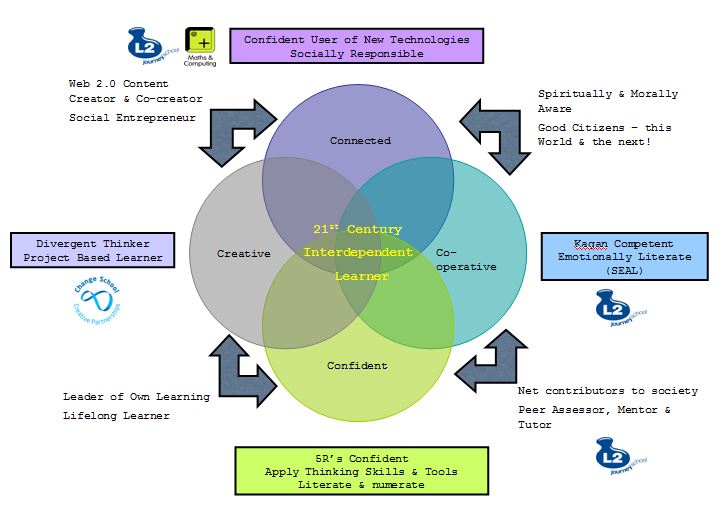
If we are to become the Master Chefs of the education system then choosing the right ingredients and discovering new ones to use will be crucial. Take the big debate, or is it an argument, over the contents of the new National History Curriculum. What are your thoughts? Look on the bright side if it’s implemented we may yet win the World Pub Quiz Award for years to come! Here are a few thoughts to start you off:
- Calling it the National Curriculum is a misnomer, what we have is the National Random List of Facts & Incidents that may provide some of the multi-structural knowledge (SOLO Taxonomy) on which we can build deeper levels of understanding (Relational & Extended Abstract in SOLO Taxonomy terms). A reasonable start.
- As with Master Chef you may have to add a few ingredients of your own to the National Random List. Remember you will add to and in no way detract from the History Curriculum as you build a greater coherence for your students.
- What would happen if you didn’t use all the ingredients? For example in Key Stage 2, there is “Warwick the Kingmaker”. Great, I loved the ladybird book I read about him when I was a child and if it’s still in print I can thoroughly recommend it. Having ignored many an idiotic edict or “request” from the Secretary of State, DfE and local authority over many years and having not yet ended up in prison (yet) I dare you not to teach “Wolfe and the Conquest of Canada” or “Clive of India” if they don’t help your students understand history or become better historians and see what happens.
- To truly be called a curriculum what is proposed is simply inadequate as the skills and habits of mind required within the subject as well as to develop young people as learners are missing. Neither have the pedagogical opportunities been explored. But for once I say “alleluia”, as this is our domain, we are the master chefs and I don’t want this to be dictated to teachers or schools from on high.
Redesigning Schools cannot happen within a vacuum but rather as part of a strategic movement with a “sense of direction, discovery and destiny” woven into it. It must take account of what is happening and raise its eyes to scan the horizon for what might happen and what is possible. It will not be possible for “recipe followers” to lead the way but they may follow. What will be required is master chefs who are able to identify with clarity a direction to travel, select the ingredients of high quality learning and development and skilfully combine them into a world class education system for all. It is time for courageous leaders, at every level in our system, to step forward.
Leadership: Being, Knowing, Doing (New Book)

Liminal Leadership

COPYRIGHT LICENCE

@LeadingLearner by Stephen Tierney is licensed under a Creative Commons Attribution-NonCommercial-NoDerivatives 4.0 International License.
Based on a work at www.leadinglearner.me.

