@LeadingLearner
CPD
The Behaviour Collection
Understandably behaviour is one of teachers’ greatest concerns. It has a massive impact on: the quality of a teacher’s professional life, how well s/he can do their job and a teacher’s personal well-being. Behaviour is likely to be easier to manage when there is a whole school consistent approach.
Quality of Teaching: The Wider Context
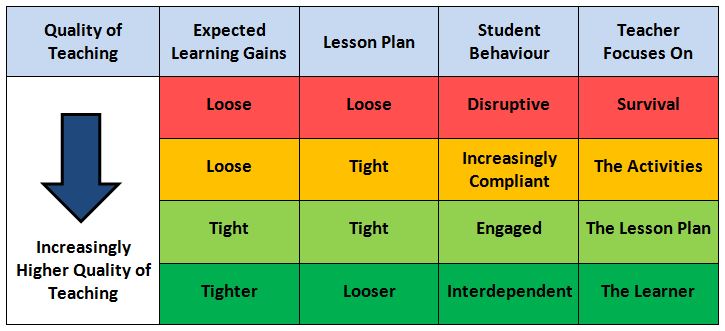
An Early Draft of Thinking Around Improving the Quality of Teaching by @LeadingLearner
I’m currently working on a resource around the Quality of Teaching. Whilst the main focus will be on planning the expected learning gains and delivering them it would be impossible to write anything worthwhile without acknowledging the impact of behaviour. The above table is an outline of some key stages or signposts towards improving the Quality of Teaching.
Taking the “Student Behaviour” strand, it seems a statement of the obvious, where there is significant student disruption in lessons, low or high level, then learning will not occur. Sadly, too many teachers spend time in class surviving. Both they and their students deserve better.
As students become increasingly compliant with the standards of behaviour expected of them the Quality of Teaching can start to improve. Teaching needs the right conditions to flourish. Engagement is not simply creative tasks and activities or having fun though these have a part to play. It is also about challenging and interesting work for students to develop those moments of flow.
Interdependence potentially moves the learning to a whole new level but needs to be seen within the context of the whole. It is not something you simply do in this or that lesson. It is a level of maturity in the learning process where the learner positively acknowledges and uses resources including the teacher, other students and people across and beyond the school to benefit her/his learning. In turn the student is a resource to others. Their learning behaviours are self-motivated. This needs to be explicitly planned for and built over time.
The following three posts give a background and some useful practical strategies to help you get that behaviour right.
Planning to Get Behaviour Right: Research Plus Experience
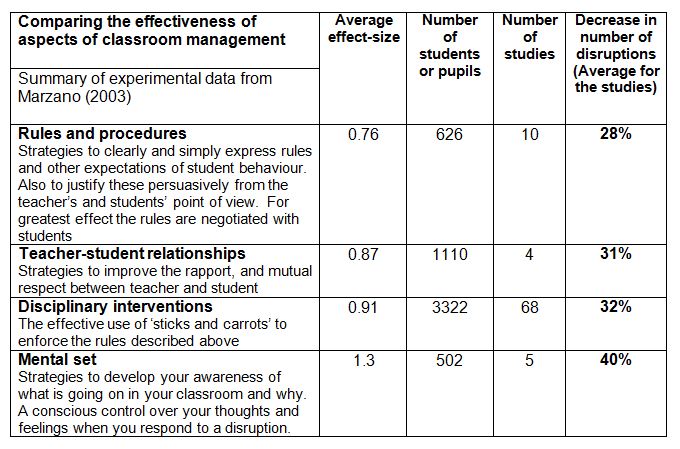
Acknowledgement: Petty, G (2009), Evidence Based Teaching: A Practical Approach. Nelson Thornes
Before releasing the #5MinBehaviourPlan Ross and I looked at a structure for the plan. We built the plan’s structure around the work of Robert Marzano et al (2003) “Classroom Management that Works” as quoted in Evidence Based Teaching (Petty, 2009). The four elements: Rules & Procedures; Teacher-Student Relationships; Disciplinary Interventions and Right Mental Set are explained in the post alongside some reflections from the class room.
The #5MinBehaviour Plan by @LeadingLearner and @TeacherToolkit
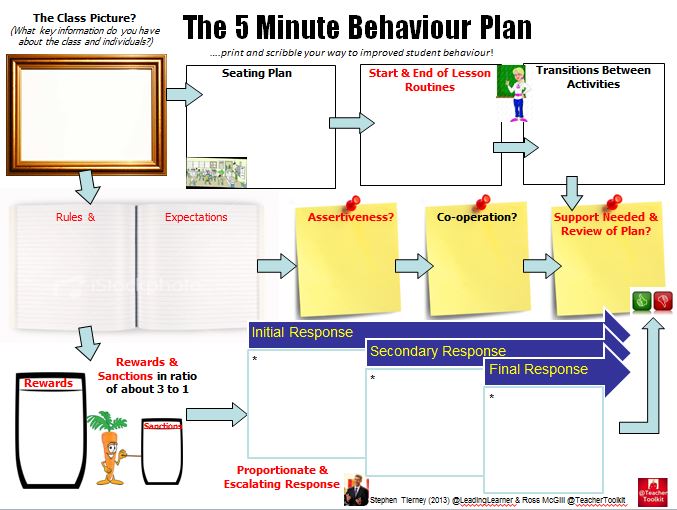
This plan is great for new teachers or more experienced ones who just want to make sure they are bringing a systematic approach to the management of behaviour. There are a set of boxes to prompt thinking about key elements of behaviour management. Behaviour is likely to be easier to manage when there is a whole school consistent approach, however, each teacher has a professional responsibility to get it right in his/her classroom .
Whole School #5MinBehaviourPlan

I used the plan to illustrate the new Behaviour Policy we have put in place at St. Mary’s Catholic College. It isn’t rocket science but it does require people to be consistent. Over the past few years consistency has improved as staff and students have become more familiar with the various elements. There is always more that can be done but staff, students and parents have all recognised the even better behaviour through our various annual evaluations.
Going Beyond
In great schools behaviour is more than compliance and engagement. These schools have built an aspirational culture in which students’ motivation becomes intrinsic compared to the more extrinsically motivated behaviour systems put in place by the school. This culture is more easily built where the values of the parent body are aligned. However, in areas of high deprivation or low aspiration it becomes even more important.

How We Learn: The Science
The summer always provides a welcome break and a some time for reading. Apart from a bit of light reading I’ve enjoyed Switch: How to Change Things When Change is Hard by Dan & Chip Heath, Leverage Leadership by Paul Bambrick-Santoyo and Essentialism: The Disciplined Pursuit of Less by Greg McKeown.
Continue reading
Blagging Bloggers and Research Scientists
Saturday mornings are usually sacrosanct. They consist of me reacquainting myself with the family, enjoying a bit of café culture and time with my long suffering wife. However, the opportunity to attend BELMAS 2014 provided sufficient attraction to pull me to Stratford for the day. It’s where the Blagging Bloggers of #SLTeachMeet met the Research Scientists of #BELMAS2014.
Acknowledgement: BELMAS Annual Conference Website
One of the joys of blogging is that you decide what to write about, how you express your ideas and how much emphasis or bias you want to put behind a particular point of view. There is however a danger that I don’t always validate statements I’m making and so the blagging blogger is born. This can also be true of what happens, on occasions, in the class room. We have more freedom than we may actually think. But how do we make sure we’re not blagging it in the class room.
Tom Bennett (Teacher & Director of ResearchEd) describes the current relationship between research and the classroom teacher as “a chaotic one, totally dysfunctional.” Bad research is unwittingly adopted by the profession and more useful ideas are lost in the general noise of what’s proven or not. Equally, good research can be either poorly implemented or given too little time to take root.
Ivory Towers & Inner Sanctums
The divide between the researchers and the practitioners may seem as wide as ever. However, teachers are now becoming much more familiar with the randomised control test (RCT). RCTs are deliberately designed to try to reduce the number of variables or at least account for them, so a cause and effect type relationship can be established. As a scientist this rather appeals to me as it is familiar territory. Cause and effect, statistical models and data and errors are all part of the language used. Researchers don’t always help bridge the divide as many articles have an almost impenetrable language to them. We all have a technical language but I would urge researchers to talk to the profession not just your peers.

Photo Credit: Psychopyko via Compfight cc
The inner sanctum or class room as you may call it also creates problems in this relationship too. For one, it can be a research free zone with too little reflection on the long standing or emerging evidence coming from research about teaching & learning. It’s partly about time but it goes deeper than that. Many teachers feel much more at home with a social sciences type of approach, less concerned about control of the variables and much more interested about the development of a narrative. It feels more real and linked to our everyday working life. Would you really want to be treated by a doctor or surgeon who hadn’t learnt about any of the medical advances in the last twenty five years?
Goldfish Bowls & Classroom Test Beds
Social media, conferences organised by ResearchEd or the Teacher Development Trust, the opportunity to attend BELMAS and lesson study will all have an impact over time.

Photo Credit: Louish Pixel via Compfight cc
Vic Goddard recently left a thought provoking comment on a blog post (Growth Mindset: The Latest Silver Bullet?). I could almost sense his frustration about the marginalising of the Teacher’s Voice in helping determine what works and what doesn’t.
“However this seems to be the default position of too many of the sceptics – some would call them the Pedagogy Police – that the moment someone mentions something that has worked for them, in their classroom, with their young people, on a sunny day, in July, in Naboo then the coffin creaks open and someone shouts ‘where’s your evidence?’. I would prefer to back the common sense and intellect of the people that will make the decisions about how to use whatever research comes out.”
(Vic Goddard, Principal of Passmores Academy)
He got me thinking about how I see the relationship between research and teaching, between researchers and teachers. I ended up with this. The Bible starts with the laying down of the Law, the prophets question the Law and people’s approach to it and Wisdom, the true spirit and meaning of the Law, eventually shines through. Reinterpreted, it may look something like this:

Rambling Imaginings of a Blagging Blogger
From wisdom we can loop back round to the beginning and develop a deeper understanding of the law, the research evidence. If teachers had greater opportunity to work with researchers the ivory towers can become gold fish bowls. We can peer into the controlled environment of the researcher and gain a greater understanding of the work s/he is doing. Equally when the inner sanctum is opened up to the researchers it can become a test bed for research work to be taken further in situ.
The boundaries between the phases have always been blurred.
They were never that clear cut but our challenge is to blur them even more.
The divide needs to breached and become more of a continuum.
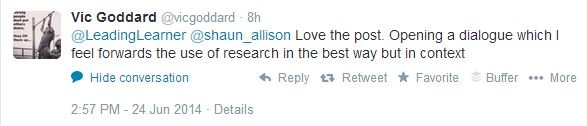
Tweet by @vicgoddard
So What the Hell Will Work?
Individual research papers can be interesting but are not definitive. Researchers argue with each other about impact, the size of the impact and the degree of error. With a growing level of certainty, there seems to be some evidence for, we can’t be certain but … so the language of research goes. This is often re-interpreted too crudely in the class room as black and white, right and wrong.
Maybe John Tomsett and Alex Quigley are looking at part of the answer. This Much I Know About … How You Can be Involved in Our EEF Research Project outlines a huge undertaking for Huntington School:
“It marks the official start of an exciting project that will see participating schools, working in collaboration with Alex Quigley from Huntington and the Director of Durham University’s Centre for Evaluation and Monitoring Professor Rob Coe, establish highly effective school-based Research-leads in order to improve students’ outcomes…
This project, led by Huntington School, aims to test whether a research-based school improvement model makes a significant difference to classroom practice and student outcomes. Each school in the programme will appoint a ‘research lead’ who will be responsible for implementing the improvement programme in their school, with a particular focus upon improving student attainment in English and mathematics at GCSE.”
The divides have just been breached, the ivory towers have crumbled and the inner sanctums have opened their doors. I’m interested.
Just for the record the bloggers speaking at BELMAS 2014 are much, much more than a bunch of blaggers. Each presenter will give a six minute input. What about this for a list:
- Developing research culture: spreading the bug by @HelenaMarsh81
- Management with colours; making progress visible by @listerkev
- Trainee Teachers & Learning from Lesson Observations by @Runrober
- Teacher-led CPD by @jkfairclough
- How teachers use web 2.0 to facilitate their work by @faisal530a
- Researchers and practitioners – stronger together by @LCLL_Director
- The Professional Doctorate – being an insider and an outsider by @jillberry102
- The quick wins of research by @MaryMyatt
- Some Ideas for Qualitative Research by Dr. @cazzwebbo
- Balancing teaching and parenting by @thosethatcan
Other Related Posts:
#5MinResearchPlan by @LeadingLearner & @TeacherToolkit
The Jerusalem & Babylon of Professional Development (Presentation for #NTENRED in York)
Leadership: Being, Knowing, Doing (New Book)

Liminal Leadership

COPYRIGHT LICENCE

@LeadingLearner by Stephen Tierney is licensed under a Creative Commons Attribution-NonCommercial-NoDerivatives 4.0 International License.
Based on a work at www.leadinglearner.me.
 @LeadingLearner