@LeadingLearner
CPD
Next Step to Outstanding
In a previous post “Consistently Good to Outstanding” I described my views about outstanding teaching following interviews with a number of teachers at St. Mary’s Catholic College, Blackpool who had been consistently graded outstanding in lesson observations.
I finished with these thoughts:
- Outstanding is not simply doing more good things it’s doing different. It involves a mindset shift.
- Absolute clarity of how knowledge and understanding are vertically integrated in your subject and helping students to work at a conceptual level. The teacher needs to be working there first.
- Keeping the lesson plan “loose” so that you can respond to the learner as s/he makes their learning visible to you at the beginning, during and end of lessons.
The following table and the thinking behind it attracted quite a bit of interest:
|
Grading |
Learning Gains |
Lesson structure |
Focuses On |
| Satisfactory (RI) |
Loose |
Tight |
The activities |
| Good |
Tight |
Tight |
The lesson plan |
| Outstanding |
Tight |
Loose |
The learner |
I’ve set myself the challenge of trying to develop a CPD programme to help teachers move from good to outstanding “#OutstandingIn10+10”.

I want to put a note of realism in here, this is not about producing outstanding teachers but rather helping them take the next step on an evolutionary journey. Working with teachers who have consistently been graded as good, and are utterly frustrated that they have never got the coveted outstanding lesson grade, I want to see whether in twenty weeks (10+10) they can achieve an outstanding lesson with a bit of structured support.
This blog and the process is fraught with problems, I’m going to acknowledge them but move on regardless. They cannot be allowed to paralyse me into no action. Dylan Wiliam has spoken about the need to have six observers cross referencing their judgements to gain a level of reliability in grading lessons by observation. This makes sense but isn’t a reason for not supporting colleagues, I just need to recognise the process is far from perfect.
The actual notion of taking a continuous variable, think of this as measuring the quality of a lesson from 1-100, but then treating it as a discontinuous variable, only four grades – inadequate, requires improvement, good and outstanding, is clearly madness. If you think about the difference between a lesson that is just good compared to one at the top end of good it is far greater than that between a top end good lesson and one that just makes outstanding. I acknowledged this but staff still deserve help and support to become better teachers. To not help and support is even greater madness.
Some scientists suggest the process of evolution is very dynamic, that is, there are significant periods of relatively slow evolutionary changes followed by short periods of dynamic change. What I want to try to produce is one of these short periods of dynamic change that will then require an extended period of slow evolutionary change. The first outstanding lesson observation is followed by the long, hard years of deliberate practice that leads to consistently outstanding teaching and then the outstanding teacher whose work is reflected in the outstanding outcomes of their students.
Ross McGill’s blog post #GoodinTen – Requires Improvement CPD Programme is the starting point for my work. I’m currently enjoying doing some collaborative work with Ross and I’m of the age that it makes me smile to think you can collaborate with someone who is not in the same room as you! I’m also going to try my first bit of collaborative blogging by later on asking for suggestions to add to a CPD programme.
Outstanding Teachers Think Differently
Absolute clarity of how knowledge and understanding are vertically integrated in your subject and helping students to work at a conceptual level.
The graphic below is my attempt to capture the thinking of outstanding teachers. They focus on the learning first and foremost.

Starting with the big picture they have absolute clarity about where they want the learning to go. They often work backwards from this point to identify the key learning points for students, the “stickability” bit. You can read more about this, “So what is #Stickability? by @TeacherToolkit and @Head_StMarys” (@head_stmarys is my original twitter handle that I now use only for school tweeting). To emphasise this point about the teacher being totally clear about the learning I have included a section on challenging learning gains, breaking this down into: knowledge and understanding, subject procedural skills and attributes & skills of a learner. These will be familiar to staff at St. Mary’s and I would recommend that you look at the SOLO Taxonomy as a way of organising your thinking about knowledge and understanding. All of our outstanding teachers referred to it as a tool they use. Two blog posts that might help are:
- Redesigning Classrooms: Using SOLO to Increase Challenge
- Redesigning Classrooms: Spreading & Embedding the SOLO Taxonomy
Whilst this seems rather pedantic it will form a key part of the programme. Teachers must be absolutely clear about the gains in learning they are seeking as an outcome of their teaching until this is second nature for them. It is for outstanding teachers.
Outstanding Teachers Work Differently
Keeping the lesson plan “loose” so that you can respond to the learner as s/he makes their learning visible to you at the beginning, during and end of lessons.
The next section looks at making students’ learning visible. Teachers need to be clear about what success looks like for students who are making the required gains in learning and so do the students. This requires a teacher to think through both success criteria and some very efficient ways of seeing what students’ had learnt. Their assessment techniques were very simple, unobtrusive and permitted the lesson to keep flowing.
QUICK RANT: I want to start a national campaign to get rid of traffic lights in Assessment for Learning. I wasn’t a belligerent or awkward student rather I was pretty compliant most of the time. However, with five minutes to go to break, and a game of football with my mates to look forward to, the idea I would ever give anything other than the “green light” would be ridiculous. Risk an amber or red and be invited to stay behind for further explanations, no chance!
The last bit is to look at the flow of the lesson, not too detailed as you may need to change the plan or go through various elements at a different pace to what you expected. Outstanding teachers focus on the learner and respond to their learning.
Pedagogical Toolkit
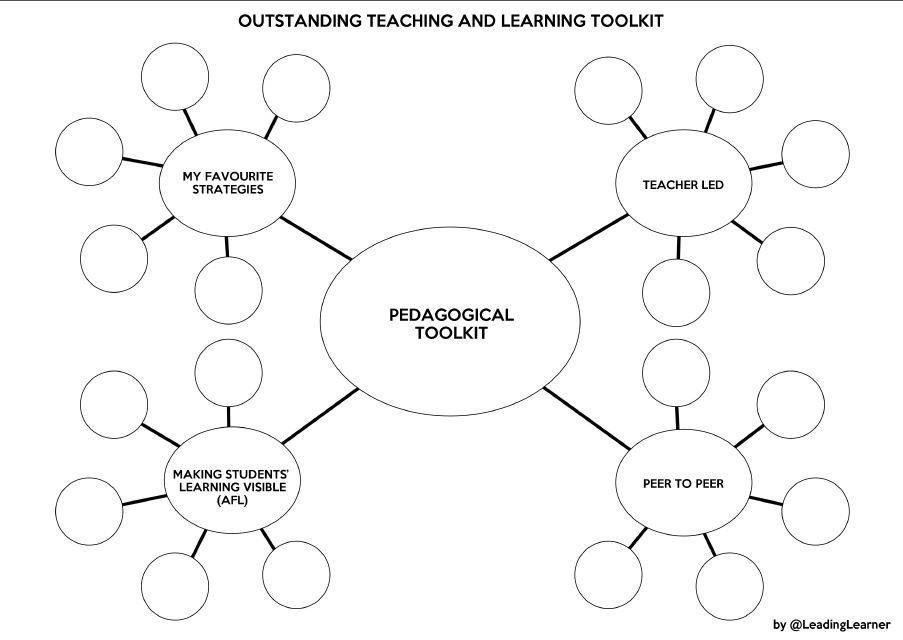
This is deliberately blank. Outstanding teachers keep the lesson plan loose. Just a few simple branches about possible different strategies: teacher led, peer to peer (group or pair work, on-line collaboration, peer assessment), favourite strategies and crucially ways of making students’ learning visible. Nothing prescriptive, nothing required just great pedagogy of their choice.
It is important to recognise that outstanding teachers have honed their skills through deliberate practice. I’m wondering whether they possibly use fewer strategies than good teachers but use them much more effectively. A key part of the CPG Programme #OustandingIn10+10 must be teachers choosing effective, proven strategies to work an and hone through effective practice.
#OutstandingIn10+10
The first ten weeks of the CPD programme is going to involve some shared lesson observations, facilitated sessions around the thinking behind and the use of the two simple tools above and starting to practice the methodology with one chosen class.
Since I’m hoping to work with three teachers, my intention in the second ten weeks is to get them to work as a teacher learning community to support each other on their evolutionary journey.
I’m hoping to possibly do some collaborative work with Ross, @TeacherToolkit, to customise the planner and pedagogical toolkit so it may be more widely used and also to pull on his experience of the #GoodInTen CPD programme to build this one in more detail. He may be too busy but here’s hoping.
I want to include a series of blog posts that teachers involved in the programme will be required to read to extend their thinking. I have mentioned a few above and others in the “Consistently Good to Outstanding” and have started a list:
- Tom Sherrington (headguruteacher) Great Lessons 7: Agility
- Chris Hildrew (Chris Hildrew) Progress In My Classroom. How it is Made and How I Know It
- Alex Quigley (HuntingEnglish) Becoming a Better Teacher by Deliberate Practice
I would be interested in your help and thoughts about what other blog posts you would suggest are included. There is going to be some great stuff out there I simply haven’t seen or have seen and forgotten. Please leave me a comment. If a lot of people leave suggestions I simply won’t be able to include them all but if you wanted to replicate the CPD programme in your own school then you can obviously chose the posts yourself.
If you would like a copy of the planner or toolkit please find the link below:
Outstanding Teaching and Learning @LeadingLearner
I’ve now turned this into a CPD Programme #OutstandingIn10Plus10.
Consistently Good to Outstanding
Reading Ross McGill’s blog post #GoodinTen – Requires Improvement CPD Programme got me thinking, his posts often do. As a school we have been consistently good, for the past decade, with increasing amounts of outstanding reported in each consecutive Ofsted Inspection but we are stuck at good. Good with many outstanding elements still equals good. The quality of teaching has got better and better, over the years, with more outstanding teaching observed through our formal lesson observation programme. However, we have teachers who have consistently been graded as delivering good lessons and they are utterly frustrated at not yet having achieved a “coveted” outstanding grade. They are also stuck at good. Continue reading
Upside Down CPD: R and D Communities
Continuing Professional Development (CPD) for teachers often tends to stem from whole school priorities around raising attainment and achievement, improving teaching and learning including assessment or responding to various local, national or Ofsted agendas. These whole school priorities tend to monopolise the resources available including funding, access to external courses and use of INSET Days.
I’ve read blogs and tweets that liken INSET days, with training on these whole school priorities from external consultant, headteachers or members of the senior leadership team, to a little bit like the proverbial being dumped on teachers from on high. Suggestions about people leading the CPD, particularly when it is about teaching & learning, include things like mirroring the strategies (the two hour talk on actively engaging students is a classic misjudgement) are important but miss a key point.

Part of our human nature leads us to enjoy and engage with issues that we have a particular interest in or ownership of. If we really want to personalise CPD for staff then we need to shift the power in the decision making process from school leaders and external pressures to classroom teachers. It is not simply improving the delivery it is moving the decision making by tipping it upside down and distributing the authority to make decisions about their own professional development to teachers. This is not an either or – too often in education in England we take an extreme position and then seek to defend it – it’s about rebalancing CPD so that teachers’ particular pedagogical and curriculum interests are afforded time and resource alongside whole school priorities.
I’ve blogged before about setting up some new Research & Development Communities in the post “Improving Teaching Not Simply Measuring It” and the proposals are now in. The basic structure behind the R&D Communities is:
- A R&D Community can be set up to develop and embed best or emerging good practice within the College.
- A R&D Community can be used to take forward an idea, innovation or approach by a group of staff that will lead to improved standards of attainment, levels of achievement, student well-being or student personal development. A R&D Community can be set up by any member of staff.
- Each R&D Community must have a named leader who will be responsible for the community, its outcomes and leading a group of staff between 3-8 people in size.
- Funding of £100 per person in the R&D Community will be made available to fund the community’s work, the leader will have their teaching commitment reduced by one period (periods are 100 minutes in length) per fortnight and supply vouchers for use by community members can be bid for.
- Funding will be released following the R&D Community’s idea and success criteria being accepted.
- Approximately half termly a voluntary meeting slot will appear in the calendar for R&D Companies that may be used if some/all of the company members wish to.
- Applications can be submitted in April/May each academic year, but no later than two weeks before the late Spring Bank Holiday and the funds will remain in place for the following academic year.
- Student research and developers may be useful additions to the R&D Community.
R&D Communities for Next Academic Year
What impact does using SOLO taxonomy in peer assessment have on the quality of formative feedback, and learner responses, over one academic year, on an English writing assessment at KS3 and KS4?
Our R&D community wishes to look at various elements of technology in teaching and map them onto the SOLO taxonomy. Similar work has been undertaken by various teachers globally with Bloom’s taxonomy which shows which tools are most useful for developing each skill area, and we would like to do the same for SOLO, providing a pedagogically sound platform for implementing the use of various technologies/web 2.0 tools/apps across the College.
How can we embed SOLO success criteria into the classroom in a way that encourages pupils to take ownership for their learning?
How far can student attainment be improved by implementing a ‘flipped classroom’ within their daily teaching and learning environment in order to accelerate their deep learning over a one year period?
The group would aim to carry out action research exploring ways by which students develop their moral awareness and “proclaiming, worshipping, service and civic duty” can be developed within the college. Initially, the group would look to identify key moral threads from the PSHE / Citizenship curriculum that could be developed and lead into delivery via the peer mentoring ‘plenary team’ introduced this year. The main vehicle for development would be through peer mentoring across Key Stages 2, 3, 4 and 5.
Narrowing the Gap for FSM students: Improving achievement through participation in enriching experiences.
I’m not sure what you think about the different proposals and the good news is it doesn’t matter. They are of interest to the staff groups that devised them. All of them could potentially “develop and embed best or emerging good practice within the College” and that was the key requirement. CPD has been flipped and turned upside down in this particular instance. Teachers have decided what interests them and been given the resources to pursue it. This is part of an increasing blend of different learning opportunities including INSET days, Thursday afternoon CPD and external and internal courses that staff may choose to go on. The R&D Communities add a dimension we have never had before and fills a gap in provision. All proposals were accepted. The SOLO Taxonomy features heavily and this is something that has been a consistent theme of development for the past three or four and there are a couple more posts on this blog about using the SOLO Taxonomy to increase challenge and how we have sought to spread and embed it.

Produced by Pam Hook (@arti_choke) http://pamhook.com/wiki/The_Learning_Process
The total funding for the six projects involving thirty four staff – thirty one teachers and three support staff – is £3,400 though I don’t think the actual spend will be anywhere near that. Teachers aren’t that great at spending money at school. In addition, one hundred and twenty three cover vouchers have been asked for. The use of the cover vouchers will need to be monitored as we won’t be able to release a large number of teachers all at once but leaders have been very clear that a number of cover vouchers will simply be used to keep staff “free” and our cover supervisors will support the release time for staff. I can almost hear people shouting about the missed classes but this cover equates to about one day per member of staff per year. This is equivalent to a one day course each, which often has no impact back at school, against what may well end up being about one hundred and fifty days equivalence of collaborative planning, lesson observations and peer evaluations with this deliberate practice developing staff’s pedagogical knowledge and skills.
The six R&D Communities are being led by two teachers who are currently Newly Qualified Teachers (NQTs) in their first year of teaching with us, three staff who have other middle leadership responsibilities and a part time main scale teacher. It’s a wonderful mix and I just think a fantastic opportunity to develop leadership skills. One of the responsibilities of the R&D Communities is to capture and transfer knowledge so I will be blogging about the successes, failures and lessons learnt by each group during next year.
What would you want to research and develop with a group of colleagues if given a £100 of funding each and a bit of time?
Leadership: Being, Knowing, Doing (New Book)

Liminal Leadership

COPYRIGHT LICENCE

@LeadingLearner by Stephen Tierney is licensed under a Creative Commons Attribution-NonCommercial-NoDerivatives 4.0 International License.
Based on a work at www.leadinglearner.me.
 @LeadingLearner