@LeadingLearner
Leadership
Journeying to Great: 2. The Purple One
I’ve just invested £14 in an attempt to make a crucial point during our next INSET (In-Service Training) Day.

We are a good school but we are not yet great. We want to be and intend to be. My role is to help discern what we keep for the next stage of our journey, what we abandon and what we tweak. The first part of the “journey” can be found in the previous post, “Journeying to Great: 1. The St. Paulsing Way”.
Having visited two great schools in the last fortnight I’m wondering whether it’s all about the Purple One. To make sense of this I need to share two different conversations that have come together (in my head at least) and will hopefully help us on our journey.
Freedom, Responsibility & Interdependence
The first great school I visited was St. Paul’s Catholic College, in Burgess Hill. I was there as part of the SSAT (The Schools Network) Redesigning Schools Programme. In conversation with the Headteacher Rob Carter (@robcarter2012) we discussed the differences between good and great schools. I started scribbling down a simple table describing schools and their “Loose/Tight” features relating to the coherence and consistency found within them. It looked something like this:
|
School Description |
Vision & Values (Coherence) |
Systems & Consistency |
|
Not Good At All |
Loose |
Loose |
|
Good |
Tight |
Tight |
|
Great |
Tighter |
Loose |
Just as a quick aside, I have deliberately not used Ofsted gradings in this table as they sometimes miss the point and certainly the gradings will confuse things here.
Rob made it clear that the “Loose” in the Systems & Consistency column, in the table I drew, was not the same in “Great” Schools and those schools that are “Not Good at All”.
In schools that are “Not Good at All” the loose systems leads to a lack of consistency and huge variability. Senior leaders have failed to get a grip of what is going on and allow unacceptable variations that lead to poor outcomes for students.
However, the “loose” in great schools relates to the freedom middle leaders had to implement the school’s vision & values in order to produce very high value-added outcomes for students as part of a holistic education. This freedom is balanced with a responsibility for ensuring high quality systems are in place – for example, tracking students’ outcomes, ensuring great teaching & learning and the professional development of staff – that eliminate inconsistency and ensure students have a great education. Middle leaders are supportive of each other and hold themselves and each other to account, in essence, they made the vision and values explicit for staff and students every day, everywhere and in every way.
“We’ve Moved from Red to Blue but Probably Need a Bit of Purple”
Move on five days and I was in Milton Keynes for my first meeting as a member of the Teacher Development Trust’s National Teacher Enquiry Network. The meeting was at Shenley Brook End School and hosted by Chris Holmwood (@LTCSBE) the school’s Senior Deputy Headteacher.
Chris told the story of Shenley Brook End’s journey from good to outstanding. One of the slides he used was:

The original idea of red/blue appears in Mike Hughes’ “The Main Thing Is Learning” and the above is an adaptation of his diagram which Chris used as part of his presentation.
In talking about the move from the red to the purple, in a hugely engaging narrative, he said something along the lines of “but you probably need a bit of purple”.
The Purple One

My mind immediately made links with the conversation the previous week with Rob. The “Loose” in great schools is a purple one. It is not simply a balance of the blue and red, as the situation requires, but it is a shifting of the determination of the response to middle leaders. They have been given and accepted the freedom to make decisions, to really lead, and the responsibility for being accountable for the outcomes.
In a school stuck at good, is the former what senior leaders are not very good at doing (giving freedom) and the latter (accepting accountability and demonstrating peer accountability) what middle leaders are not very good at accepting?
Leadership Changes as Schools Move from Good to Great
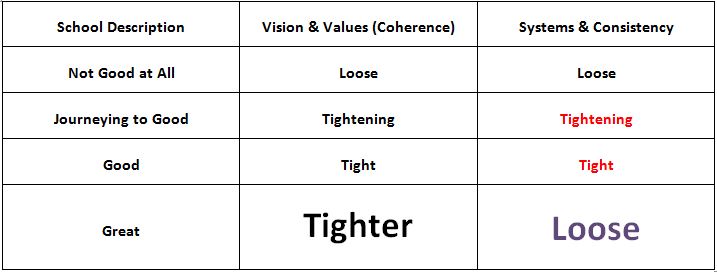
The table below is a summary of my thinking thus far with a massive assist from Rob & Chris. The table is a bit of homespun theory. I offer it, not because it is necessarily right but, because I found it useful in shaping my thinking:
Not Good at All
In schools that are “Not Good at All” there is no underlying direction or way of operating to guide staff and students and their systems are inconsistent. In short, chaos rules and people seek survival either on their own, doing their own thing or by offering each other support against a common enemy – senior leaders, staff, students, parents, Ofsted – the list of “enemies” is endless. There is no compelling narrative that is inspiring, engaging and directing the school community. The tightening might be a response to inspection or fall in numbers or new headteacher, somewhere and somehow an impetus for change must be introduced.
Journeying to Good
There needs to be an engaging vision and direction of travel expressed by the headteacher. Some practices are now unacceptable and there is a bottom line introduced. There has to be a tightening of both the coherence and the consistency but both of these may be driven by the leader, you are in the red zone of autocratic leadership. I would suggest this is neither good nor bad, it is just what is needed at this stage. Heroic leaders can be parachuted in to save the day but on their own they will only ever get the school to good. There is the introduction or imposition of protocols for lessons and possibly learners, data is introduced and used to monitor outcomes and track students’ progress and professional development is focussed. Monitoring by senior staff is the order of the day.
Good
There is a coherence and consistency around good schools that can be very comfortable. Staff are aware of the vision & direction of travel and the strong systems produce a consistency of outcomes. Middle leaders are increasingly influential. The problem is what has taken these schools to good won’t make them great. I think this is where I am going wrong! Simply doing more good things isn’t the answer – the great schools I have visited made a decision to move on in a very deliberate way.
Final Thought
Leading is a little bit like moderating students’ work, you can go on all the courses you like but as soon as you start on the real scripts they are never the same as the ones you have just moderated. What is required is an underlying understanding to guide your marking. In leadership it is the vision & values, within a school, that produce coherence for the many different members. There is an explicit narrative that describes a way of thinking and operating that guides people, in short, there is a known Way. Middle leaders can not only explain and describe the story, they embody it in great schools.
The next part of the “Journeying to Great” series was envisioned after listening to Professor David Hopkins for the first time, after 26 years in education, don’t know what took me so long!
If you are interested in reading more about the “Shenley Brook End Way”, Chris wrote a chapter in the book “Sustainable School Transformation” which describes their journey:
http://www.bloomsbury.com/uk/sustainable-school-transformation-9781780937830/
Journeying to Great: 1. The St. Paulsing Way
A bit like Schwarzenegger & Devito in the film Twins, St. Paul’s Catholic College and St. Mary’s Catholic College may not look like an automatic pairing but Rob Carter (@robcarter2012) and myself were twinned as part of the SSAT (The Schools Network) Vision 2040 Group. Our mission is to establish a clear understanding of the difference between the national curriculum and the framework it provides to the school curriculum, with its unique interpretation in our own setting and context.

Whilst the schools may seem different on first appearances the DNA running through them is pretty much identical. People in faith schools like to talk about journeys, we are a Pilgrim people – this is about journeying to become great schools, a journey and aspiration we all share as schools and teachers across England and beyond.
Having visited St. Paul’s Catholic College, I realise they are further down the road on the journey to being a great school but the vision, values and increasingly the systems at both schools are converging. This was a real comfort to me as it was hugely affirming that we are at least on the right path! There is nothing worse for a leader then to suddenly realise that you have spent the past however long taking people up a cul-de-sac or down a blind alley.

“Everything That’s Worked Well, We’ve Done Together” (Quote from a Middle Leader)
I could have easily used, “We shed blood for each other” as the quote, again from a middle leader, to launch this section as it was rooted in a similar vein of thinking. Amongst the staff I spoke with there was a clear ambition and aspiration to be the absolute best they could be: for the students, for each other and for the school. It was really infectious and the sense of enjoyment in working at and pride in the school was really prevalent, as was the positivity that seemed strong and widespread. Staff had agreed that there were certain things which needed consistency, for the sake of the students, rather than pursuing their individuality.
An example was the adoption of a common teaching protocol based on the Accelerated Learning Cycle with lesson objectives focused on content, process and benefit. I heard this first from senior staff and then an identical response from middle leaders. Students were able to talk to me about the 5Rs, the colour coded badges for top performers in each of the Rs and then there were posters around the school reinforcing the message. The teaching & learning protocols and approaches are all connected up. There is a shared language of learning and a real focus on the core business. Another area of consistency was their collective effort to ensure no-one was left behind. The college has a large number of statemented students and at 7.7% it is well above national average. The systems it has for tracking students’ progress, intervening and supporting students was well known by staff and hugely appreciated by students. There was a sense that even if you wanted to fail at St. Paul’s you wouldn’t be allowed or able to. Impressive!
“Rob’s Relentless, Positive & Proactive”
There isn’t an externally imposed aggressive “doing to/you must do” approach but rather middle leaders leading the accountability agenda and committed to quality assuring the work they and their teams do. They were very conscious of not letting anyone down and making sure they contributed to the team effort – it intrinsically drove them on towards even greater excellence. As one middle leader stated, “It’s a different kind of pressure”. In great schools it seems it is the middle leaders who assure quality and hold themselves and each other to account. I sometimes think we still have a bit of a “wait until your father gets home” (me being father) at St. Mary’s which is why we’re stuck at good. By the time I’ve noticed what’s going on it’s usually miles too late! Taking this idea further, in World Class schools, I wonder whether it is every teacher, in every classroom who holds themselves and their colleagues to account? I’ll develop this theme in a future post on “Journeying to Great”.
“Keep the Principle, Change the Practice”
Over time the school has changed and evolved by challenging themselves to do better whilst also looking outside benchmarking and learning from other great schools. Values run deep, the language is about: care & support, respect & forgiveness, enthusiasm & passion for learning and challenge & choices. With workforce reform a small army of support staff entered schools but at St. Paul’s the boundaries of who does what have merged. This keeps the focus on the students and also means the career development of staff looks more seamless than in many schools. This approach is enhanced by their Teaching School status which has led to a “grow your own” approach to teachers, leaders and future employees in general.
For leaders the principles, vision and values keep the direction secure and empower leaders to do “whatever is needed” in pursuit of their goals. This encompasses many small changes the one percenters, for example:
- The introduction of twenty minute “butterfly INSET” for staff,
- The use of tablet technology for the whole of Years 10-13 with notebooks for Years 7-9 with an impressive use of the technology as you walk the school
- Direct contact with parents via e-mail, no waiting around asking permission or going through pastoral staff
There was a “ruthless simplicity” to the approach, they kept “the main thing the main thing” and didn’t get diverted or waste energy on needless issues or overcomplicated systems. It is a school that has developed an improvement mentality and momentum.
“We Have a Real Knitting Teacher”

Stars of the show – Hollie, Alice, Will, Dom, Freddie & Phoebe
Whilst this might not be the rallying cry of many Secretaries of State, HMIs or Ofsted Inspectors, the students who were talking to me about their Wednesday afternoon enrichment options were genuinely excited. Walking around St. Paul’s you can’t fail to be impressed by the Art work, it is simply stunning. At a time when departments whose core business is creativity are being side-lined and downsized the creative curriculum at St. Paul’s is alive and well. The Wednesday enrichment afternoon with its huge variety of options, the vast number of sports (I couldn’t write quick enough to get the full list) and the many extra-curricular opportunities talk of a school that offers its students so much more than a purely functional curriculum.
There is a richness to what is on offer to students that is part of the rounded development of them as people.
The St. Paulsing Way
Chatting with students and the staff a common thread appeared around the “St. Paulsing Way”. I first heard the expression talking to senior staff. When I asked students about it they all started laughing and just said, “yes” and middle leaders nodded earnestly.

Many examples were given including my personal favourite Guardian Angels which just really appealed to me. It involves two or three Year 10 students who support each Year 7 form by just simply going along and playing games and getting to know them. The fruits of this are borne in on-going relationships as these students more into Year 8 and then eventually to them becoming Guardian Angels themselves. The process is generative. This led onto a discussion around student leadership, the importance of the Student Council and Sixth Form Committee and how both the council and committee focused on others not just themselves – a commitment to charity work and organising events for younger students “We’re big on community”. The St. Paulsing Way seems to be focused on the needs of the individual within a community context that is supportive, enriching and aspirational.
Relationships are at the core of everything at St. Paul’s and this chimes with St. Mary’s, it’s the sixth R.
Journeying to Great
I’ll remember not only the warmth and openness shown by all the people I met at St. Paul’s but also their passion for working at and on behalf of St. Paul’s, the cohesive community made up of students, staff and parents. Rob is clearly the Guardian Angel of this spirit and the support given to staff is as generous and fulsome as that provided to students. The visit inspired me to think about “Journeying to Great” and will be at the root of the next series of blogs. Special thanks go to Rob for his hospitality and to Debbie, Darren, Laurie, Matt, Peter and Sue for their time on a mad busy school day … the journey continues.
The next blog post in this series is:
Journeying to Great: 2. The Purple One
If you would like to read Rob’s post about his visit to St. Mary’s it is here, “The Power of Collaboration”
Preparing and Applying for Your First Headship
I wrote the following article for the Guardian. I have added a few of the tweets, I got when I used twitter to get some ideas, on what people thought was the best advice for applicants for their first headship.
Nineteen ninety nine seems a long time ago but it was then I made my first application for a headship. It was a bit of a false start as I actually withdrew the application having visited the school. This is no reflection on the school, which was excellent, but I hadn’t fully thought through uprooting my whole family and moving to a different part of the country. My next applications were more considered and after not getting through to the second day of the first post I was interviewed for I was the only person taken through to the second day at St. Mary’s Catholic College, where I have served as Headteacher for the last thirteen years.
The Need to Match the Visions
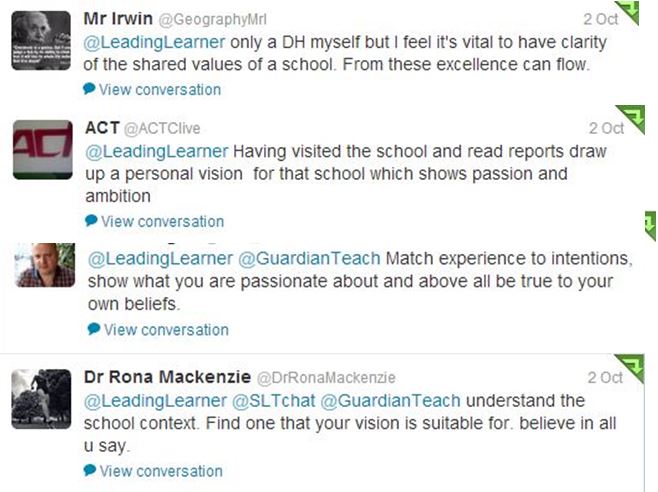
It’s interesting reflecting back on the only two experiences I have of being interviewed for headship. The feedback from the first school was that they thought I was far too radical in my thinking and not in touch with reality. They may have been right. At St. Mary’s they were looking for a leader who would help develop a new vision for the school and lead it into the 21st Century. This isn’t about good school/bad school or good applicant/bad applicant, this is about matching your vision and aspirations with those of the school and governors that you will be working with and for. If the visions don’t match the school, governors and headteacher are all in for a torrid time. Imagine being in a boat with everyone rowing in a different direction, that is conflicting visions for you. Governing bodies aren’t always confident or sure in articulating their vision but they know an engaging and inspiring vision when they hear one. This is a key area for any aspiring headteacher to consider. If you can’t articulate your vision to a friend or relative or yourself in the mirror you are not yet ready to lead a school.
Are You Ever Ready? You’ll learn.
With the exception of vision I think that you have to accept that there is no preparation for headship quite like actually being a headteacher. You need a good knowledge of: how schools work; structures and systems that ensure good order and high standards of teaching & learning; the ability to work with and influence people and an abundance of resilience.
What I knew about premises and finance, when I became a headteacher, you could write on the back of an envelope and a not very big one at that. Over the past thirteen years I have had overall responsibility for £30 million of capital building programmes and £80 million of recurrent funding. Another worry for applicants can be personnel issues that go beyond the difficult conversation into formal procedures. Outside of a few difficult meetings, where I had been alongside the headteacher as a “professional development opportunity”, again my experience was limited. Remember to follow the policy, make sure you have a good HR provider and be calm and balanced in your approach, you will grow in confidence with experience in time.
Headship is a Team Game
I hope we have eventually given up on the myth of the heroic headteacher who gallops in to save the day single handed. Headship is now more about the team than simply the individual. Make sure you meet the senior leadership team of the school you are applying for and consider whether this is a group you can work with. I would tend to keep it social and just get a feel for the group and start to build the relationships. Most of all be yourself, it is who you bring to genuine and authentic leadership, and it has already got you to deputy headship.
Fewer Better Applications
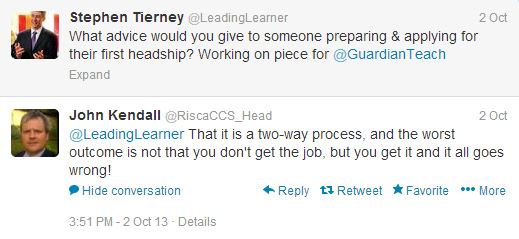
A few high quality applications are more likely to succeed that trying to send in a generic application for lots of headships. This is a major decision and you have to get it right. Research the school well, visit it prior to applying if you can and make sure the application is totally personalised to the school. We recently appointed three assistant headteachers at St. Mary’s. All of them, along with a number of other potential applicants, visited the school before applying and took the time to write highly personalised letters. These are the people you want working at your school, these are the type of people you want leading your school.
Interview Days
This is likely to be a pretty gruelling few days with a series of panel interviews, data tasks and presentations. I was successfully interviewed for the Executive Headship of St. Mary’s Catholic College and Christ the King Catholic Primary School, earlier this year, but I had no idea how many other candidates would be invited for interview. The poor governors may have to listen to presentations all afternoon. I wanted to make the point that if we wanted to be outstanding we were going to have to do something different and that the skills I had acquired as a secondary headteacher would be transferable to the Executive Headteacher role. The opening two minutes of my presentation was a card sort of the characteristics of outstanding primary and secondary schools taken from two Ofsted documents. It was only after they had sorted them into a couple of groups and noticed all the repetition that I explained where they had come from. Doing something different and my skills are transferable. Please don’t fall into the trap of gimmicks but look for the opportunity to let your light shine out from the crowd. If you’re not successful then maybe it just wasn’t the job for you. Remember to learn from each experience, keep a record of questions asked and tasks given and good luck, I hope the right school is out there for you.
If successful you may be interested in the post, “First Hundred Days of Headship”.
And here are a cryptic one (not sure what Dave Carter is up to – I can now reveal it was a reference to the early entry announcement and the challenges facing Headteachers.) and an out take:


Leadership: Being, Knowing, Doing (New Book)

Liminal Leadership

COPYRIGHT LICENCE

@LeadingLearner by Stephen Tierney is licensed under a Creative Commons Attribution-NonCommercial-NoDerivatives 4.0 International License.
Based on a work at www.leadinglearner.me.

