@LeadingLearner
Redesigning Classrooms
To Outstanding with #OutstandingIn10Plus10
Over the past few weeks I’ve been blogging about outstanding lessons and what makes them different. My starting point was Ross McGill’s (@TeacherToolkit) blog post #GoodinTen – Requires Improvement CPD Programme and with his permission I’ve “borrowed” the approach.
In putting together this post I just want to echo some of my previous reflections. This isn’t about a quick fix to outstanding nor will it be the end of a journey for the teachers involved. As leaders, we must all be “people developers” and helping people take the next step, even when there is a long road ahead, is part of what we do. There is a danger that we are paralysed by the uncertainties and imperfections of the plans we have constructed. One of our Deputy Headteachers likes telling the story of the frogs on the lily pad.

“There were there frogs sat on a lily pad and they all talked and thought about jumping off. How many frogs left on the lily pad?”
Answer: Three, they only talked and thought about jumping off, no-one actually did it.
So to action … I’m hoping to find at least three willing colleagues at St. Mary’s who meet the following eligibility criteria which have been kept to an absolute minimum.
Eligibility Criteria for Involvement in #OutstandingIn10Plus10
- Your teaching must have been consistently graded as good but you must never have been given a grade 1 (outstanding) for your teaching at the College
- You must be prepared to give up the good things you do to do outstanding things (another borrow, this time from @dylanwiliam)
- You must be willing to attend and actively engage in additional voluntary CPD sessions over a ten week period (this is the first 10 weeks of the programme)
- You must be prepared to work in a collaborative triad (Teacher Learning Community) as a critical and supportive friend (this is the second 10 weeks of the programme)
Outstanding is not simply doing more good things it’s doing different. It involves a mindset shift.
- Absolute clarity of how knowledge and understanding are vertically integrated in your subject and helping students to work at a conceptual level. The teacher needs to be working there first.
- Keeping the lesson plan “loose” so that you can respond to the learner as s/he makes their learning visible to you at the beginning, during and end of lessons.
The following table and the thinking behind it attracted quite a bit of interest when I first published it:
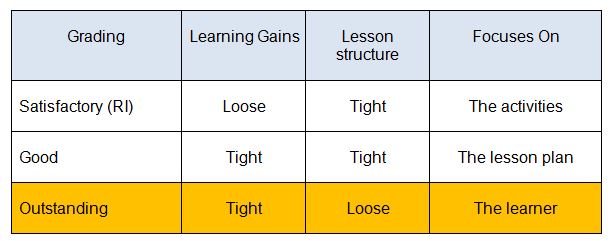
Keep the Learning Gains Tight and Lesson Structure Loose
#OutstandingIn10Plus10
First Ten Weeks of #OutstandingIn10Plus10
The first ten weeks will be about starting the process of changing people’s mindsets and breaking with old habits.
CPD Activity 1 (Week 1) – Outlining & Committing to the Programme
Prior to the session I will be asking participants to read the two posts written prior to this one about outstanding lessons:
This first session is centred around exploring the difference between good and outstanding lessons in terms of what teachers do. What each of us does is within our own control, we have a choice – keep doing it or change, this is the challenge for good teachers if they wish to move to outstanding. Once we start to understand what teachers, who are consistently graded outstanding do, we can start on our journey, albeit a long journey, to join these outstanding colleagues. I will also be asking the participants to identify a class who are going to be the focus of their efforts, in developing outstanding pedagogy, during the second ten week section of #OutstandingIn10Plus10.
CPD Activity 2 (Weeks 2-3) – Joint Lesson Observations
One of the most powerful ways of enabling teachers to reflect on their own practice is to observe a lesson with them. I have found this far more powerful than ever reflecting with them on their own lessons. When we are reflecting on our own lessons there is just too much emotional attachment to the lesson and the outcome for us to clear our heads and look at our teaching with sufficient clarity. Being able to discuss in real time a lesson, as it is happening, the teaching and the response of students is a real eye opener for many staff.
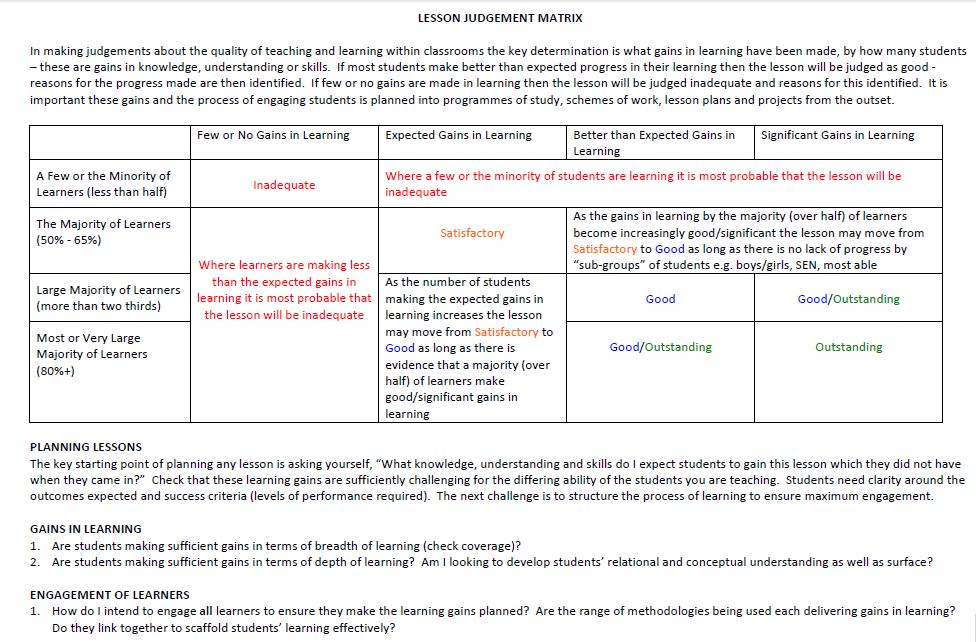
The above table I carry around in my pocket and have used for years with teachers to look at what happens in the classroom. It just has two main themes – “gains in learning” and “engagement” in terms of how many students are making these gains. It is limited in many ways but really helps staff focus on the students and their learning rather than the teacher and the activities.
CPD Activity 3 – (Weeks 4) – Focus on the Learning
Participants will begin to use the Outstanding Teaching & Learning Planner. This will be the longest session and I’ve written most about it – this is no coincidence as it is at the core of the programme.

The focus in this session will be to help participants understand and develop the skill of setting challenging learning gains in a way that ensures lesson time: is maximised for learning, focuses on key concepts linking it to the critical knowledge required prior to building a deeper understanding and then moving back to those big concepts. It will also be about ensuring that the learning is vertically integrated in and across lessons.
Big Picture
Key concepts (including common student misconceptions) and big ideas must be clear to the teacher first if they are ever going to be clear to the learner. Teachers must start with the topic’s important concepts, common misconceptions and big ideas – the end points must be clear in the teacher’s mind and should be recorded in the “Big Picture”
Stickability
This section is about the fundamental aspects of the lesson or topic students must learn and upon which further progress in the subject or area will be built on. This is then expanded in more detail in the “Challenging Learning Gains” section.
Challenging Learning Gains
Knowledge & Understanding
One of the most effective and influential pieces of CPD we have delivered at St. Mary’s is around the SOLO Taxonomy and these two previous posts will be pre-session reading:
- Redesigning Classrooms: Using SOLO to Increase Challenge
- Redesigning Classrooms: Spreading & Embedding the SOLO Taxonomy
I would also add to this Chris Hildrew’s blog post on progress.
It is critical for “teacher clarity” that each teacher knows exactly what knowledge is required and how the different pieces of knowledge relate to each other, if they are to help students build a deeper understanding of the subject. The SOLO Taxonomy is ideal for this.
Subject Procedural Skills & Habits of Mind
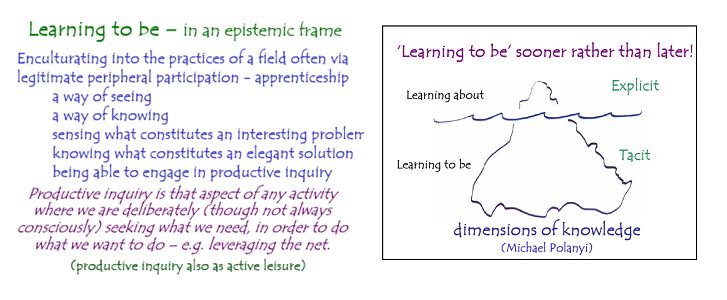
Subject procedural skills and habits of mind (what Seeley Brown terms “learning to be” rather than “learning to do). How will you help your student become mathematicians, linguists historians etc rather than making them do Maths, English or History. Make a note of the key skills students will learn or practice during this topic.
Attributes & Skills of Learners
We all have a responsibility to help create effective learners taking them from novice, to advanced and eventually expert learners as they progress through the school. Include here the attributes that students will need to develop, we use the 5Rs – Responsible, Reasoning, Reflective, Resourceful and Reflective Learner – plus key elements of literacy and numeracy that form part of a cross curricular approach to developing these skills.
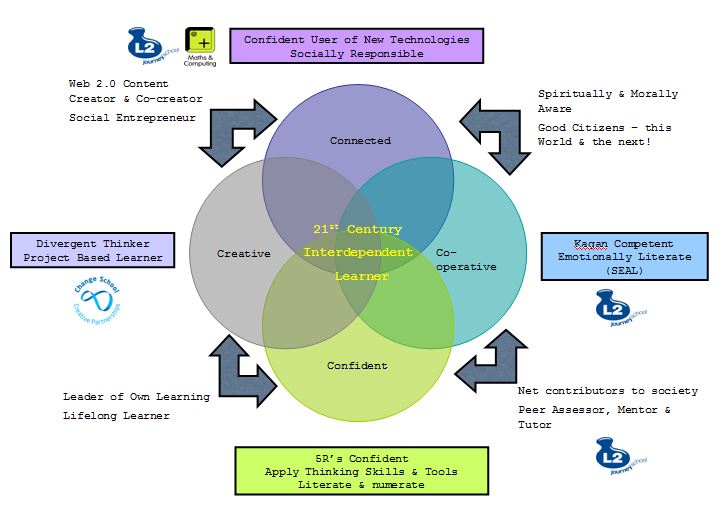
These three elements form the DNA of learning in the 21st Century in a balanced way that is far more coherent then the knowledge versus skills debate which simply misses the point. I blogged about this in more detail in “Vision 2040: Learners at the Centre III”.
These will be the “challenging learning gains” for the class identified as the focus of the new mindset and habits of the teacher during the second ten week period.
Making Students’ Learning Visible
This title is a tweak of John Hattie’s “Visible Learning”, there are now two books that are a must read for teachers.
Success Criteria
Once the teachers have clearly identified the learning, they will need to also be clear how they expect students to evidence it in and across lessons. How will the gains or lack of gains be visible to them? How will students be evidencing these learning gains?
Assessing Prior Learning
Many of the outstanding teachers I talked to had simply ways of seeing where students were up to in their learning at the start of topics or lessons. In this section teachers need to record how they will do this in an efficient and effective way. A simple consensus map or examination question at the beginning of a lesson would help a teacher see the starting point for the lesson – remember that by now participants in the programme will have a very clear vertically integrated map of knowledge, understanding skills and attributes firmly fixed in their head, they will be able to start the journey from where the students are.
Assessing On-Going Learning
How will you keep making the students’ learning visible throughout the lesson and as it draws to a close. Again participants will need to keep it simple, for example, pausing for students to add to the consensus map or redo parts of the question but always keeping an eye on what responses students are giving and comparing them to the success criteria already identified.
Flow
I think this is a great way to describe what happens in outstanding lessons, the learning and lesson just flows. This will need to be a simplified plan, limited detail, of how the various stages of the lesson and the learning connect to each other.
Just a note here, the above planner can be used to focus on learning in one lesson or across a number of lessons but outstanding teachers would often find this a false dichotomy. Their mindset tends to be, “this is what I want my students to learn”, with the pace of the learning then determined by the learners’ progress rather than the teacher’s plan.
CPD Activity 4 (Weeks 5 & 6) – Clarifying the Learning with Peers
Once the planner is understood by the participants they will need to work with other subject specialists or colleagues from the same phase to really detail and refine the learning gains expected.
This will hopefully be a really rich discussion about the learning not the activities, just the learning, what to include and how and why it will be sequenced in a certain way. I think and hope that departmental meetings are focussed on this type of activity, it is critical to the development of teachers and the transfer of knowledge between them. Sadly too often departmental meetings get sidetracked too much into administrative areas rather than the development of teachers. I will be encouraging the participants to discuss using a departmental meeting to focus on the topic so that they can get constructive feedback from colleagues and build a shared understanding of the learning gains expected.
CPD Activity 5 (Weeks 7 & 8) – Pedagogical Toolkit
Essential pre-session reading will be Tom Sherrington’s blog from his Great Lesson series: Agility
The outstanding teachers, I talked to, tended to be far more selective about the pedagogical strategies they used and took from various INSET sessions, in essence, not all that glittered was gold. This selectiveness meant they would hone, sometimes over months and years, particularly useful strategies that became like second nature to them. They could easily pull a number of different strategies, almost effortlessly, from their pedagogical toolkit bag and employ them when required. This in term limits the planning linked to approaches and activities compared to good teachers and allowed the lesson structure to remain loose and responsive to the learners.
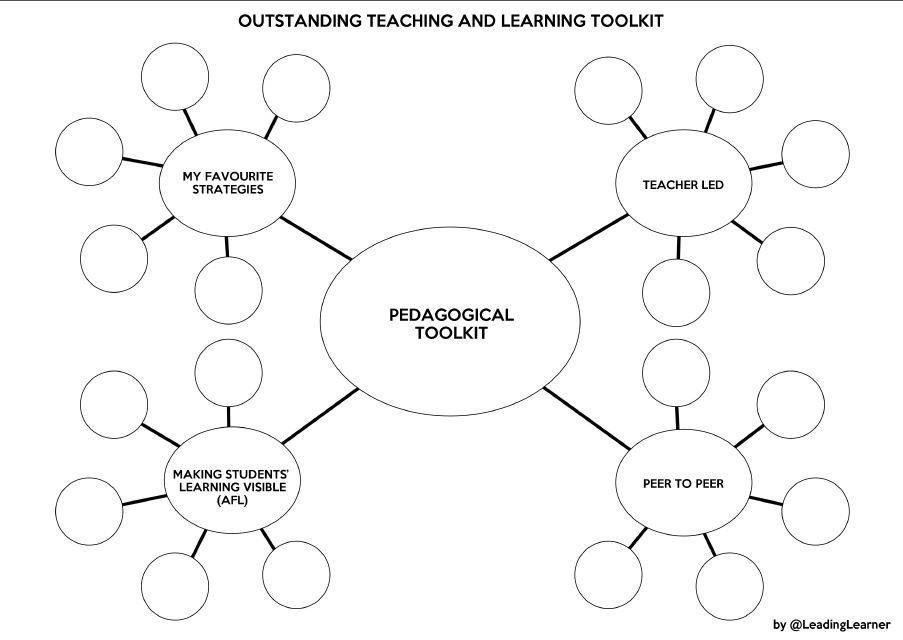
The session will focus on teachers identifying strategies they are particularly skilful at and a few they want to develop. Time need to be spent on the “Making Students’ Learning Visible” bubble as this will be key to checking progress within the lesson.
Post session reading will come from Alex Quigley (@HuntingEnglish): Deliberate Practice
CPD Activity 6 (Weeks 9 & 10) – Project Based Learning
I’ve blogged about this before: “Project Based Learning Not PBL Lite”. What is really important if you have a moment to look at the blog is how all the above elements linked to rigour and the development of knowledge, understanding skills and the learner all come together in the project. It is another way of getting teachers to hone their new skills. This can be focussed on the chosen class or, time permitting, another class the teacher is responsible for.
Second Ten Weeks of #OutstandingIn10Plus10

CPD Activity 1 (Weeks 1-3) – Teacher Learning Community Cycle 1
It’s important to remember these are already good teachers and they are capable of organising themselves and learning with and from each other. The CPD Programme has already got them to identify a class and working in triads they will:
- Discuss Teacher A’s plan prior to the lesson
- Observe the lesson and formatively assess it – strengths and areas to develop, no grading
- Feedback to Teacher A and discuss how the lesson could have been improved in terms of challenging learning goals and making the learning visible.
CPD Activity 2 (Weeks 4-6) – Teacher Learning Community Cycle 2
Same again but this time the focus is on Teacher B.
CPD Activity 3 (Weeks 7-9) – Teacher Learning Community Cycle 3
Same again but this time the focus is on Teacher C.
CPD Activity 4 (Week 10) – Graded Lesson Observation
I’m guessing that this won’t work this smoothly in reality but the plan gives a direction of travel and structure. As ever blogging has helped me to organise my thoughts. It may be possible to achieve two cycles in an academic year starting one in late September and the other in January.
As time goes by I hope to refine the approach, I think everything here is open source and if anyone looks at implementing in their own school a comment or two below would be really helpful to help me make the required amendments.
After trialling and refining this it will be time to “Train the Trainers”. Three trainers could work with nine staff, nine trainers with twenty seven staff and so it goes. My hope is eventually it becomes part of our ethos – the way we do things around here – rather than a CPD programme.
Enough thinking and blogging, time to jump off the lily pad …
A PDF of the planners is here:
A Mid-Summer Night’s Twitter
I can take no credit for the ideas below, the quite wonderful English Department at St. Mary’s has put it together with Miss Preston taking a lead. My only part is to blog it out and push it on twitter. I hope that it might help engage young people in reading, help develop their literacy skills and give you some food for thought along the way. The basic idea is to use twitter as a way of sharing pictures of students reading books in all the wonderful places they will visit this summer. The scheme has been launched by the English Department and form tutors have used a PowerPoint provided by the department to publicise it during form time.
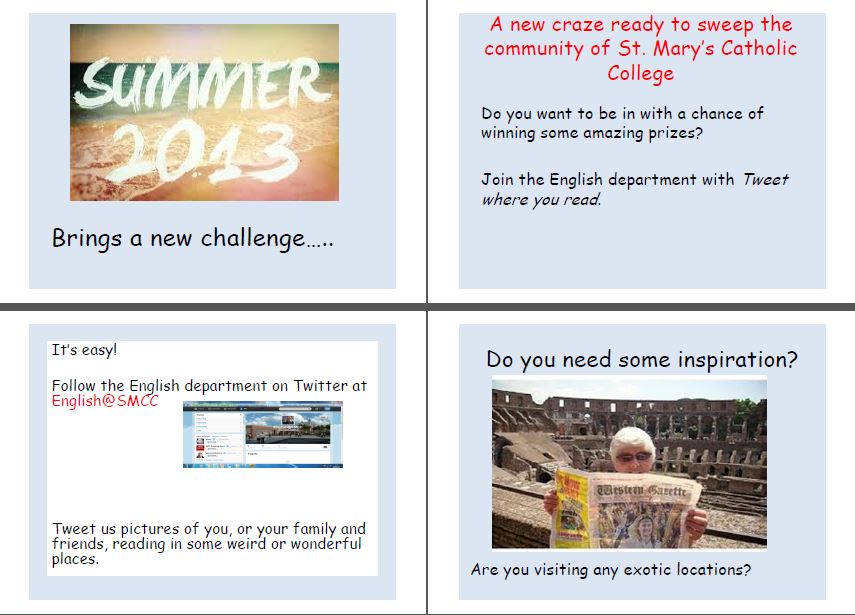
Due to recent changes in the English GCSE curriculum, the issue of literacy has never been more prevalent. With this in mind, the English Department at St. Mary’s have been working tirelessly to begin to address this issue. The students will often score full marks on literacy starters and can easily spot simple errors when asked to do so. Yet the fact remains, they don’t apply this to their own writing. Many of us were born in a generation where literacy was never taught in the classroom, yet we “got it” as the students would say. What made us different to the students we are now encountering on a daily basis? During a recent departmental meeting, the same issue continued to crop up, like the often quoted elephant in the room: reading.
To put it simply, the children just didn’t do enough of it. Or if they did, they were often too embarrassed or reluctant to admit having a huge passion for books. In the pressurised climate of reaching end-of-year target grades, we often only have the chance to study one novel per year with our students. The question we had to ask ourselves was this: how could we encourage the students to read outside of the classroom?

“They’re too busy on the computer to pick up a book,” people often lament with a look of horror on their faces. At St. Mary’s, we pride ourselves on encouraging the use of new technologies and don’t see the use of the internet as a negative thing. The challenge we found ourselves facing was this: how can we incorporate the two? Alongside two other members of staff, we began researching ideas, and read about schools who had asked students to take pictures of themselves reading in exciting places over the summer break. We liked this idea instantly, but felt that we needed a hook to excite our technologically savvy students. This is where the idea for ‘Tweet Where You Read’ was born. We do not profess to have been the creators of this idea (if only for fear of copyright infringement), and I’m sure that similar schemes have been run before, but we felt excited and confident that students would really engage and, dare we imagine, enjoy this.
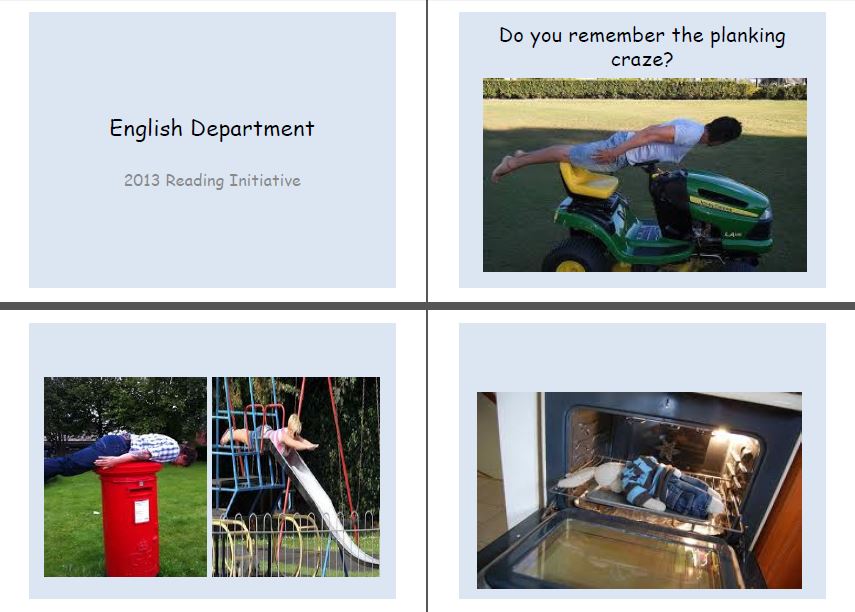
I put together a simple, yet humorous, PowerPoint (PDF copy at the bottom of this blog), featuring staff in some weird and wonderful places with their favourite books. We laughed immensely and hoped that the students would too. However, as we all know, adults and children often have contrasting views about what is funny and I was concerned that students would not be interested in the idea.

In preparation for this rejection, I decided to trial the PowerPoint on my most ‘challenging’ and hard to please Year 10 class. To my delight, they howled with laughter and frantically began sharing their ideas for where they would be ‘snapped’. This was yesterday morning and we now have 31 followers to our English@SMCC account. We are confident that the number will grow increasingly over the next 7 days.
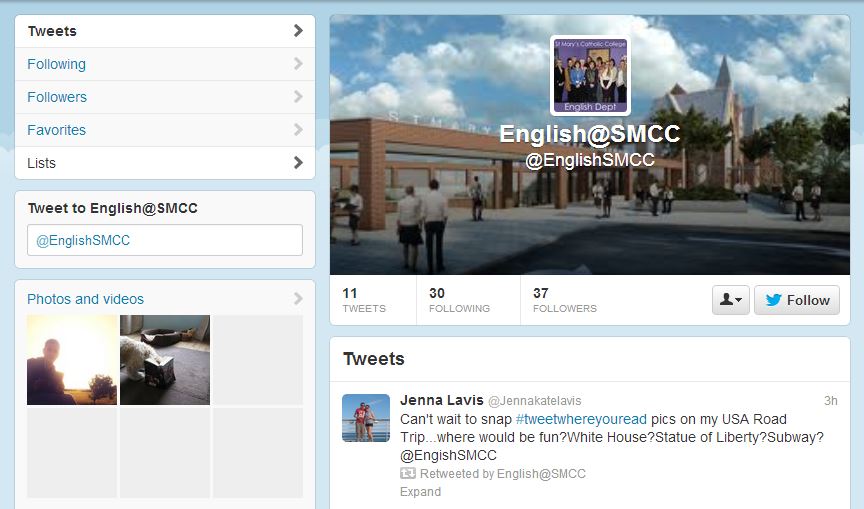
Whether this will be a success or not still remains to be seen. Students have been given the summer to submit their entries and a winner will be announced in September. What is evident, and in my eyes already makes this successful, is that students are already talking about books. I have no doubt that some of our students will be snapped in a weird place and yet never even open the book they hold. Nevertheless, the fact remains that some of them will open their books and may even read them. Who is to say that once they discover the sheer joy of independent reading they won’t continue? Only time will tell.
Clearly this is an idea that can be extended by asking students to start a blog site and write a review of their book. The winner of the best blog can be announced alongside the winner of the twitter award. A boost to reading, writing & literacy with the advantage of young people constructively occupied and a few less hassled parents. This must be a winner.
English Department Reading Initiative
If you want to tweet a picture of you reading to the English Department I’m sure they will happily retweet all those pictures that are in good taste.
The #5MinMarkingPlan by @TeacherToolkit and @LeadingLearner
Marking is an occupational hazard for all teachers. Whilst the “5 Minute Marking Plan” can’t do your marking for you (sadly) it will help you focus on the job in hand and help ensure you maximise your students’ learning and your own.
This planner adds to a growing number of 5 Minute Plans produced by @TeacherToolkit including the “5 Minute Lesson Plan” and the “5 Minute Assembly Plan” which are available on @TeacherToolkit’s website.
The thinking that underpins the plan seeks to highlight those elements of marking that have greatest impact on learning, namely:
- Sharing the key marking points (you may refer to these as success criteria). A student is much more likely to be successful if s/he knows where they are going. This is all part of teacher clarity
- Giving clear feedback to students about their work, comments only marking, but crucially making sure they respond to your marking by correcting their work or re-doing it, using your comments to guide them, to a higher standard
The time spent on marking students’ work must also help you identify common errors, so you can:
- Require students to correct and improve their work
- Re-teach elements of the lesson, scheme of work, programme of study or syllabus to help close key gaps in students’ knowledge, understanding or skills
- Inform future teaching programmes
The “5 Minute Marking Plan” and an explanation of how to use it is available to download below:
Five Minute Marking Plan – version 3.1 – PDF
Five Minute Marking Plan – version 3.1 (PowerPoint)
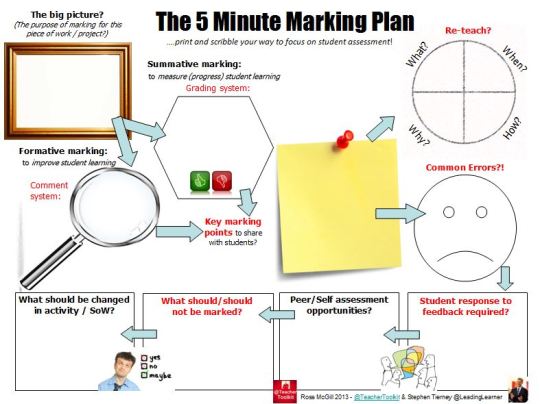

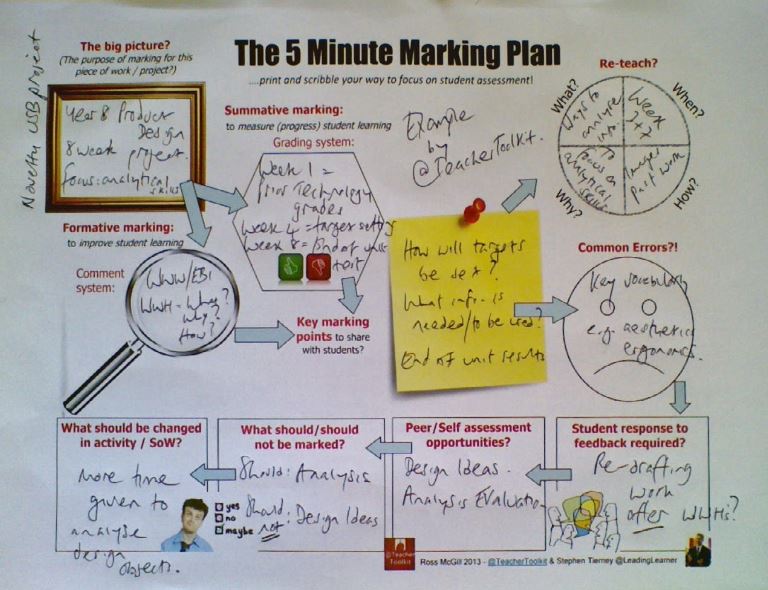
Context – (What each area means?)
The big picture? What is the purpose of marking for this piece of work / project? Try to be clear right from the beginning how the time you spend marking will improve teaching & learning.
Summative marking – Grading system: Are you going to use GCSE or A-level grades? Is it levels or have you started to think about a post-levelling world? Is it a numerical mark out of 10 or 20? Does the school, department or phase have an agreed system for teachers to use?
Formative Marking – Comment System: Do you have an agreed way of giving comments on students work – www (what went well), ebi (even better if), ioti (in order to improve), three stars and a wish? Have you given thought to numbering / lettering the key marking points, shared with students, so teachers can give comments via numbers / letters instead of writing out comments in full? Will you annotate the piece of work by putting the numbers / letters against the corresponding questions / text?
Key marking points to share with students? This is absolute critical. First of all teachers and then learners need to be clear what marks can be gained for. It’s all about teacher clarity. Sharing the key marking students with learners before they start the work will really help improve their work. Don’t forget to include a bit of “spoof assessment” to help learners understand what the key marking points are. You can give learners two answers of different quality and get them to assess them using the key marking points – can they grade / level the work and give reasons why. Another approach is to give them the different pieces of work and get learners to rank them and identify the main reasons why one was better than the other – can they give you the key marking points?
Common Errors – identifying common errors across a number of learners’ work is an important part of diagnostic assessment and links to other parts of the #5 Minute Marking Plan – Re-teach, Student Response to Feedback and What Should be Changed in Activity / SoW .
Re-teach – is there an important part of the module, topic, lesson that learners just haven’t got. Don’t worry it happens to all teachers. The important thing is to spot the “gap” in learning and then go back and address it again. Plan the re-teach: What, When, How & Why?
Student Response to Feedback Required? – Once you’ve spent time putting comments on learners’ work they must go back and either correct errors or redo areas of their work that needs improvement. A good strategy is to give students time to correct / redo the work during the lesson when the work is handed back – this is a key part of them improving and learning. Think about it, every student has a personalised action plan of ebi / ioti / a wish (or two) to work on.
What should be Changed in Activity / SoW – Is there a gap between the learning you wanted and what actually happened when you looked at the work submitted by the learners? Think about the activity or scheme of work – are some tweaks needed or a major rethink? What do colleagues think who have also taught the activity / SoW? This is a powerful way to improve the teaching programme whilst things are still fresh in everyone’s mind.
Peer/Self Assessment Opportunities – Learners need to develop these skills and it’s worth investing time in particularly as part of a whole school / department / phase approach. Make sure the learners have the key marking points available to them. Try to get to the point where before you mark a very important learner’s piece of work it has gone “self, peer, self” in terms of assessment & improvement before you look at it.
What should/should not be marked – This can be a hard one for teachers. We want to mark everything but quality and quantity can create problems. Go back to “The Big Picture”. Why are you marking, what will add most value to the teaching & learning?
Remember, there is no need to complete every box they are there as a guide for you to use.
With special thanks to the staff at Grieg City Academy who tested an early draft of the plan and to Sam, Cathy, Jenna and Clair who produced a set of Key Stage 4 exemplars (PDF Resource) in just over five minutes, which is great going for the first attempt at using the plan, at very short notice.

With a bit of practice the plan becomes more familiar and easier to use – we may need to rename it the “Sub 5 Minute Marking Plan” before too soon.
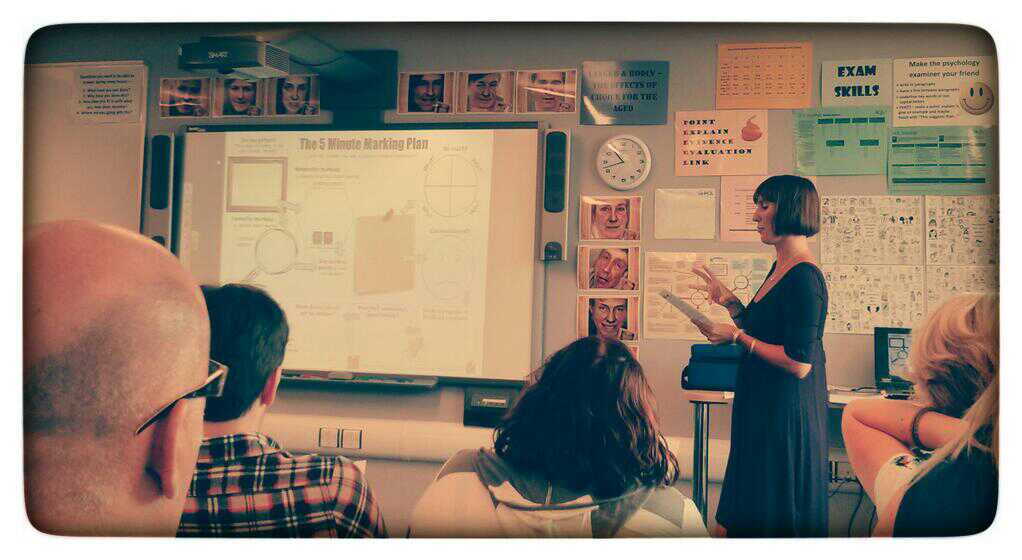
The last few weeks has been my first major “collaboration in the ether” with @Teacher Toolkit and this has been central to producing the marking plan. I hope it won’t be the last as genuine collaboration can not only be great fun but benefits both parties. If you ever want to show the power of collaboration here is the first draft that @TeacherToolkit and @LeadingLearner managed to produce. What an evolution!
The College’s Marking Policy is here and contains a bit of “pull, push and nudge” to try to ensure quality marking & feedback is given to all students.
Leadership: Being, Knowing, Doing (New Book)

Liminal Leadership

COPYRIGHT LICENCE

@LeadingLearner by Stephen Tierney is licensed under a Creative Commons Attribution-NonCommercial-NoDerivatives 4.0 International License.
Based on a work at www.leadinglearner.me.
 @LeadingLearner