@LeadingLearner
Uncategorized
#WhatstheProblem
If “what works is good” (MW) then what doesn’t work must be bad.
I wonder how often, as leaders and teachers, we ask ourselves the simple question #WhatstheProblem – in my school or in my classroom – in a reflective and evidenced way?
This stream of thought was set off last July by the irrepressible Professor David Hargreaves who was talking to a group of aspiring senior leaders on the SSAT Leadership Course. I’m the course leader hence my attendance at the event. His presentation was on the Self-Improving School System and at one point he was talking about the difference between Joint Practice Development (JPD) and Sharing Good Practice (SGP).
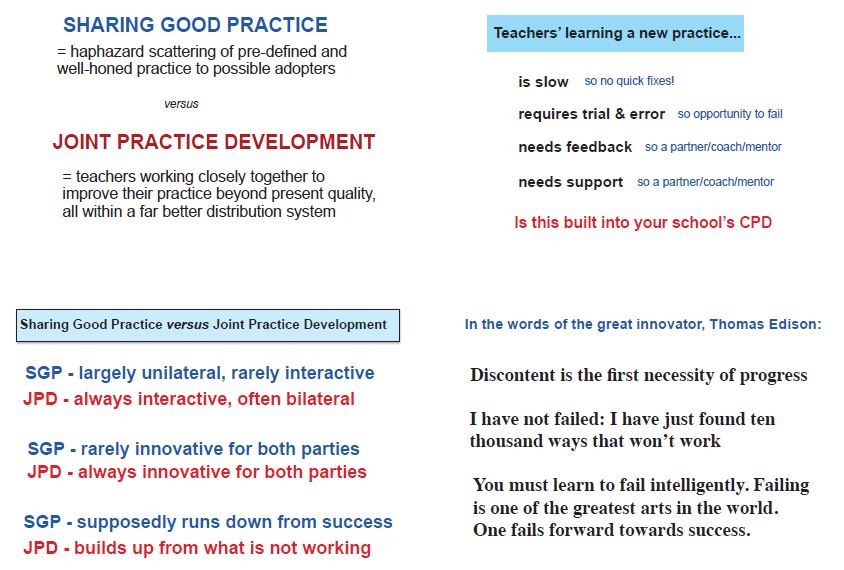
Listening to David I had one of those “light bulb, road to Damascus” moments but also a sinking feeling in the pit of my stomach. Have I spent the past thirteen years as a headteacher and before that as a senior/middle leader and classroom teacher essentially solving problems that didn’t exist or using the wrong solution for the rightly identified problem?
Sharing good practice – and let’s be honest, who hasn’t used this phrase over the past few years – isn’t a bad thing per se, however, too often the good practice hasn’t been exposed to the rigorous evaluation need to actual prove it is “good”. It becomes good practice simply because someone has decided it was “good practice” or examination results went up one year and someone has decided it was because of this particular “good practice”. We have become a system looking for silver bullet solutions. I’m as guilty as anyone, pressure and accountability makes us do some strange things.

Glynn Potts recently put this heartfelt comment on one of the blog posts I had written. I’m sure we are not both alone in looking back and wondering “what if I had done this … or that ..?” Possibly it’s time to re-think our approach to issues and school improvement. What would happen if we started from “what is not working” and our collective discontent about an issue as “the first necessity of progress”. Our question then changes from, “What is working in another context” (SGP) to “#WhatstheProblem?” (JPD).
I’ll blog another time about Professor David Hargreaves presentation but his suggested approach was disciplined, distributed and collaborative, not a simple free for all. It required high social capital, collective moral purpose and evaluation & challenge. As leaders we need to accept a responsibility for the progress of children beyond our own schools and build the trust required with other headteachers to work together for the benefit of all students. As teachers it’s about responsibility beyond our own classroom and the students in our classes. Our work must have a positive impact on all our students, all our classes and all our schools.
Cue the equally irrepressible Tom Sherrington’s (@headguruteacher) recent tweet:

But what’s the stuff we need to do “that’s going to be massively successful?”
I think a great starting point would be the right question, #WhatstheProblem? Once we know the problem that we need to address, we can start sharing thoughts, ideas, and strategies before determining a way forward.
Is this how #SLTChat works? A number of people suggest issues, we vote on the ones that are of greatest importance/urgency for us and then spend half an hour on a Sunday evening sharing ideas and thoughts.
I’m wondering whether to try #WhatstheProblem at a school level to:
- Revise or refine systems and processes
- Identify CPD Issues
- Determine future development plan objectives
- Sort the small irritating stuff out (usually pretty quickly)
Would it work with students as well as staff?
What would it look like as a collaborative process using twitter, Google docs, blogs etc?
One of our new Assistant Headteachers, Phil Brown (@AsstHead_SMCC), has devised a #5MinPlan to help solve #WhatstheProblem – I think it is really neat. His challenge is to solve the problems we are having with the further development and implementation of mobile technology. Please find below his work and a template for you to use:

Blogging Barons & Heineken Tweeters
I have been a teacher for 26 years, a Headteacher for 13 years, and at the age of 49, this much I know … John Tomsett writes some great blogs. His partner in crime at Huntington School in York, Alex Quigley also writes a mean blog. As a scientist I consider the world of blogging very unfair as these English teachers, and there are quite a few about in the blogosphere, have a significant advantage as they are on home ground and write with such ease and flow. They are definitely blogging barons.

I’ve been blogging for one hundred days and decided to write this post to give thanks and praise for the world of blogging. I started a blog after joining the SSAT Vision 2040 group as it was one on the things expected of people in the group. Starting from a very low base, in fact base zero, I needed to upskill very quickly. In the car bringing my son back from university I asked him what a blog was – I told you I started from a very low base. With his usual encouraging and supportive manner he said, “Don’t worry dad it won’t really affect you.” However, after explaining my predicament he gave a brief explanation and suggested I looked up WordPress.
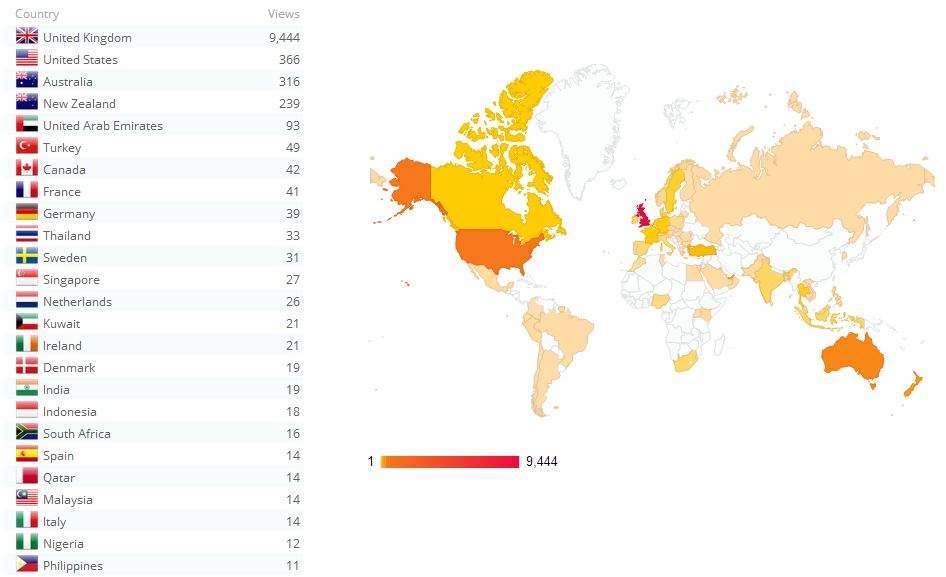
One hundred days later, with 23 posts and soon to be 24 posts to my name I am enjoying blogging. There have been just under twelve thousand views of the various posts on the blog site. I’m uncertain that the Google image searches for a jungle picture which end up at the post on “PRP: We’re in the Wrong Jungle” should really count. Posts have been viewed in seventy seven countries across the globe but clearly the whole of Central Asia and Africa have got better things to do and making a breakthrough in Greenland is proving rather elusive.
The first really Blogging Baron I came across was Tom Sherrington and his “Great Lessons” posts set a frighteningly high bar. I shared them via e-mail with all staff at the school. Other Blogging Barons I’ve come across include Keven Bartle, Pragmatic Education, TeacherToolkit, Chris Hildrew and the very bubbly Teachertweaks. I’ve recently come across LearningSpy who writes some pretty serious stuff. There are loads more for me to yet discover and I’m sure I will over the coming months and years,
As many people have commented blogging makes you sequence and sort out your thoughts. However, from a different angle, as my head is already like a box of frogs, getting a continual stream of thoughts and reflections from bloggers tends to spark off new ideas and trains of thought. Staff live in continual fear of what madness I will discover next from the Blogging Barons I follow and have yet to discover.
I posted a fun blog on “Who Do You Bring to Leadership?” which is based on a Mr Men theme the weekend before Mr Gove decided to launch an unwarranted and outrageous attack on the use of Mr Men, in the teaching of History. A blog on the SOLO Taxonomy received a positive and affirming reply from @arti_choke who I noticed was from New Zealand. I decided to do a nice little note back commending our antipodean bretheren, Prof John Hattie and Pam Hook, for their great work only to receive the response back, “I am Pam Hook”. I’m sure I’ve been called many things in my time but my most recent post was referred to in another post identifying me as one of three ladies and the headmistress of a school. In Blackpool “difference makes no difference” and the blogging world can provide you with a laugh or two.
I’m now aimlessly rambling but that is the beauty of blogging. I write and publish about the things that interest me and capture my imagination. No-one would publish my posts but that’s OK because I can now do it myself. People read them if they want to or can flick off them if they don’t hit the mark. I’ve no idea why “Consistently Good to Outstanding” has almost topped my list of posts and poor old “Masterchef III: Great Food” went down like a lead balloon. I’ve also no idea what “Home Page/Archives” is all about either.

Heineken Tweeters, are probably not the best tweeters in the world – this distinction falls to the Carlsberg tweeters – but they can reach parts other tweeters can’t. I soon worked out that if you want your blog read then tweeting is one way to alert people to it. I know it sounds daft but I didn’t realise, when I first started blogging, that people would be directed to your posts from Google or other search engines or via links from other posts but they can. It’s been a revelation to me.
Thanks to anyone and everyone who has ever tweeted or retweeted one of my posts I really do appreciate it. The blog counter has been sets spinning by @TeacherToolkit, @headguruteacher, @johntomsett and @GuardianTeach. I’m definitely OCD and so like to check the numbers on my phone often – I think if my long suffering wife ever decided to kick me out she will cite my mobile phone as the third party in our relationship! It’s interesting to just reflect on the potential power that the Heineken tweeters will have on information flow over the coming years, not good or bad, just is. I have 977 978 followers which is a mix of students, parents and teachers or those interested in education. There is a part of me, the OCD part, which wonders whether I should separate out my twitter activity so I have one account for parent and student information and another for my blogging activities. Any thoughts?
Twitter is interesting as I’m sure that it helps build social capital and there is an odd kind of affinity between people who have probably never met except in the ether. At the first meeting of the Vision 2040 Group, I said hello to a number of people introducing myself as Stephen, because that’s my name. As we chatted which school we came from was an obvious part of the small talk. I mentioned St. Mary’s and the response was, “Oh, you’re @Head_stmarys”. It’s odd to be known by your twitter handle but I now find myself doing the same.
Twitter bedazzles, bemuses and befuddles me all at the same time. I only follow forty seven tweeters and struggle to keep up with them so goodness knows how you follow a thousand or so people. When I find out how I promise to follow more tweeters. Tweeters make me smile and theirthought launches a thousand more.
I’m a blogger who tweets and the combination of the two is now my greatest source of CPD. Off now for a cup of tea with my blogging widow – the 21st Century version of the golfing widow.
Leadership: Being, Knowing, Doing (New Book)

Liminal Leadership

COPYRIGHT LICENCE

@LeadingLearner by Stephen Tierney is licensed under a Creative Commons Attribution-NonCommercial-NoDerivatives 4.0 International License.
Based on a work at www.leadinglearner.me.
 @LeadingLearner