@LeadingLearner
CPD
Improving Teaching Not Simply Measuring It
This is a post largely based on an article written for SecEd and published on 2nd May 2013. I’ve added in a few more twitter suggestions to the the final “prayer” part (with thanks to Ross at @TeacherToolkit for advice on how you can do this) and also a link to a summary of our Teaching Improvement Programme, on which this article is based, can be found here:
Paper – Teaching Improvement Programme – April 2013
The Teaching Improvement Programme is an attempt to formalise a lot of good practice we have and ensure it is consistently applied across the College. It also has a new idea to us around Research & Development Communities.
As the saying goes, “you don’t make a pig fatter by weighing it”. At some point we must commit as individuals, schools and as a whole system to improving the quality of teaching and learning in a formative, consistent and holistic programme.
Everyone interested in education knows that “the quality of an education system cannot exceed the quality of the teachers in it.” The difference seems to be how best to achieve the desired outcome, of exceptionally high quality motivated teachers, and performance related pay simply won’t deliver this. The research evidence is pretty conclusive that teaching is a far too complex profession for performance pay to have a positive impact. Not only that but it has now agitated the teaching unions into industrial action and will cause a loss of the “discretionary effort”, which teachers and others working in schools give in such abundance and is crucial to a school’s success. Not deterred and keen to avert disaster we are working on systemising key aspects of developing teaching and learning, here are my four wishes and a prayer.
Four Wishes
1. Student Voice
We’ve used student voice before on a number of occasions in a rather hit and miss way. The programme we have now implemented is getting feed back, from students on twenty five different aspects of teaching and learning, at a whole school, departmental and individual teacher level. With a programme written by John Jenkins, one of the ICT teachers, and the use of Google Docs just over two thousand seven hundred responses were inputted by students over a three week period. At a whole school and departmental levels we can track impact in all twenty five areas and focus our CPD on specific areas. However, the real power of the data is at a teacher level. The information for each teacher is only available to her/him. Each teacher has been asked to identify an area of strength and become “expert” in it. As an expert they can provide support for any colleague who wishes to develop this area of their practice. Each teacher has been asked to focus on one area of her/his practice which needs to develop. This is about putting deliberate practice into action (see the piece on Deliberate Practice by @HuntingEnglish). The data collection will be repeated every six months so we can track progress. Everyone making small steps forward has a massive impact on the overall quality of teaching and learning. The first set of responses at a school level are below with a comparison to data collected via The Measures of Effective Teaching Project where the questions were identical or matched:

These are the responses from the first full Student Voice survey of Teaching & Learning. Questions that were taken from MET/very similar have corresponding Upper & Lower Quartiles from the MET 2010 Analysis
The first set of results are very encouraging with both the upper and lower quartiles for teachers at St. Mary’s being higher than the corresponding ones in the MET Project.
2. Innovation Fellows
For about five years we have given teachers the opportunity to work as Innovation Fellows for a two year period. Teachers apply for the position in about February/March each year giving an area of interest that they wish to research. The only criterion is that they must have an “outstanding” grade in one of their lesson observations. Each Innovation Fellow appointed has a reduction in their contact time from between one day a fortnight to one day a week giving them the capacity to do their work. The Innovation Fellow will lead a research programme first of all working on their own or in a pair and in the second year extending it to a department, learning house or other group. The Innovation Fellow also works alongside colleagues in the classroom in a coaching role to help further improve teaching & learning.
3. Formative Lesson Observation
How much do you honestly learn from someone observing your lesson? Time to think about flipping the observation process. This started with me observing a lesson alongside a trained Ofsted Inspector to moderate my judgement of lessons. Then I would moderate senior staff’s judgements and they in turn would moderate heads of department. What was soon apparent was the real value and richness of the conversations around what constituted high quality teaching & learning. This year I worked with each new member of staff, to the school, in pairs carrying out joint lesson observation. It is a real “light bulb” moment for teachers new to the profession to be able to dissect a lesson, in real time and understand the importance of viewing the impact of their teaching. I once stood next to a very talented teacher who just kept saying, “OMG I do that, OMG I do that …”. I think you learn a lot more by observing a lesson with a colleague experienced in lesson observation than you ever do being observed. We are going to use the Autumn Term to carry out paired formative lesson evaluations with all staff new to the school and any current member of staff who would like to. The only record kept will be a www.ebi (What Went Well, Even Better If – often used in formative assessment) set of bullet points that will be collated to identify good practice and areas for focus during CPD which we hold on Thursday afternoon from 3:00 – 5:00 p.m.
4. Research & Development Communities
This is a new idea for September 2013 that has engendered a lot of interest. A R&D Community can be set up to develop and embed best or emerging good practice within the College.
- A R&D Community can be used to take forward an idea, innovation or approach by a group of staff that will lead to improved standards of attainment, levels of achievement, student well-being or student personal development. A R&D Community can be set up by any member of staff.
- Each R&D Community must have a named leader who will be responsible for the community, its outcomes and leading a group of staff between 3-8 people in size.
- The lead member of the R&D Company will be given a period a fortnight reduction in contact time.
- The leader of the R&D Community must commit to knowledge capture and transfer at the college, local and regional level as required.
- Each R&D Company will request a number of “cover vouchers” which they could use to free/keep free company members for meetings/activities as appropriate up to their allocation. The cover vouchers will be redeemable through the College A&E process.
- Funding of £100 per person in the R&D Community will be made available to fund the community’s work.
- Funding will be released following the R&D Community’s idea and success criteria being accepted.
- Approximately half termly a voluntary meeting slot will appear in the calendar for R&D Companies that may be used if some/all of the company members wish to.
- Applications (see Appendix 2) can be submitted in April/May each academic year, but no later than two weeks before the late Spring Bank Holiday i.e. 13th May 2013 for this academic year, and the funds will remain in place for the following academic year.
- Student research and developers may be useful additions to the R&D Community.
- The first set of ideas can be found in the blog post on “Upside Down CPD”
If you’re interested in leading a R&D Community you should look at the following guide which will be really useful in shaping this the action research: http://educationendowmentfoundation.org.uk/uploads/pdf/EEF_DIY_Evaluation_Guide_2013.pdf
Alternatively the community might want to adopt a “Lesson Study Process” approach. More details may be found at: http://lessonstudy.co.uk/the-lesson-study-process/
And a Prayer …
This is a little more hopeful and long term but I would like to help the staff understand how powerful twitter, blog posts and a simple application or programme for capturing storing and organising online material that is of interest and use to you. Here’s how it works, get your self a twitter account and then put the twitter app on your phone so the two can synchronise with each other. Follow some people who may be of interest to you. There are loads to choose from but a few to start with are: @headguruteacher, @TeacherToolkit, @SSAT, @HuntingEnglish but there are lots of interesting people to follow.
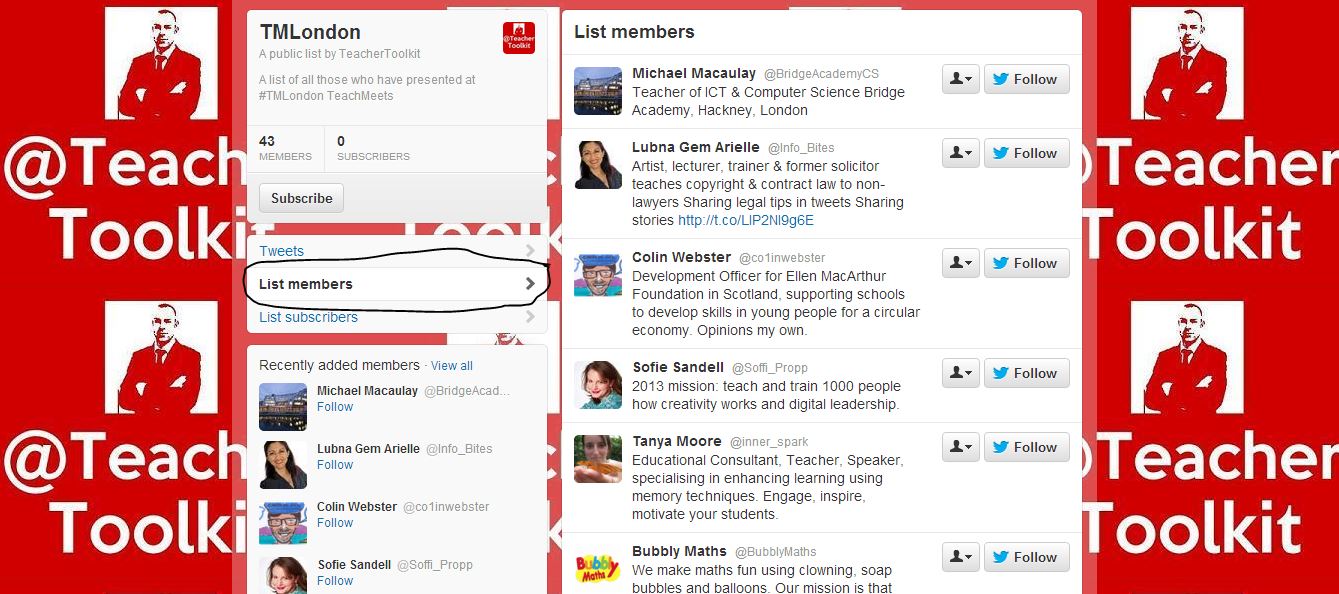
Another great one for teachers is @pedagoo. Ross McGill (@TeacherToolkit) suggested that it might be a good idea to look at some lists. This link is to @TeacherToolkit site and if you follow it then click on the “List Members” you will see a number of people who contribute to TeachMeet in London. Anyone you would be interested in following?
Other possible headteachers or leaders that I follow and find interesting include:
- @RosMcM
- @Carter6D
- @johntomsett
And if you want a guru or two I started with these:
- @alatalite (Alistair Smith – Learning to Learn Guru)
- @dylanwiliam (Assessment & Curriculum Guru)
- @SirKenRobinson (Creativity Guru)
- @HargreavesBC (Building Professional Capital Guru)
- @arti_choke (Pam Hook – SOLO Taxonomy Guru)
- @GuardianEdu (Upto date News)
Simply scan the tweets for useful information and links to articles that you might want to read. If you want to capture one of these articles, to read later or keep for future reference, then Pocket is a neat little app and very easy to use. As you get more advanced or depending on preference then Evernote or Diigo (PowerNote is the app for your phone) are different options to Pocket. As a short aside, I introduce Sixth Form students who are doing their Extended Project Qualification with me to use twitter, for research, and Diigo to store and organise any key information they find.
Now you have Martini CPD, any time, any place, anywhere professional development at your fingertips and convenience. You can use twitter to tap into some rich online content that is of interest to you and then start putting your own thoughts onto a blog. I’ve been using WordPress for just over a month and find it very easy to use.
To borrow a few phrases from the hugely successful London 2012 Olympics, Better Never Stops … so just take the next step.
Redesigning Classrooms: Is Your Summative Assessment Trustworthy?
Are we about to enter a national assessment black hole? We may soon be facing an assessment system with a terminal exam at the end of Year 11 and Year 13. A five year gap, from the beginning of secondary schools to GCSE, without any nationally recognised or externally accredited examinations to affirm for us how our students are performing.
In contrast, when I started at St. Mary’s we had end of Key Stage 3 SATs, the option to buy in SATs papers for the end of Years 7 & 8, module assessments throughout Key Stage 4, coursework at GCSE and the new modular A-level with coursework modules available. These have already or are about to disappear and to confound the matter further the safety blanket of levels may soon be ripped from around us as well.
We are going to need to get much better at assessment including the summative element by understanding key principles and developing some highly effective practice. This blog post is built on the symposium led by Dylan Wiliam that I have previously written about titled, “Redesigning the School’s Curriculum: Find your Compass.”
Below is some actual summative data from three different students, in three different subjects produced in response to our assessment system. It formed the starting point for a Thursday afternoon staff CPD session that started with the simple question, “So, what do you notice?”

Staff not only notices things but began to explain them. First up were the drastic differences in between some consecutive assessment cycle grades – students B went from a 6a to a 5c, nearly a two year regression in about half a term is some going. Also staff picked up the often significant drop as students moved from Year 7 to 8, look at both students A & B. The tendency to use one test/assessment piece to produce the summative grade, the narrow set of skills being assessed and the lack of transfer of assessment data from Year 7 to 8, even though it is all available in the SIMS, were raised as issues.
It presents the fundamental question, is our summative assessment system trustworthy? Do students and parents have faith in the outcomes? Is it actually telling us which of our students are more able mathematicians, linguists, scientist, historians, geographers etc?
Principle one: Is the school’s system to be trusted (do stakeholders have faith in the outcomes)?
The challenge was set to look at current practice in relation to the set of principles that would guide the building of a reliable summative assessment system. Are assessments:
Principle Two: Distributed (so that evidence collection in not undertaken entirely at the end)
Principle Three: Synoptic (so that learning has to accumulate)
Principle Four: Extensive (so that all important aspects are covered)
Interestingly, we may find some help from an unlikely source as it is often the Cinderella subject in the school’s curriculum if it is there at all – Drama. Drama has operated in the Key Stage 3 Curriculum black hole for an eternity. The following was written by Cathy Lloyd, Head of Performing Arts, and it’s interesting to reflect on what lessons are transferable and applicable.
![Drama[1]](https://leadinglearner.me/wp-content/uploads/2013/04/drama1.jpg)
“Currently there is no National Curriculum for Drama. Because of this, it was decided to create a syllabus based around the skills of an actor, namely technical ability, interpretation of a character and knowledge (of both the theatrical setting and Drama terminology such as hot seating, improvisation, teacher in role). The information for this was developed from the syllabus of one of the top Drama schools and its external examinations (LAMDA).
In each year group, we have structured Schemes of work that focus on one of these skills at a particular level (although the latter is flexible). Therefore, throughout the course of a year, students will develop their skills in each of the three key elements. It was felt that the current assessment schemes are extensive (they covered our key areas of learning) and distributed (we took multiple snapshots during the year) but that there is not a synoptic element.
With this in mind, we intend to change the final Schemes in each of the three year groups from Assessment cycle 4 to Assessment cycle 6 (wht will be the new assessment cycles 3 to 4) and to create mini projects that would culminate in a finished production. This final production could be showcased to parents/other students. This production could be either a Devised or Scripted play and is excellent preparation for a GCSE in the subject. It would also allow students to focus on ALL of the skills as they would each have a character and be equally responsible for the staging and production of the piece which would develop both skills and knowledge. This would ensure that at the end of the year the grade for the student would include a synoptic reflection of their overall ability and be an excellent indication of general ability for the new teacher/student and indeed parent. It would also be useful information for those students intending to study the subject at GCSE level.”
What interests me in this approach is that Drama has been able to use the opportunity afforded by not having a national curriculum to devise a coherent and integrated curriculum and assessment model.
The curriculum has content (knowledge and understanding), a procedural dimensions (how actors go about their business and the habits of mind that need to be developed) and whilst not apparent from the above it also has the development of the learner (metacognitive) as part of the overall package.
The assessment programme, used for summative purposes and grades reported, is distributed, extensive and now synoptic. The department intend to “roll over” the synoptic element from Year 7 to 8 and 8 to 9 to use in the mid-year summative grades that are reported to prevent the beginning of Year 8 drop seen in the examples above.
The approach leads to a really well though through programme that will keep the wolves away from the door and would be good enough for my children – key touchstones when making decisions.
Other departments all had various ideas for strengthening their assessment processes and making the outcomes we report and use to target interventions more valid and hence trustworthy:
- Religious Studies have already developed an assessment system that is both distributed and synoptic. It consists of a series of end of module tests which are “cumulative”, that is they include in each module test questions from the previous module(s). However, they intend to focus on skills based assessment at Key Stage 3 as they considered the results would be far more consistent than knowledge based assessment. Since fifty percent of the Religious Studies GCSE marks are for questions that assess reflection and reasoning skills, i.e. evaluation, these skills should be developed and the focus for assessment in lower school RS. Their assessment programme will now be more extensive.
- English were concerned that they were using individual assessment pieces as the basis of reporting and intend to move to a more distributed model where they use a number of pieces to determine grades for reporting purposes. This matches well with the portfolio approach that they already have that builds up a student’s English profile. As a spin off of the more distributed approach they can move away from a written assessment, prior to an attainment grade being entered for a student, and increase the amount of speaking and listening which further secures the extensive nature of their assessment programme.
And now the final principle:
Principle Five: Manageable (so that costs are proportionate to benefits)
We currently have six assessment cycles per year. This was madness before we introduced the Marking Policy this year and attempted to integrate the two. Staff at St. Mary’s are big hearted and always up for a challenge but this particular “spinning wheel” challenge is getting them down and not yielding enough benefits for the students. The teachers are honest, we needed to improve the quality and quantity of our marking as a school, but as a leader I also need to be honest and accept the system is unmanageable. The proposal for September is that we move to four assessment cycles for subjects with ten percent or more curriculum time and two for subjects with less than ten percent.

Our draft proposals for Assessment, Recording & Reporting at St. Mary’s next year
This is a fine tuning of the system as are many of the proposals out of yesterday afternoon’s CPD but such is the Redesigning Schools programme. It is about developing best and next practice not throwing out baby and bath water and starting again. Much of what we do is already good, we need to have the mindset and determination to just keep doing things a bit better each day, week, month and year.
Talking of doing things a bit better, it’s worth spending a moment reflecting on current plans for GCSE and A-levels and whether they meet the key principles associated with high quality, effective summative assessment. My own thoughts are that the arrangements will be far more manageable and clearly may contain a synoptic element. However, the absence of distributed and extensive elements is a matter of concern and will bring the trustworthy element into question. The new examination system may restrict what we do but it must never define us. It will change and hopefully evolve to something that is far more fit for purpose. There was a reason why we moved away from the O-level and A-level end of course examination system of my youth. Maybe that lesson should be included in the new History Curriculum.
Leadership: Being, Knowing, Doing (New Book)

Liminal Leadership

COPYRIGHT LICENCE

@LeadingLearner by Stephen Tierney is licensed under a Creative Commons Attribution-NonCommercial-NoDerivatives 4.0 International License.
Based on a work at www.leadinglearner.me.
 @LeadingLearner