@LeadingLearner
Education
The #5MinMarkingPlan by @TeacherToolkit and @LeadingLearner
Marking is an occupational hazard for all teachers. Whilst the “5 Minute Marking Plan” can’t do your marking for you (sadly) it will help you focus on the job in hand and help ensure you maximise your students’ learning and your own.
This planner adds to a growing number of 5 Minute Plans produced by @TeacherToolkit including the “5 Minute Lesson Plan” and the “5 Minute Assembly Plan” which are available on @TeacherToolkit’s website.
The thinking that underpins the plan seeks to highlight those elements of marking that have greatest impact on learning, namely:
- Sharing the key marking points (you may refer to these as success criteria). A student is much more likely to be successful if s/he knows where they are going. This is all part of teacher clarity
- Giving clear feedback to students about their work, comments only marking, but crucially making sure they respond to your marking by correcting their work or re-doing it, using your comments to guide them, to a higher standard
The time spent on marking students’ work must also help you identify common errors, so you can:
- Require students to correct and improve their work
- Re-teach elements of the lesson, scheme of work, programme of study or syllabus to help close key gaps in students’ knowledge, understanding or skills
- Inform future teaching programmes
The “5 Minute Marking Plan” and an explanation of how to use it is available to download below:
Five Minute Marking Plan – version 3.1 – PDF
Five Minute Marking Plan – version 3.1 (PowerPoint)
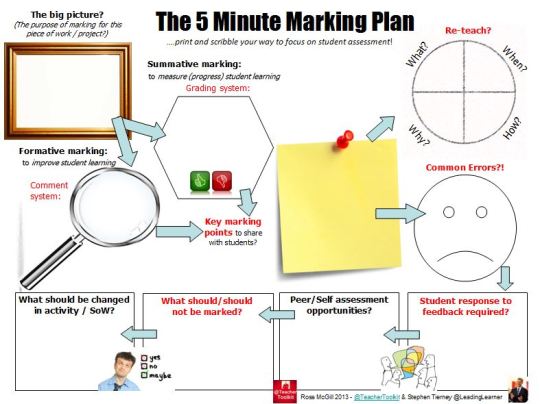

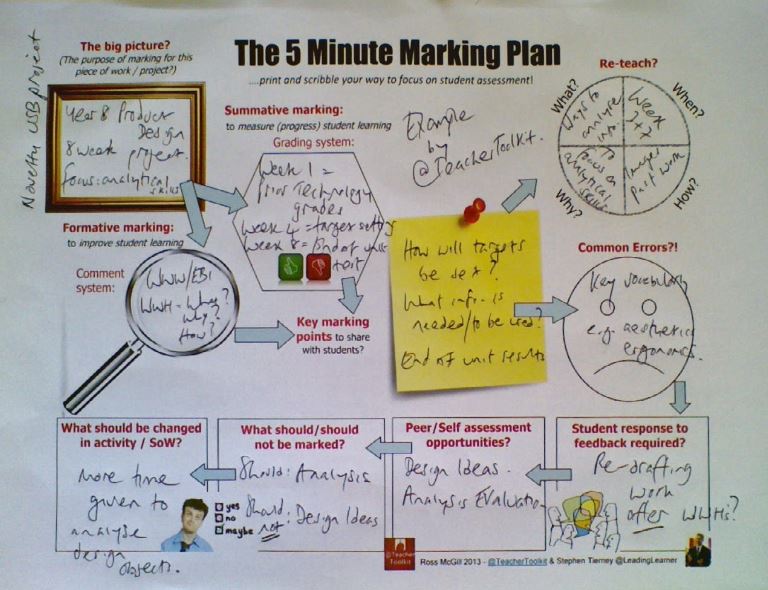
Context – (What each area means?)
The big picture? What is the purpose of marking for this piece of work / project? Try to be clear right from the beginning how the time you spend marking will improve teaching & learning.
Summative marking – Grading system: Are you going to use GCSE or A-level grades? Is it levels or have you started to think about a post-levelling world? Is it a numerical mark out of 10 or 20? Does the school, department or phase have an agreed system for teachers to use?
Formative Marking – Comment System: Do you have an agreed way of giving comments on students work – www (what went well), ebi (even better if), ioti (in order to improve), three stars and a wish? Have you given thought to numbering / lettering the key marking points, shared with students, so teachers can give comments via numbers / letters instead of writing out comments in full? Will you annotate the piece of work by putting the numbers / letters against the corresponding questions / text?
Key marking points to share with students? This is absolute critical. First of all teachers and then learners need to be clear what marks can be gained for. It’s all about teacher clarity. Sharing the key marking students with learners before they start the work will really help improve their work. Don’t forget to include a bit of “spoof assessment” to help learners understand what the key marking points are. You can give learners two answers of different quality and get them to assess them using the key marking points – can they grade / level the work and give reasons why. Another approach is to give them the different pieces of work and get learners to rank them and identify the main reasons why one was better than the other – can they give you the key marking points?
Common Errors – identifying common errors across a number of learners’ work is an important part of diagnostic assessment and links to other parts of the #5 Minute Marking Plan – Re-teach, Student Response to Feedback and What Should be Changed in Activity / SoW .
Re-teach – is there an important part of the module, topic, lesson that learners just haven’t got. Don’t worry it happens to all teachers. The important thing is to spot the “gap” in learning and then go back and address it again. Plan the re-teach: What, When, How & Why?
Student Response to Feedback Required? – Once you’ve spent time putting comments on learners’ work they must go back and either correct errors or redo areas of their work that needs improvement. A good strategy is to give students time to correct / redo the work during the lesson when the work is handed back – this is a key part of them improving and learning. Think about it, every student has a personalised action plan of ebi / ioti / a wish (or two) to work on.
What should be Changed in Activity / SoW – Is there a gap between the learning you wanted and what actually happened when you looked at the work submitted by the learners? Think about the activity or scheme of work – are some tweaks needed or a major rethink? What do colleagues think who have also taught the activity / SoW? This is a powerful way to improve the teaching programme whilst things are still fresh in everyone’s mind.
Peer/Self Assessment Opportunities – Learners need to develop these skills and it’s worth investing time in particularly as part of a whole school / department / phase approach. Make sure the learners have the key marking points available to them. Try to get to the point where before you mark a very important learner’s piece of work it has gone “self, peer, self” in terms of assessment & improvement before you look at it.
What should/should not be marked – This can be a hard one for teachers. We want to mark everything but quality and quantity can create problems. Go back to “The Big Picture”. Why are you marking, what will add most value to the teaching & learning?
Remember, there is no need to complete every box they are there as a guide for you to use.
With special thanks to the staff at Grieg City Academy who tested an early draft of the plan and to Sam, Cathy, Jenna and Clair who produced a set of Key Stage 4 exemplars (PDF Resource) in just over five minutes, which is great going for the first attempt at using the plan, at very short notice.

With a bit of practice the plan becomes more familiar and easier to use – we may need to rename it the “Sub 5 Minute Marking Plan” before too soon.
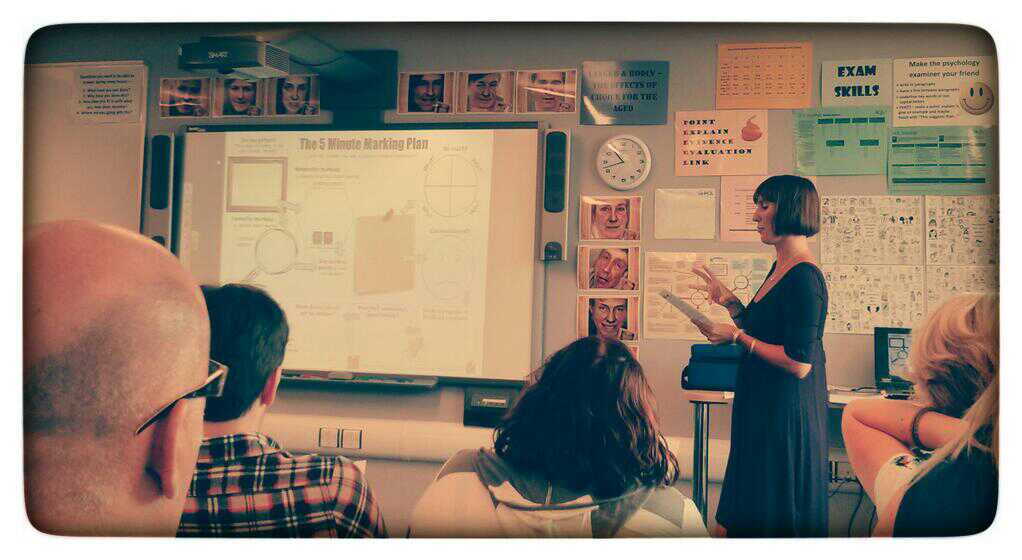
The last few weeks has been my first major “collaboration in the ether” with @Teacher Toolkit and this has been central to producing the marking plan. I hope it won’t be the last as genuine collaboration can not only be great fun but benefits both parties. If you ever want to show the power of collaboration here is the first draft that @TeacherToolkit and @LeadingLearner managed to produce. What an evolution!
The College’s Marking Policy is here and contains a bit of “pull, push and nudge” to try to ensure quality marking & feedback is given to all students.
Next Step to Outstanding
In a previous post “Consistently Good to Outstanding” I described my views about outstanding teaching following interviews with a number of teachers at St. Mary’s Catholic College, Blackpool who had been consistently graded outstanding in lesson observations.
I finished with these thoughts:
- Outstanding is not simply doing more good things it’s doing different. It involves a mindset shift.
- Absolute clarity of how knowledge and understanding are vertically integrated in your subject and helping students to work at a conceptual level. The teacher needs to be working there first.
- Keeping the lesson plan “loose” so that you can respond to the learner as s/he makes their learning visible to you at the beginning, during and end of lessons.
The following table and the thinking behind it attracted quite a bit of interest:
|
Grading |
Learning Gains |
Lesson structure |
Focuses On |
| Satisfactory (RI) |
Loose |
Tight |
The activities |
| Good |
Tight |
Tight |
The lesson plan |
| Outstanding |
Tight |
Loose |
The learner |
I’ve set myself the challenge of trying to develop a CPD programme to help teachers move from good to outstanding “#OutstandingIn10+10”.
I want to put a note of realism in here, this is not about producing outstanding teachers but rather helping them take the next step on an evolutionary journey. Working with teachers who have consistently been graded as good, and are utterly frustrated that they have never got the coveted outstanding lesson grade, I want to see whether in twenty weeks (10+10) they can achieve an outstanding lesson with a bit of structured support.
This blog and the process is fraught with problems, I’m going to acknowledge them but move on regardless. They cannot be allowed to paralyse me into no action. Dylan Wiliam has spoken about the need to have six observers cross referencing their judgements to gain a level of reliability in grading lessons by observation. This makes sense but isn’t a reason for not supporting colleagues, I just need to recognise the process is far from perfect.
The actual notion of taking a continuous variable, think of this as measuring the quality of a lesson from 1-100, but then treating it as a discontinuous variable, only four grades – inadequate, requires improvement, good and outstanding, is clearly madness. If you think about the difference between a lesson that is just good compared to one at the top end of good it is far greater than that between a top end good lesson and one that just makes outstanding. I acknowledged this but staff still deserve help and support to become better teachers. To not help and support is even greater madness.
Some scientists suggest the process of evolution is very dynamic, that is, there are significant periods of relatively slow evolutionary changes followed by short periods of dynamic change. What I want to try to produce is one of these short periods of dynamic change that will then require an extended period of slow evolutionary change. The first outstanding lesson observation is followed by the long, hard years of deliberate practice that leads to consistently outstanding teaching and then the outstanding teacher whose work is reflected in the outstanding outcomes of their students.
Ross McGill’s blog post #GoodinTen – Requires Improvement CPD Programme is the starting point for my work. I’m currently enjoying doing some collaborative work with Ross and I’m of the age that it makes me smile to think you can collaborate with someone who is not in the same room as you! I’m also going to try my first bit of collaborative blogging by later on asking for suggestions to add to a CPD programme.
Outstanding Teachers Think Differently
Absolute clarity of how knowledge and understanding are vertically integrated in your subject and helping students to work at a conceptual level.
The graphic below is my attempt to capture the thinking of outstanding teachers. They focus on the learning first and foremost.

Starting with the big picture they have absolute clarity about where they want the learning to go. They often work backwards from this point to identify the key learning points for students, the “stickability” bit. You can read more about this, “So what is #Stickability? by @TeacherToolkit and @Head_StMarys” (@head_stmarys is my original twitter handle that I now use only for school tweeting). To emphasise this point about the teacher being totally clear about the learning I have included a section on challenging learning gains, breaking this down into: knowledge and understanding, subject procedural skills and attributes & skills of a learner. These will be familiar to staff at St. Mary’s and I would recommend that you look at the SOLO Taxonomy as a way of organising your thinking about knowledge and understanding. All of our outstanding teachers referred to it as a tool they use. Two blog posts that might help are:
- Redesigning Classrooms: Using SOLO to Increase Challenge
- Redesigning Classrooms: Spreading & Embedding the SOLO Taxonomy
Whilst this seems rather pedantic it will form a key part of the programme. Teachers must be absolutely clear about the gains in learning they are seeking as an outcome of their teaching until this is second nature for them. It is for outstanding teachers.
Outstanding Teachers Work Differently
Keeping the lesson plan “loose” so that you can respond to the learner as s/he makes their learning visible to you at the beginning, during and end of lessons.
The next section looks at making students’ learning visible. Teachers need to be clear about what success looks like for students who are making the required gains in learning and so do the students. This requires a teacher to think through both success criteria and some very efficient ways of seeing what students’ had learnt. Their assessment techniques were very simple, unobtrusive and permitted the lesson to keep flowing.
QUICK RANT: I want to start a national campaign to get rid of traffic lights in Assessment for Learning. I wasn’t a belligerent or awkward student rather I was pretty compliant most of the time. However, with five minutes to go to break, and a game of football with my mates to look forward to, the idea I would ever give anything other than the “green light” would be ridiculous. Risk an amber or red and be invited to stay behind for further explanations, no chance!
The last bit is to look at the flow of the lesson, not too detailed as you may need to change the plan or go through various elements at a different pace to what you expected. Outstanding teachers focus on the learner and respond to their learning.
Pedagogical Toolkit
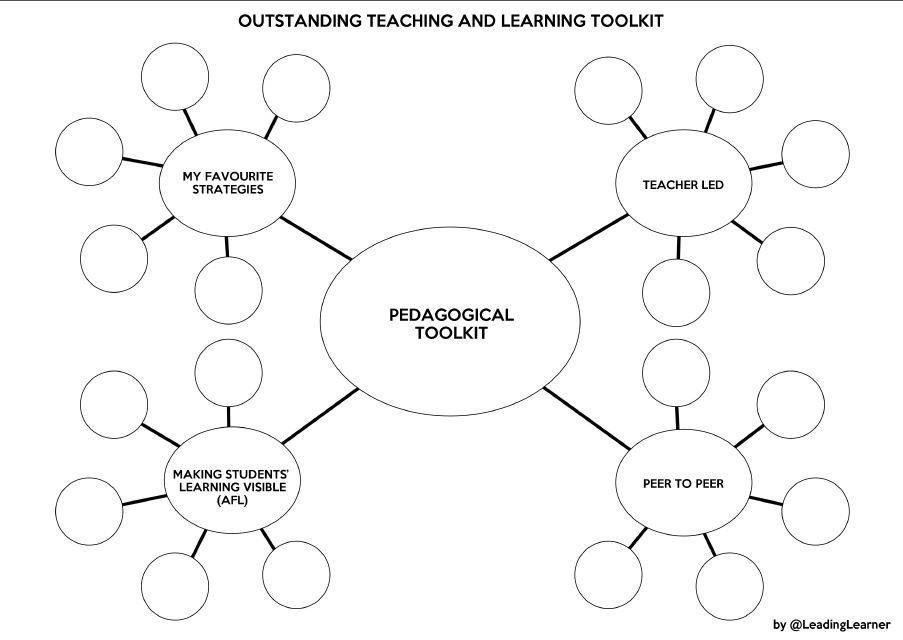
This is deliberately blank. Outstanding teachers keep the lesson plan loose. Just a few simple branches about possible different strategies: teacher led, peer to peer (group or pair work, on-line collaboration, peer assessment), favourite strategies and crucially ways of making students’ learning visible. Nothing prescriptive, nothing required just great pedagogy of their choice.
It is important to recognise that outstanding teachers have honed their skills through deliberate practice. I’m wondering whether they possibly use fewer strategies than good teachers but use them much more effectively. A key part of the CPG Programme #OustandingIn10+10 must be teachers choosing effective, proven strategies to work an and hone through effective practice.
#OutstandingIn10+10
The first ten weeks of the CPD programme is going to involve some shared lesson observations, facilitated sessions around the thinking behind and the use of the two simple tools above and starting to practice the methodology with one chosen class.
Since I’m hoping to work with three teachers, my intention in the second ten weeks is to get them to work as a teacher learning community to support each other on their evolutionary journey.
I’m hoping to possibly do some collaborative work with Ross, @TeacherToolkit, to customise the planner and pedagogical toolkit so it may be more widely used and also to pull on his experience of the #GoodInTen CPD programme to build this one in more detail. He may be too busy but here’s hoping.
I want to include a series of blog posts that teachers involved in the programme will be required to read to extend their thinking. I have mentioned a few above and others in the “Consistently Good to Outstanding” and have started a list:
- Tom Sherrington (headguruteacher) Great Lessons 7: Agility
- Chris Hildrew (Chris Hildrew) Progress In My Classroom. How it is Made and How I Know It
- Alex Quigley (HuntingEnglish) Becoming a Better Teacher by Deliberate Practice
I would be interested in your help and thoughts about what other blog posts you would suggest are included. There is going to be some great stuff out there I simply haven’t seen or have seen and forgotten. Please leave me a comment. If a lot of people leave suggestions I simply won’t be able to include them all but if you wanted to replicate the CPD programme in your own school then you can obviously chose the posts yourself.
If you would like a copy of the planner or toolkit please find the link below:
Outstanding Teaching and Learning @LeadingLearner
I’ve now turned this into a CPD Programme #OutstandingIn10Plus10.
Consistently Good to Outstanding
Reading Ross McGill’s blog post #GoodinTen – Requires Improvement CPD Programme got me thinking, his posts often do. As a school we have been consistently good, for the past decade, with increasing amounts of outstanding reported in each consecutive Ofsted Inspection but we are stuck at good. Good with many outstanding elements still equals good. The quality of teaching has got better and better, over the years, with more outstanding teaching observed through our formal lesson observation programme. However, we have teachers who have consistently been graded as delivering good lessons and they are utterly frustrated at not yet having achieved a “coveted” outstanding grade. They are also stuck at good. Continue reading
Leadership: Being, Knowing, Doing (New Book)

Liminal Leadership

COPYRIGHT LICENCE

@LeadingLearner by Stephen Tierney is licensed under a Creative Commons Attribution-NonCommercial-NoDerivatives 4.0 International License.
Based on a work at www.leadinglearner.me.
 @LeadingLearner