@LeadingLearner
Learning
Vision 2040: Learners at the Centre II
In the first part of what now looks like it will be a trilogy, Vision 2040: Learners at the Centre I, I put forward the idea that as we move towards 2040 we will see various power shifts in education including from teachers to students, where the learner takes centre stage in decision making about her/his learning both its direction and process.
Take a moment to think about the best learners you have ever taught, not necessarily the most able, articulate or brightest but the learner who impressed you most with her/his approach to your lessons … now imagine a whole class full of these learners sat in front of you! This would fundamentally change what happens in schools, for the better, but we have a responsibility to explicitly develop these learners. Tom Sherrington (Chair of the SSAT Vision 2040 Redesigning Schools Group and tweeting as @headguruteacher) effectively pre-empted the first part of this post with his comment on my previous post:

“The blend of these ideas … rather than pitting them against each other.”
As I think about schools and learners of the future then three aspects of learning have to be put into place. We need to see these as interrelated, summative and synergistic as we work with all three elements together:
- A cognitively and vocationally challenging curriculum
- The habits of mind and procedural skills that enable students to be
- Explicit development of students as learners – independent then interdependent.
We need students to have a cognitively and vocationally challenging curriculum. They need to develop sufficient knowledge on which to build a conceptual framework of an area of study, a real deep understanding, and this conceptual framework is then the basis on which further knowledge and concepts can be built. I’ve blogged before about the SOLO Taxonomy (Redesigning Classrooms: Using SOLO to Increase Challenge which has links to some other posts that might be of interest). Lots of teachers at St. Mary’s have found the SOLO Taxonomy really useful to build challenge into their class room practice on in a sequentially and organised way.
We also need to build the habits of mind and skills that will allow students to be scientist, historians, linguists, technologists, mathematicians etc rather than simply doing our subject. An interesting experiment pitted a group of history professors against some American history undergraduates. The first part of the experiment tested knowledge and understanding focussed on a period of history studied by the undergraduates but not the specialist area of the professors. The undergraduates outperformed the professors. However when both groups were given materials about a period of history neither were familiar with the professors way outperformed the undergraduates. The undergraduates had learnt about a period of history but the professors knew how to be historians – critically analyse sources, make hypothesise, draw out different inferences and come to a conclusion. We need our students to be not simply to know.
Let me just turn this on its head for a moment as these procedural skills need to be placed in a rich and challenging curriculum not a vacuum. About twenty five years ago, as a young Science teacher, I was asked to speak at a Science Conference about some work I was doing on Process Science – explicitly teaching scientific procedural skills. There were a number of presenters and one was talking about a thirty minute observation homework where students had to observe the bubbles for half and hour and write about what happens to bubbles made with washing up liquid in water. I don’t know about you but this would bore me stupid: process without a challenging context is superficial and a wasted opportunity.
Both these areas, whilst always accepting that we could improve further, are familiar to schools. The real gap in many schools and in our curriculum thinking and planning is around the explicit development of a learner.

We need learners who initially becomes independent but whose ultimate aim is for interdependence. This is part of a natural process akin to the move from childhood dependency, to teenage independence and then an adult interdependency. As we set our sights on 2040 we need to put the learner at the centre, a decision making highly able learner, who can personalise their curriculum both within any mandated core and beyond it. Learning in 2040 will be more multi-faceted, distributed and personalised than it currently is or was in the 20th Century and this will be massively accelerated by technology.
The 4Cs Learner
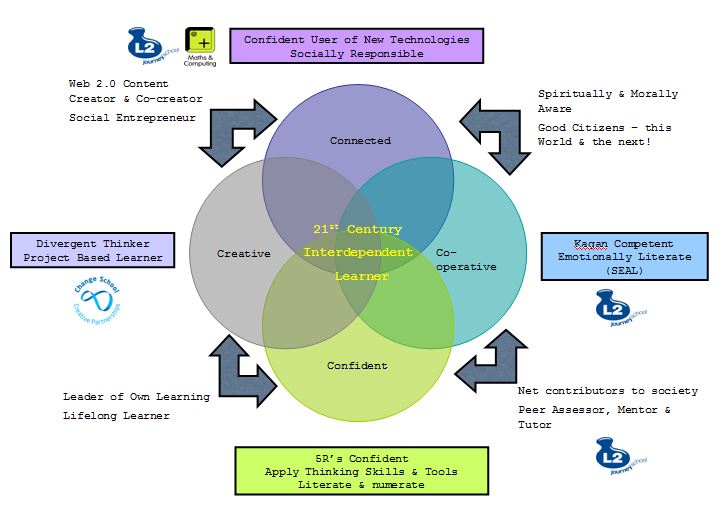
The 4Cs Learner was first produced in Summer 2008 in response to a request from a member of staff to put a stream of different ideas and thoughts I was presenting and discussing with teachers, about the type of learner we should be aiming to develop, onto one side of A4. Staff were interested in the various ideas but were really confused by my usual “box of frogs” thinking and needed a coherent picture to engage them. However, the root of the 4Cs Learner goes much further back to fundamental beliefs about what education is about. Part of this is how we build academic success for our students. In my first presentation to staff at St. Mary’s, on Day 1 as a newly appointed headteacher in September 2000, I said that we would build our students’ academic success on three things: literate, numerate and ICT capable learners; learners with good interpersonal and social skills and learners with a wide range of thinking skills. This pretty much still sums up what I believe now about developing learners. My thinking was greatly influenced by Alistair Smith (@alatalite) who I first heard talk about developing learners and learning in the late 1990s in Leeds and the Cognitive Acceleration in Science (CASE) Programme, which is one of the few things I would make compulsory in schools if I was Secretary of State for Education for a day.
The link below takes you to a different view of the 4Cs learner which is a bit more dynamic and has some resources attached – it’s like looking into my mind, so carries a big health warning.

http://webbrain.com/brainpage/brain/960FBA40-91C4-9B2C-EB54-AB3C0A0A8D77#-2
You cannot create the power shift in decision making required to personalise learning, at a micro or student level, without having highly confident, co-operative, connected and creative learners. I want to focus on the Confident Learner, as this is the first stage of the journey, that takes the learner from dependency on a teacher to independence as a learner.

The Confident Learner consists of a number of key elements, ensuring a learner has: the literacy and numeracy skills required to access an increasingly challenging curriculum; the attributes of a successful learner that we have based on Alistair Smith’s 5Rs and combined these with Social & Emotional Aspects of Learning (SEAL) and the development of thinking skills and use of thinking tools.
In some ways I feel that we were doing better in realising the vision of a learner back in 2008. A huge capital building programme has knocked the school sideways in recent years but we are approaching the end of that and I intend to help staff reconnect the 4Cs Learner with everyday practice. However, here are a few things already going on to help us realise the Confident Learner:
Literacy & Numeracy
The development of literacy and numeracy has had its profile raised by the most recent Ofsted framework but it has always been there in most teachers’ minds. Last year our Head of Learning Support, Paul Gillespie, started a pilot with paired reading between Year 11 students and students in Years 7 & 8 who had low reading scores, on standardised tests. This was a real joy to observe, as you walked down the “street” you would see younger students being mentored in their reading by older ones during morning registration. He followed this up with spelling tests for Years 7 & 8 also in morning registration. Paul produced a list of twenty spellings for the week which were handed out to students in Year 7 & 8 forms by Year 11 students who would then administer the test and mark them before reporting scores back to Paul – a highly efficient system. This year we want to move this on and look at the use of MangaHigh and Khan Academy to help develop students’ numeracy skills and mathematical understanding.
This September we will be implementing the National Mathematics Partnership’s “Passport Maths” programme which aims to move students who enter secondary school at level 3 or a weak level 4 to a secure level 4 in the first term of Year 7. We have also just appointed a new Literacy Co-ordinator, in an agreement with a number of our associated primary schools, who will work primary co-ordinators to develop a coherent English and literacy curriculum across the later years of primary school and the early ones of the secondary. In addition she will develop or find a literacy programme, similar to the Maths one mentioned above, to move students with weaker literacy skills to a “good level 4” as soon as possible in Year 7.
These developments all have real promise and collectively could be powerful agents in helping develop our students as Confident learners. Our challenge is to pull this together into a coherent and consistent programme of literacy and numeracy development for all students in their early secondary years. We have started but there is a long way to go.
Attributes (Traits) of a Successful Learner

These are a set of soft skills that I hope we will develop in all learners – we want our learners to be responsible, resourceful, reasoning, reflective and resilient.
To help clarify, there was a great little “twitter dialogue” about resilience as part of #sltchat. One line of thinking developed from “we need students to be resilient and able to keep learning particularly when they are struggling or find the work difficult” with the other developing from “we need cognitively demanding work first for students to develop the attribute of resilience in their learning”. Within a few tweets love and fraternity broke out as it is clear these are mutually inclusive perspectives. Resilience cannot be developed in a vacuum lacking rigour and challenge but if we want to increase the level of rigour and challenge then we need students to be resilient in their learning.
These are expected to be present in teachers’ planning, lesson objectives, success criteria when marking key pieces of work and we report on these to parents. I say “expected” as we still have someway to go but this is about fundamental beliefs as a teacher and converting this into daily class room reality – do you believe it is part of a teacher’s role to explicitly develop students as learners? If “yes” then all that needs sorting out is the what and how. If “no” then who will develop the learning skills of those students who don’t possess them, often some of our most vulnerable young people?
Thinking Skills & Thinking Tools
To help develop young people’s thinking skills we use a range of different courses across Key Stage 3 particularly in Year 7. Thinking Skills in History and Thinking Skills in Geography plus Cognitive Acceleration in Science and Maths. A Learning to Learn Programme, co-developed by Alistair Smith at ALITE, is delivered by a number of departments: the RE Department teach “I Learner”, the Science Department “Team Learner” and the ICT & Computing Department “21st Century Learner”. Most recently we’ve had a dynamic day with different year groups trialling the “I Thinker” challenges.
The thinking tools sound exotic but will be familiar to many teachers as graphic organisers which help students order and organise their thinking and ideas. There are many really useful examples of tools that can be found on the internet – my current favourite is the “Lotus Diagram”.
Our challenge as a school is to develop the 4Cs Learner and the associated elements consistently and to a very high quality. This is very much a work in progress, part vision and part reality, but it is an essential element of Vision 2040 if power is going to shift.
My first blog post on Vision 2040 was “Reflections of an Apprentice 2040 Visioner” but there are an increasing number of great blog posts coming in from Kev Bartle Part I and Part II and all the Vision 2040 Group – it would be great if you got involved.
Redesigning Classrooms: Spreading and Embedding the SOLO Taxonomy
In this set of posts about redesigning classrooms I want to look at some of the changes that teachers can incrementally make to their classrooms that may over time transform their practice. The first post about the SOLO Taxonomy can be found here:
Redesigning Classrooms: Using SOLO to Increase Challenge

Produced by Pam Hook (@arti_choke) http://pamhook.com/wiki/The_Learning_Process
SOLO first appeared as part of our CPD programme a number of years ago and all staff are familiar with it, however, a number of staff have started taking the use of the SOLO Taxonomy to new levels, spreading and embedding its use as they go. One of the interesting dimensions of the work is how staff are using the SOLO Taxonomy with students and explicitly developing their understanding of it and how to use it to increase the depth of the work they are doing. This post is a series of short inputs from staff at St. Mary’s
Art, Design & Technology Department – Student Friendly Success Criteria (Anna Johnson – HoD)
In the Art, D&T Department we are developing student friendly success criteria based on SOLO Taxonomy that allow us to identify ascending cognitive complexity in individual and collective student performance for understanding when mastering new learning. This will allow us to easily and reliably assess students’ progress.

Example of success criteria for students in Food Technology
The next step is to incorporate the 5 R’s using SOLO Taxonomy. We are also incorporating GCSE exam questions into Key Stage 3 lessons to allow students to demonstrate relational and extended abstract understanding.
RE Department – Developing the Learner (Phil Allan – HoD)
We made a decision to teach SOLO taxonomy discreetly to students in order to demythologise the whole concept. We used a card sort on topics familiar to the students (Blackpool FC and the X Factor) and they had to sort information into one of unistructural, multi structural etc.

Two different card sorts that were used to help students understand the different levels of complexity in the SOLO Taxonomy
The students grasped the idea immediately and were table to transfer these skills to recognise where a religious topic moved from multi-structural to relational or extended abstract levels. Our lesson planning was revolutionised by the success of this initial lesson as we then attempted to ensure that students learned some declarative knowledge (multi structural) early in the lesson and were then able to make the move to functional knowledge (relational/extended abstract).The level of challenge in lessons has increased markedly as each lesson requires students to think at a higher level at some point.
The lesson plan and a further exemplar can be found below:
SOLO template – blind man and the elephant model
Embedding SOLO in the English Department (Helen Stuart – Innovation Fellow)
When first faced with SOLO as, what seemed like yet another initiative to ‘get in the way’ of any actual teaching and learning, a sense of déjà vu, tedium and (if I am to be entirely honest) slight annoyance set in. However, it takes a brave teacher to admit when they’re wrong. In fact, SOLO has proven itself in my classroom time and time again to be an invaluable tool which is an accessible catalyse for students to: easily understand how ideas within the subject connect by forming real meaning of their learning; partake in cognitive demanding activities to achieve deep learning and appreciate the necessary strategies which are needed in order to unpack their skills.
I have found that by integrating SOLO into my planning, through the learning objectives and success criteria, students are more able to co-construct the lesson, using SOLO terms, as they actually become eager to achieve an extended abstract level of understanding within the lesson. The power of SOLO within their own learning instantly creates high challenge, due to a greater level of engagement, and students being able to, almost instinctively, identify their next step and maximise their conceptual understanding.
The “SOLO Taxonomy and Making Meaning Workbooks” (Hook & McNeill) are tangible resources within the learning environment which put SOLO into real practice (something I know myself and the department craved in order for an educational theory to become reality). The SOLO maps and rubrics within these texts have now become a staple part of English lessons, allowing students to select them as learning tools in order to scaffold their understanding. I also find an insightful activity for students, and me as their teacher, is to ask them to define the SOLO level of an activity and then challenge them to change the activity in order that it be classed as extended abstract, which they then complete. This activity also works well with forming questions on a given text, for example when analysing the writer’s purpose.
SOLO is one of those rare teaching acronym initiatives that actually works, in terms of: in a real classroom, with real students, to see real improvements in their metacognitive skills. Embedding SOLO within my own teaching has effortlessly led to more engaged, higher achieving, interdependent students who can lead their own learning…albeit to my surprise.

This is an example of the HookED SOLO Describe ++ Map that can be found in the “SOLO Taxonomy & Making Meaning Series. The books contain a number of different SOLO Maps and examples.
Essential Resources: (there are Australia, New Zealand and Rest of the World websites for Essential Resources as well) publishes some fantastic resources – “SOLO Taxonomy & Making Meaning” are a set of three literacy based books, two books that introduce “SOLO Taxonomy: A Guide for Schools” are two books that give you a great introduction to SOLO and finally one titled “Using SOLO as a Framework for Teaching” are all worthwhile.
Science – Use of Hinge Point Questions (One from me but not yet used in a real classroom)
SOLO Taxonomy can be used to produce increasingly complex hinge point questions. The final slide is taken from a video in which @eric_mazur is explaining how the Flipped Classroom works.
Students armed with a white board and a pen select the answer they think is correct. If a large majority of the students have the right response it’s probably best to quickly explain the answer to other students and then move on, don’t linger too long as most students won’t be learning anything. If the number of students getting the correct response is somewhere between 30-70% (Eric Mazur’s figures) then resist giving students the answer and get them to discuss it with each other – this can lead to some really great debates. If fewer then 30% of students have the answer you probably need to take a step back and revisit some earlier work as somewhere along the line their learning has a disconnect – can you prompt them forward to the next SOLO level without simply giving them the answer?
This series of slides is to help students learn about the expansion of solids when heated. This first slide just requires students to describe a series of events linked to the age old ball & hoop experiment. It would follow a demonstration of the experiment and is at a multi-structural level.

Hinge Point Q1 – Describe is at a multi-structural level
This second slide moves to a relational level in SOLO terms as students are required to explain what has happened. The slide contains the correct answer and a common misconception amongst students to really test their thinking.

Hinge Point Q2 – Explain is at a Relational Level
Finally it’s a move to the extended abstract with the students asked to hypothesise. This is a really tough ask which has baffled more than one Science teacher I have used the slide with.

Hinge Point Q3 – Hypothesise is at an Extended Abstract Level
If you’re not sure think about the answer to slide 2 and the particles on the edge of the hole in the middle. A “student model” is really useful here.
If you would like another way that SOLO Taxonomy is used at St. Mary’s to ensure we have rigorous and challenging Project Based Learning, please see the post below:
Redesigning Classrooms: Using SOLO to Increase Challenge
If we are going to Redesign Schools then we are going to need to redesign classrooms. Most of the changes to education over the past thirty years have been to do with the structure of education, in a country or state, and the curriculum offer. However, many of these curriculum changes have influenced the subjects offered in schools rather than affecting the diet received in the classroom by students. To change classroom practice requires teachers to have a deep understanding of pedagogy and their subject and a school where there are focussed multi-faceted CPD and high levels of support. Continue reading
Leadership: Being, Knowing, Doing (New Book)

Liminal Leadership

COPYRIGHT LICENCE

@LeadingLearner by Stephen Tierney is licensed under a Creative Commons Attribution-NonCommercial-NoDerivatives 4.0 International License.
Based on a work at www.leadinglearner.me.
 @LeadingLearner