@LeadingLearner
Redesigning Schools
Redesigning Schools: Masterchef III – Great Food
When cooking I tend to a bit of a manic “chef”. Having chopped the onions for the curry and put them in the pan to fry I have less than ten minutes to chop the garlic, ginger, chilli, chicken pieces and sort out the spices. Needless to say it all ends up a bit of a race against time, sometimes I win and sometimes its burnt onions. My wife suggested I might want to prep all the ingredients before I start cooking – may seem obvious to you but it was a revelation to me.

However, this type of prepping won’t be enough for me to ever be successful on Masterchef. My problem is I don’t have a grounding or understanding of the basic flavour combinations, techniques and processes used by real chefs and acquired by excellent amateurs. As I’ve said before, I’m just a great recipe follower. Whilst an appetising menu provides the framework in which great food can actually be delivered (see Masterchef II) it is the food that is actually put on the plate that is all important.
The curriculum delivered day in and day out by teachers may be differ in terms of the pedagogy used – a varied diet is good for learners – but whatever the pedagogy it must be of a consistently high quality. It is because of the hugely challenging and complex decisions that are made in the planning, delivery and evaluation of lessons that we need the best people to come into teaching and they in turn deserve the best professional development we can offer.
Moving to Informed Autonomy, Distributed Accountability
During the late 1990s and into the early part of the 21st Century a process of “informed professional prescription”, largely delivered through a series of national strategies, was a key element of curriculum planning. Whilst there was some strong elements to the national strategies there were also a number of poorly researched and implemented elements. The danger was that the profession became one of “recipe followers” with key knowledge and understanding of curriculum and pedagogy being lost. We knew what to do in the classroom but we may have lost an understanding of why we were doing it. Using certain approaches and strategies without understanding how they all link to fundamental theories about learning undermines our professionalism and moves us into the role of recipe followers. The challenge we face in the coming years is to move from recipe followers to great chefs, we are entering a period of “informed autonomy” for education. This is arguably one of the defining elements of Redesigning Schools as we look to wrestle back our professionalism. Redesigning Schools, as opposed to the work undertaken by the SSAT a number of years ago on System Redesign, is likely to be more focussed on redesigning classroom experiences. This will require the hugely challenging and massively exciting task of redesigning teaching (and teachers’ thinking) and learning (and learners’ thinking). No more can schools be places where young people go to watch old people learn.
If we get this right then a number of interrelated things may happen – first the quality of education across our schools will improve further and then politicians and wider society will have confidence in what we, as a profession, are doing. This should lead to the politicians no longer, or at least less often, trying to deliver simplistic silver bullet solutions to address complex deep rooted issues. In allowing the people who really understand and know about education – those of us involved in it on a daily basis – to lead on Redesigning Schools & Classrooms there needs to be a rigorous holding to account from within – within departments, faculties, schools, federations, clusters and localities. We can’t duck this issue, its part of being professional in our approach. My experiences tell me that where middle leaders – first line accountability – challenge and correct issues early on the outcome is more likely to be: reached quickly, positive for everyone and certainly more humane then if issues are missed or ignored only for them to be picked up in an inspection. The more we hold ourselves to account the more irrelevant Ofsted become; now there’s a positive outcome. In essence I think I am describing what the high achieving countries and states around the World do.
Moving Forward: Redesigning Classrooms at St. Mary’s
“It’s not simply about what, any more, it’s about why.”
The planned and delivered curriculum “breathes” our beliefs and values even if we don’t realise it. What and how you teach says a lot about your educational values and what you value in education. Are you a transmitter of knowledge, a constructor of understanding or a developer of the learner – or maybe all three?
It is important that we make expose the underlying beliefs, principles and structures on which our curriculum and pedagogy are built. It is critical that leaders within schools can articulate and explain these underlying beliefs and put in place the structures if any policy is ever going to influence the daily lived experiences of our students.
The first thing in Redesigning Classrooms will be to redesign how we collectively see a teacher’s role, not just as a profession but as a society. Teachers are a national asset and key professionals because they possess a unique understanding about curriculum, pedagogy and learning and the practical skills required to apply them in the classroom. For this teachers must have:
- A theoretical understanding underpinning their work in the classrooms – the theories of learning that influence me the most are Constructivism (social) and Cognitivism (structured). This is not because I want to argue that they are correct or better than any other but rather because I find them useful. I think learning should be structured, social and move from concrete to conceptual. The SOLO Taxonomy really helped me apply this and has formed part of on-going CPD for staff over the past three/four years.
- Knowledge of and ability to apply “Proven Strategies” – it may be more correct to say strategies that are “more probable” to have an impact rather than “proven” but the key is they have a clear research basis. It’s important to be able to link these strategies back to the theory so as they’re applied in that classroom we understand the key components of what we are doing in terms of why we are using the approach rather than another one. Hattie’s work is again really useful in identifying approaches to look at and consider.
- The time and ability to reflect on their own experiences – reflective practitioners, teachers as researchers and developers and teachers as evaluators of own practice are terms that are all taking us in the same direction. Can we make sense of the theories and strategies within our own context and what works in the classroom for our students?
The above suggests that universities, schools and coaches/mentors should all have a role to play in the development of current teachers and the next generation. On the job training is vital to provide opportunities: to meet with and learn from other practitioners, to put theory into practice and develop the experiences needed to reflect on that practice but the theoretical framework about learning needs to be there at the core of our thinking.
Know It, Integrate It, Own It
I used the graphic below in some CPD with staff during the Autumn Term last year to explain the SOLO Taxonomy. It hopefully will work quite well in expanding on the above.

In terms of your own knowledge and understanding of the curriculum, pedagogy & learning, would you liken it to a disorganised pile of clothes? A neat stack with certain items grouped together? Or a well organised set of clothes rails with key concepts linked together each one holding the necessary and important knowledge.
After far too many words I’ve got to the core of the blog. If we are going to be a highly valued national, professional asset that has control over the curriculum, pedagogy and learning we need to have these interrelated areas and necessary knowledge organised in our minds as we walk into our classrooms. Expert teachers do and those of us that aspire to be must combine the three elements above to develop our practice.
Redesigning schools just keeps going deeper; we are now entering the inner sanctum of the classroom. This can not be just the classrooms of a few innovative, risk taking and willing colleagues but of the overwhelming majority of the profession if Redesigning Schools is really going to influence the education system.
Redesigning schools: Masterchef I – Mustard Seeds, Yeast and Salt
The dust is now settling on a great set of symposia organised by the SSAT on Redesigning Schools. A bit like the parable of the mustard seed I have a sense that from small beginnings this movement will grow and grow until it becomes one of the mainstream educational groups of this decade. The use of social media is helping it reach beyond the physical group of people and out into a virtual world, the “yeast and salt” that produces massive effect far beyond its original being.

All this talk of mustard, yeast and salt takes me to one of my favourite television programmes, Masterchef. It involves groups of contests competing to become the best chef by surviving and thriving through a series of increasingly complex challenges. My wife thinks I should go on Masterchef (she is absolutely lovely and very kind about my culinary skills) but I am simply a very good “recipe follower” and would be caught out by the first challenge, the Invention Test. This requires contestants to make a beautiful tasting dish, in one hour, having been given a whole series of different ingredients. The most successful chefs seem to be able to identify with absolute clarity what they want to produce, select the ingredients carefully and skilfully combine them to produce a mouth watering dish. Some poor contestants, either through stress, a lack of imagination or limited skills try to put nearly all the ingredients together into a totally weird and incoherent dish, which tastes awful, or produce something so simple that it fails to reach the exacting standards required.
Education is standing at a crossroads where the vision, skills and expertise of school leaders, teachers and support staff will all be required in abundance if we are not to go down the wrong road or into a series of dead ends. In an increasingly complex World the edicts of any one person, whether they are the Secretary of State for Education or the Chief Inspectors of Schools or whoever, will not be enough. We shouldn’t be either too damning of their efforts or too compliant in following their demands. I decided a long time ago that whilst we, as a school, may be restricted by our political masters, the school would never be defined by them.
Take two examples:
- The E-Bacc was for me always a fundamentally poor idea, though its possible root of greater rigour (as opposed to some people’s view that its root was all about one person’s 1950s grammar school style education) in students’ studies is commendable. However, the lack of congruence with our Christian root that sees the education we offer as helping students develop greater wisdom – the ability to make life enhancing decisions – also recognises that no subject has a monopoly on this; the one size fits all approach (it doesn’t); the restrictive nature of having to take one subject from each discipline (three sciences or two languages weren’t given credence unless you had GCSE History/Geography at grade C, goodness only knows why); dubious use of statistics and exhortations about learning from the high achieving educational jurisdictions in the World (the fact I put “high achieving jurisdictions” in a sentence doesn’t mean I have actually distilled the wisdom of the lessons learnt from these countries/states) and the simple wind up of excluding RE and English Literature which are both facilitating subjects in the Russell Group Report (not included in the list as they aren’t often specific entry requirements of degree courses but look at the small print under the facilitating subjects) meant it never featured in our curriculum. With the exclusive nature of the measure, if you didn’t get a grade C at GCSE in any one element you were not counted in the statistics, it was easy for the school to ignore. At Key Stage 4 any student who wanted to pursue subjects leading to the E-Bacc was able to do so, they always had been, but other students could opt for subjects that linked to their own aspirations, skills and interests. The approach pleased students, parents and staff. The E-Bacc did not restrict our curriculum offer to students and got no where near ever defining it.
- The latest proposals put forward as part of the “Secondary School Accountability Consultation” will restrict us but they will never define us and what we believe a high quality education looks like. The reason for this different view is simple, there is far more congruence with the proposals and our vision of what education should be. The proposal to move to a best 8 point score, with the implication that every child and every grade matters, is a huge step forward in thinking as it moves away from C/D borderline, cliff edge manoeuvring; the reintroduction of a value added measure is another commendable proposal which, if Ofsted use properly as the primary measure of schools, might break the clear statistical link between being graded an outstanding school and having few students on FSM/large numbers from high socio-economic backgrounds (exceptions and outliers don’t make rules but congratulations to those schools that are) and the combined English & Maths at grade C measure is again sensible as achieving it impacts on young people’s life chances. There is also a nod to a more expansive view of education with respect to other experiences which may be included but they don’t seem to have any great sincerity behind them and I’m not convinced including them within accountability measures is the best way to encourage students’ engagement. I can live with the three subjects from the E-Bacc list being included, in any combination, as part of the “Best 8” and the inclusion of a further three qualifications including creative and vocational subjects is good to see. If common sense prevails, it won’t but never mind – the World will not implode and we will all still be able to get on with our lives – then a whole series of other measures will be abandoned as they no longer serve a purpose and the white elephant of a Data Warehouse being “built” at a time of national austerity will be laughed out of existence. Transparency is fine as long as the people it is aimed at do gain a greater knowledge and understanding of schools rather than being overwhelmed by so much data they simply click off the site.
The school was fortunate to be involved in the System Redesign network that contained some wonderful leaders and thinkers, from which I learnt a great deal, and it helped us re-vision what education could be, including developing a more personalised dimension to our work. Working on personalisation helped crystallise in my mind three touchstones that I have always found useful as a leader when trying to make decisions when complexity levels are high:
- Will the decision help further our vision and is it congruent with our values? This can be quite complicated and you do have to be clear on your vision and values so I devised a couple of simpler ones.
- Would it be good enough for my children? How happy would I be, as a parent, if this new initiative idea was introduced at my own children’s school and affected their education?
- Will the initiative help keep the wolves away from the door? Whether it is Ofsted, the local authority or the more important accountability to parents and students you simply cannot make decisions that will lead the school or its students into the abyss.
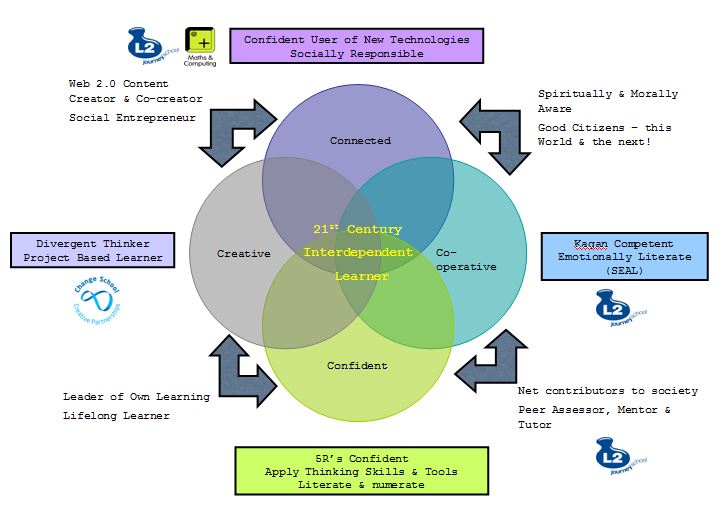
In Redesigning Schools the same three touchstones will again prove invaluable in helping us make key decisions. In 2008, I proposed a model of the learner we should seek to develop at the school termed the 4Cs Learner and this year we are rethinking both our Year 9 Curriculum and tweaking the options for students at GCSE to fit in with what may well be the outcomes of the accountability consultation. I intend to blog the details of these in the near future (Masterchef II) for your information, reflection and feedback.
If we are to become the Master Chefs of the education system then choosing the right ingredients and discovering new ones to use will be crucial. Take the big debate, or is it an argument, over the contents of the new National History Curriculum. What are your thoughts? Look on the bright side if it’s implemented we may yet win the World Pub Quiz Award for years to come! Here are a few thoughts to start you off:
- Calling it the National Curriculum is a misnomer, what we have is the National Random List of Facts & Incidents that may provide some of the multi-structural knowledge (SOLO Taxonomy) on which we can build deeper levels of understanding (Relational & Extended Abstract in SOLO Taxonomy terms). A reasonable start.
- As with Master Chef you may have to add a few ingredients of your own to the National Random List. Remember you will add to and in no way detract from the History Curriculum as you build a greater coherence for your students.
- What would happen if you didn’t use all the ingredients? For example in Key Stage 2, there is “Warwick the Kingmaker”. Great, I loved the ladybird book I read about him when I was a child and if it’s still in print I can thoroughly recommend it. Having ignored many an idiotic edict or “request” from the Secretary of State, DfE and local authority over many years and having not yet ended up in prison (yet) I dare you not to teach “Wolfe and the Conquest of Canada” or “Clive of India” if they don’t help your students understand history or become better historians and see what happens.
- To truly be called a curriculum what is proposed is simply inadequate as the skills and habits of mind required within the subject as well as to develop young people as learners are missing. Neither have the pedagogical opportunities been explored. But for once I say “alleluia”, as this is our domain, we are the master chefs and I don’t want this to be dictated to teachers or schools from on high.
Redesigning Schools cannot happen within a vacuum but rather as part of a strategic movement with a “sense of direction, discovery and destiny” woven into it. It must take account of what is happening and raise its eyes to scan the horizon for what might happen and what is possible. It will not be possible for “recipe followers” to lead the way but they may follow. What will be required is master chefs who are able to identify with clarity a direction to travel, select the ingredients of high quality learning and development and skilfully combine them into a world class education system for all. It is time for courageous leaders, at every level in our system, to step forward.
Redesigning Teaching & Learning: Finding Your Magnetic North

The theme of “knowing your vision, values & direction” again featured heavily at the symposium led by that first class double act – Professor Guy Claxton & Professor Bill Lucas. The full presentations can be found here but as ever this blog tries to provide a summary and some ideas. The message from these symposia is beginning to go deep and to the core – Redesigning Schools will mean redesigning classrooms, what actually goes on in them, and the professional development of the staff leading them. This is not system but systemic redesign.
“The test of successful education is not the amount of knowledge pupils take away from schools, but their appetite to know and capacity to learn.”
Sir Richard Livingstone, OxfordUniversity, 1942
It’s a fairly challenging question for a Monday morning to be asked, “What are the valued residues from education that must be left when all else is forgotten or gone, what do we want students to leave our schools with?” These “virtuous residues” may be classified as:
- prosocial – we want our students to be: kind generous, forgiving, tolerant, trustworthy, morally brave, friendly and ecological, or
- epistemic virtues (refers to the nature of thinking, learning & knowing) our students need to develop: inquisitive, resilient, imaginative, craftsman like, sceptical, collaborative, thoughtful and practical (able to put the academic or skills learnt to use).
“The skills you can learn when you’re at school will be obsolete by the time you get into the workplace – except one: the skill of making the right response to situations for which you have not been specifically prepared.”
Prof Seymour Papert, MIT, 1998
Important learning this morning included that the “either/or” debate about subject content versus subject processes is technically referred to as “bollocks” (did you know that?). The same is true of the “either/or” debate relating to good examination outcomes versus a good education. The growth mindset and abundance mentality, which we need in education more than ever these days, is all about “and”. You can have a good education leading to good examination outcomes and rigorous subject content alongside developing the habits of mind and skills of a learner, in fact, when we get it right the different approaches and outcomes complement each other.
Guy Claxton and Bill Lucas kept returning to the theme of, “What do you believe in, what is of value in an education?” This can be looked at from various angles including our own classroom practice. If you are a History teacher do you believe that History is about retention and reproduction of facts or critical analysis of sources, perspectives and bias or both? Whilst this may look a loaded question all of these approaches have merit but what is happening in your classroom? Is your teaching congruent with your value system of education? A simple touchstone, I often use, is whether you would be happy for your own child/children to experience your teaching – is it helping produce the residual virtues you value in education? As Dylan Wiliam said, “If you don’t believe in it, don’t do it”.
To help exemplify this further, have a look at the eight principles of expansive teaching and learning below. They are full of judgements about what we value in education.
Eight Principles of Expansive Teaching and Learning in Schools (For Discussion)
- Schools are the foundation for a lifetime of learning
- There are a set of wider life and learning skills which need to be deliberately cultivated in the context of the curriculum and beyond
- What learners believe about themselves matters and a ‘growth mindset’ is both a powerful motivator and a predictor of success
- Parents and the wider community have a significant role to play in pupil’s learning at school
- When teachers actively continue their own learning and model this in their classrooms learners achieve more
- Learning works well when it builds on pupils’ prior experiences, is authentic, has clear and stretching goals and is undertaken in an environment full of formative feedback with many opportunities for reflection
- Learning requires opportunities to develop emotionally, socially and practically as well as intellectually, individually and with appropriate theoretical grounding and understanding
- Learning is learnable and improves when learners have a set of metacognitive strategies which they are able to use confidently in a range of contexts.
After discussion with a number of people around the table (thank you for your time and expertise today) we determined there were a number of things we agreed with and others we didn’t. I have written my own first thoughts below which take extensively from the list given but also has some important changes and one addition that is significant to me. It begins to expose my own views and values in education. It is a great exercise to really challenge your thinking and help form a vision for education that you will rely on in the coming years as you lead in the classroom, department, school or system.
Principles of Expansive Teaching and Learning (Also For Discussion)
Learners are themselves the foundation for a lifetime of learning:
- What learners believe about themselves matters and a ‘growth mindset’ is both a powerful motivator and a predictor of success
- Alongside subject knowledge, understanding, skills and habits of mind there are a set of wider life and learning skills which need to be deliberately cultivated in the context of the family, school, wider community and beyond
Learning works well when:
- It builds on what learners’ already know, understand and can do; is authentic; has clear, explicit and stretching goals and is undertaken in an environment full of formative feedback with many opportunities for reflection
- Learning requires opportunities to develop emotionally, socially, spiritually and practically as well as intellectually, individually and with appropriate theoretical grounding and understanding
- Learning is learnable and improves when learners have a set of metacognitive strategies which they are able to use confidently in a range of contexts
- When teachers actively continue their own learning, including into proven pedagogical strategies that have known impact, and model this in their classrooms
I believe that content is an important vehicle on which we build students’ learning (the SOLO Taxonomy is really helpful here) and develop students as learners. There is a lot of evidence about what works in the classroom (see Hattie’s work) so we should use it as a menu to choose from. Is this belief sufficiently reflected in the principles above or not?
Supporting our learners from disadvantaged backgrounds, if s/he doesn’t already have the social capital in his/her family life, and helping them to develop as learners is crucial. The more disadvantaged the student’s background the “more grit, more social intelligence, more self control” s/he will need. This is part of the moral purpose we need to develop within our, schools, classroom and thinking if we are to help the most disadvantaged. It isn’t fair but it is real and some of our poorest students have to learn to be resilient, responsible, resourceful, reasoning and reflective – Alistair Smith’s 5Rs. The same is true of developing our high achieving and very able student as learners. When they suddenly come across an academic challenge that doesn’t appear to have an immediate and obvious solution they must be able to “flounder intelligently”.
The challenge that redesigning schools presents to us is, if we accept the above, or at least most of it, is to help develop a set of virtues in young people that can take them into adulthood, so they may carry on learning in an increasingly complex World that is changing at an exponential rate.
What are the barriers to making things happen?
We managed to very quickly come up with three but you might easily beat this.
- Fear – getting it wrong in the eyes of Ofsted, the Head, the LA and the pressures of accountability.
- Time – to reflect and redesign your own practice (Remember – Redesigning Schools means Redesigning Classrooms).
- Isolation – I’m on my own trying to solve this.
We are potentially producing a profession that is Stressed, Stuck and Solitary!
It’s time for some courageous leaders. The Redesigning Schools: Building Professional Capacity Symposium led by Andy Hargreaves has much to offer in how we can move forward together as we seek to develop new habits in the classroom and leave old ones behind.
What New Habits do we Need as we Redesign Classrooms
Our vision needs to be realised in the lived, everyday classroom experience of young people – it is the hard miles, the perspiration to put policy into practice that requires our long term commitment once the vision, values and direction has been determined. In the early stages this may require: an inspiring vision to engage and give direction to staff’s work with high quality CPD (pull); careful and rigorous monitoring of what is happening in reality as past habits are difficult to break and new habits challenging to embed (push) and a bit of “nudging” in the right direction – coaching, Teachmeet sessions and celebrating practice that is congruent with vision.
Possible New Habits
- Be precise about the habits of mind you are trying to help students develop. Move away from composite generic terms to more specific detailed statements, for example the 5Rs from ALITE, with some SEAL added in, detailed in our Curriculum Policy
- Think about the 5Rs in terms of developing deliberate practice for students who are focussed on honing their specific learning skills across lessons and phases. If it requires 10,000 hours of deliberate practice to become expert, we only have this if we work cross phase. In fact, we have 15,000 hours of primary and secondary teaching and learning time. We need to break the primary/secondary divide and the dislocation in learning and messages we give children about learning that happens around 11 years of age. Let’s help young people build their learning skills progressively from novice towards the expert learner, developing learner capacity as the child journeys, through real, deep cross phase work way beyond the usual transition work done in Y6/7. In September I will take on the Executive Headship of St. Mary’s and Christ the King Catholic Primary School, we will be much more effective together than we would ever be alone – can’t wait.
- Use split screen objective – science & questioning, history & empathy, maths & resilience and english & imagination. Also use split objectives (both content and process) with associated success criteria for key assessment pieces with feedback given on both.
- Report to parents on their child’s development as a learner alongside the progress being made in content based areas.
- In one colleagues school, UPS teachers are required to acquire 45 pts to pass their next performance review. Points are acquired by delivering CPD, coaching, contributing to others’ development through collaborative practice. What’s the impact of doing this and the impact of not doing it on the ethos within your school?
- Encourage teachers to try some new routines e.g. Try 3B4 Me, plus-minus-interesting, two stars and a wish feedback to the teacher at the end of the lesson. This could become increasing sophistication if students were taught how to link their feedback to the explicit split screen teaching objectives – content and pedagogy.
These changes will require subject leaders to become the pedagogical coach of their team and the Headteacher to become the Chief Pedagogical Coach (coach of coaches) influencing other leaders – pull, push and nudge. We may not have enough time but we probably have sufficient, the challenge will be to use the available time to best effect. If your interested in Expansive Education and wish to join an action research orientated network click here for more information.
Redesigning schools is the mainstream movement for schools today, even if it doesn’t yet know it or only a small minority of schools currently involved. Thanks to Guy Claxton and Bill Lucas for another fantastic day and to Sue Williamson who is leading the SSAT onto fertile and crucially important ground. Interested in Redesigning Schools? Get involved.
Leadership: Being, Knowing, Doing (New Book)

Liminal Leadership

COPYRIGHT LICENCE

@LeadingLearner by Stephen Tierney is licensed under a Creative Commons Attribution-NonCommercial-NoDerivatives 4.0 International License.
Based on a work at www.leadinglearner.me.
 @LeadingLearner