@LeadingLearner
LeadingLearner
#5MinOfstedPlan by @LeadingLearner and @TeacherToolkit
There is nothing quite like the O-word to send the shiver down the spine of a school or adrenaline pumping through its veins. Whilst the #5MinOfstedPlan can’t guarantee an outstanding outcome it can help ensure that you are well prepared for that phone call. Don’t fall foul of the old saying, “I didn’t plan to fail but I did fail to plan.” No school wants to get caught out. Continue reading
#WhatstheProblem
If “what works is good” (MW) then what doesn’t work must be bad.
I wonder how often, as leaders and teachers, we ask ourselves the simple question #WhatstheProblem – in my school or in my classroom – in a reflective and evidenced way?
This stream of thought was set off last July by the irrepressible Professor David Hargreaves who was talking to a group of aspiring senior leaders on the SSAT Leadership Course. I’m the course leader hence my attendance at the event. His presentation was on the Self-Improving School System and at one point he was talking about the difference between Joint Practice Development (JPD) and Sharing Good Practice (SGP).
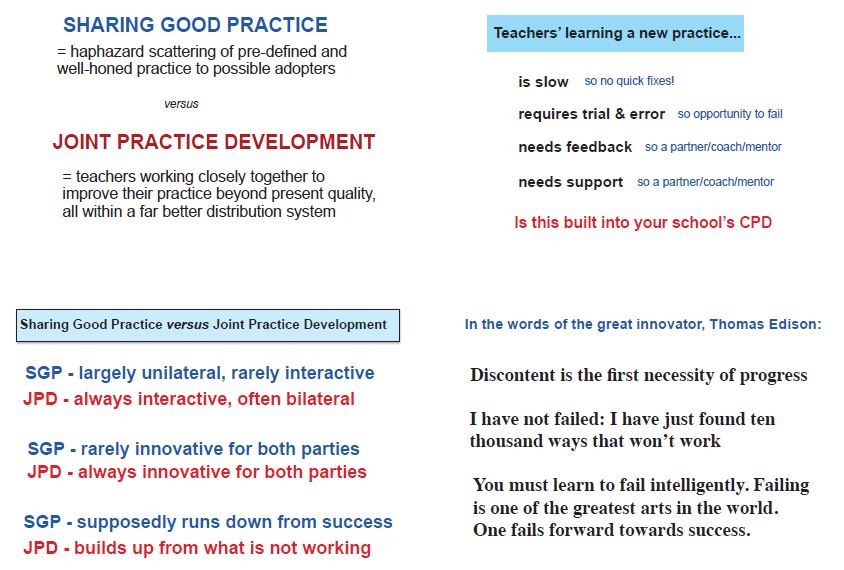
Listening to David I had one of those “light bulb, road to Damascus” moments but also a sinking feeling in the pit of my stomach. Have I spent the past thirteen years as a headteacher and before that as a senior/middle leader and classroom teacher essentially solving problems that didn’t exist or using the wrong solution for the rightly identified problem?
Sharing good practice – and let’s be honest, who hasn’t used this phrase over the past few years – isn’t a bad thing per se, however, too often the good practice hasn’t been exposed to the rigorous evaluation need to actual prove it is “good”. It becomes good practice simply because someone has decided it was “good practice” or examination results went up one year and someone has decided it was because of this particular “good practice”. We have become a system looking for silver bullet solutions. I’m as guilty as anyone, pressure and accountability makes us do some strange things.

Glynn Potts recently put this heartfelt comment on one of the blog posts I had written. I’m sure we are not both alone in looking back and wondering “what if I had done this … or that ..?” Possibly it’s time to re-think our approach to issues and school improvement. What would happen if we started from “what is not working” and our collective discontent about an issue as “the first necessity of progress”. Our question then changes from, “What is working in another context” (SGP) to “#WhatstheProblem?” (JPD).
I’ll blog another time about Professor David Hargreaves presentation but his suggested approach was disciplined, distributed and collaborative, not a simple free for all. It required high social capital, collective moral purpose and evaluation & challenge. As leaders we need to accept a responsibility for the progress of children beyond our own schools and build the trust required with other headteachers to work together for the benefit of all students. As teachers it’s about responsibility beyond our own classroom and the students in our classes. Our work must have a positive impact on all our students, all our classes and all our schools.
Cue the equally irrepressible Tom Sherrington’s (@headguruteacher) recent tweet:

But what’s the stuff we need to do “that’s going to be massively successful?”
I think a great starting point would be the right question, #WhatstheProblem? Once we know the problem that we need to address, we can start sharing thoughts, ideas, and strategies before determining a way forward.
Is this how #SLTChat works? A number of people suggest issues, we vote on the ones that are of greatest importance/urgency for us and then spend half an hour on a Sunday evening sharing ideas and thoughts.
I’m wondering whether to try #WhatstheProblem at a school level to:
- Revise or refine systems and processes
- Identify CPD Issues
- Determine future development plan objectives
- Sort the small irritating stuff out (usually pretty quickly)
Would it work with students as well as staff?
What would it look like as a collaborative process using twitter, Google docs, blogs etc?
One of our new Assistant Headteachers, Phil Brown (@AsstHead_SMCC), has devised a #5MinPlan to help solve #WhatstheProblem – I think it is really neat. His challenge is to solve the problems we are having with the further development and implementation of mobile technology. Please find below his work and a template for you to use:

Academic Review: Don’t Blame, Find Out and Fix
It is that time of year when schools up and down the country are looking at the summer’s results. There is a tendency when things have gone well to smile, congratulate and move on rather than identifying the key strengths in your approach that have led to you success. Continue reading
Leadership: Being, Knowing, Doing (New Book)

Liminal Leadership

COPYRIGHT LICENCE

@LeadingLearner by Stephen Tierney is licensed under a Creative Commons Attribution-NonCommercial-NoDerivatives 4.0 International License.
Based on a work at www.leadinglearner.me.

