@LeadingLearner
LeadingLearner
Please Don’t Just Give Teachers Curriculum Documents and Resources
The latest flavour of the month to reduce workload is giving teachers curriculum documents and resources, to save them time and energy. Produce them centrally; share or sell them to the masses and workload will be significantly reduced. Another magic bullet has been fired … and will miss the target. Continue reading
Teacher Shortages; Time to Call Critical Yet?
The National Foundation for Educational Research has released its latest report on the Teacher Labour Market in England. It makes for some grim reading; the secondary school situation requires urgent action with primary described as stable but with some risks. Schools up and down the country will be feeling the effect of teacher shortages to differing extents.
The main headlines (taken directly from the report) are:
The secondary school system is facing a substantial teacher supply challenge over the next decade, which requires urgent action

Reference: Worth J. and Van den Brande J. (2019) Teacher Labour Market in England Annual Report
NFER
The DfE forecasts that secondary schools will need 15,000 more teachers between 2018 and 2025 to meet a 15 per cent rise in pupil numbers. Yet teacher numbers have been falling, due to increasing numbers of teachers leaving the state sector and insufficient numbers entering the secondary sector. The number of in-year vacancies and temporarily-filled posts, one measure of potential shortages, has doubled between 2010/11 and 2017/18.
Teacher supply in the primary school system has increased to meet rising demand over the last decade
The DfE forecasts that primary schools will need to maintain teacher numbers over the next decade, by ensuring the numbers entering keep up with those leaving. However, the primary leaving rate has risen between 2011/12 and 2017/18 and the number of vacancies has increased, suggesting a risk of there being some supply challenges ahead.

Reference: Worth J. and Van den Brande J. (2019) Teacher Labour Market in England Annual Report
NFER
Retention rates of early-career teachers (between two and five years into their careers) have dropped significantly between 2012 and 2018
These are the critical years where the right development opportunities, nurture and support can make or break a teaching career. The Government’s Early Career Framework, which includes time off timetable for second-year teachers for professional development and mentor support, is a promising development.
Other headline findings include:
- There are acute challenges in the recruitment and retention of teachers in long-standing shortage subjects such as physics, maths, modern foreign languages and chemistry.
- Alternative sources of teacher supply, such as returners and overseas-trained teachers, have not increased in spite of the growing supply challenge.
- Teachers work longer hours in a typical working week than similar people in other professional occupations.
- Teachers’ mean pay in real terms is lower than similar individuals in other professional occupations, but median pay is similar between the two groups.
- There is more unmet demand for part-time working among full-time teachers than there is for similar professionals.
- Teaching’s traditional ‘recession-proof’ advantage over other professions has eroded over time due to a relatively strong graduate labour market.
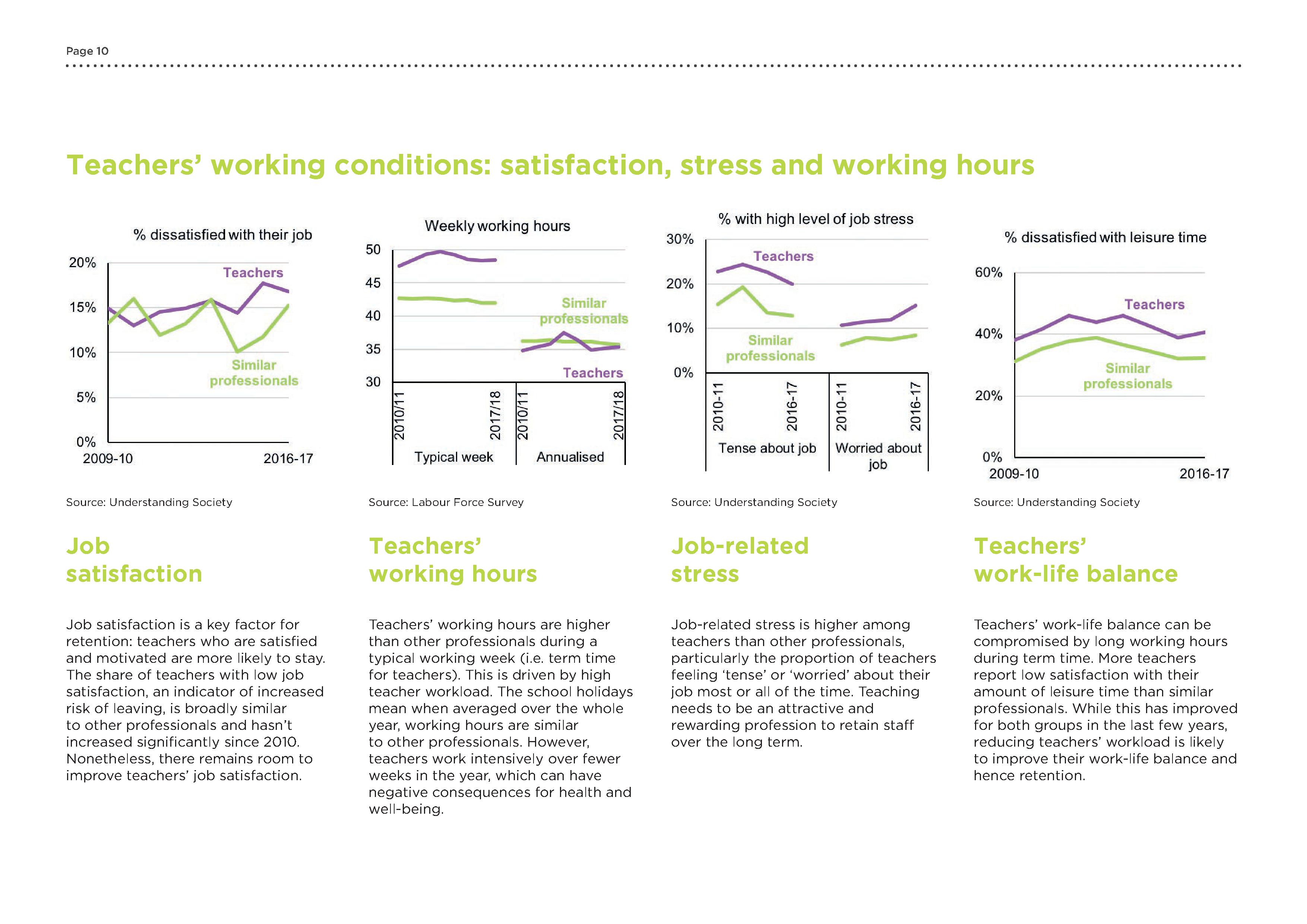
Reference: Worth J. and Van den Brande J. (2019) Teacher Labour Market in England Annual Report
NFER
There isn’t one single action that can be taken to ensure every child and young person has a well-qualified, highly capable teacher in front of them. The next few months and years are critical; the fully funded Early Career Framework is a step in the right direction but looks like an island haven in an otherwise bleak environment. Ofsted’s draft Inspection Framework was a huge missed opportunity to turn the tidal wave of pernicious high stakes accountability; the chronic underfunding of schools is a deliberate but poor choice affecting pay, workload and staff’s conditions more generally and the actions of some trust/local authority/school leaders has led to the sausage machine schools that are causing far too many people to leave the profession needlessly.
It may be time for a fundamental rethink; not enough teachers and pupils’ life chances will be affected. As always it will be the most disadvantaged who bear the brunt.
Ofsted’s Draft Inspection Framework: Coronation or Consultation? #EIF2019
Ofsted has apparently already received 1000s of responses from Headteachers on the draft Education Inspection Framework. As with most consultations, I’ve seen over the years, questions are written and presented in such a way as to maximise the number of “agree” or “strongly agree” responses. The organisation can then state, post consultation, that 80% or 90% or whatever the figure is endorses what they are doing. In essence, what is often sought is a confirmation and coronation rather than a far reaching consultation and debate. Continue reading
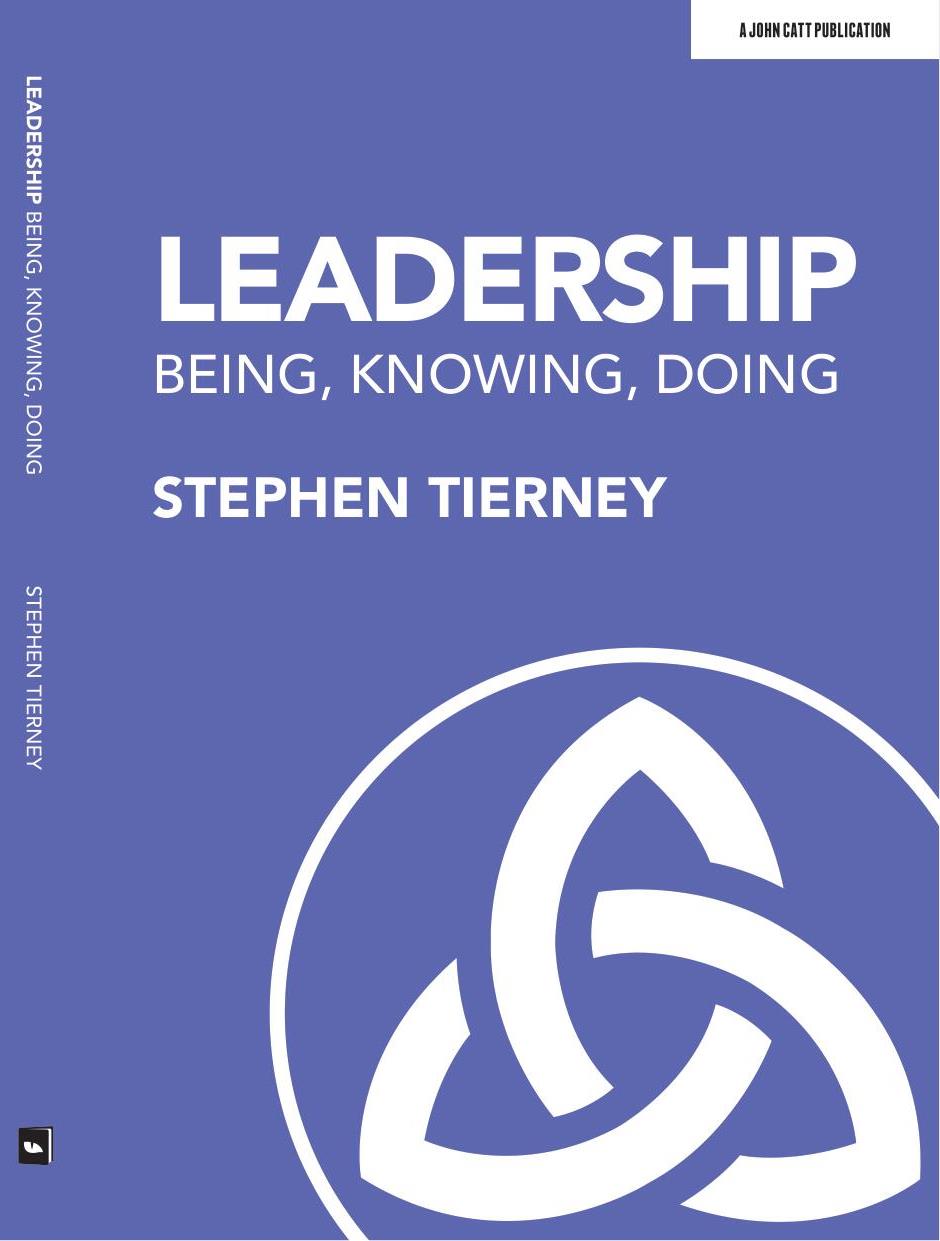
Leadership: Being, Knowing, Doing (New Book)

Liminal Leadership

COPYRIGHT LICENCE

@LeadingLearner by Stephen Tierney is licensed under a Creative Commons Attribution-NonCommercial-NoDerivatives 4.0 International License.
Based on a work at www.leadinglearner.me.
 @LeadingLearner