@LeadingLearner
Archive for
#5MinCPDPlan by @LeadingLearner and @TeacherToolkit
Continuing Professional Development (CPD) and in particular INSET Days can vary from the brilliant to the awful and often somewhere in between. The problem often lies in them: being standalone one off events; lacking a clarity in terms of the outcomes for either teachers or pupils and them being on totally the wrong thing, something for which there is limited or counter-evidence on the theme/focus having a positive impact on pupils’ learning. Continue reading
#5MinWellBeingPlan by @LeadingLearner and @TeacherToolkit

You may think it is with a certain sense of irony that @LeadingLearner and @TeacherToolkit have produced the #5MinWellBeingPlan. However, like many people working in education we need to get our lives back in some sort of order and balance. The “#GuiltyTeacher. Guilty as Charged! By @TeacherToolkit” post certainly struck a chord, with many teachers and support staff, about how we live our lives.
In schools we squash the equivalent of a full working year, and often more, into just thirty nine weeks. People outside of education see the “long holidays” but don’t often see the extended and sometimes gruelling hours we work during term time. Ask the partner of a teacher about evening and weekends during term time and they will tell a story of almost continuous work with not enough time for nights out or a bit of fun until the next holiday comes along.
It’s time to launch the #5MinWellBeingPlan:
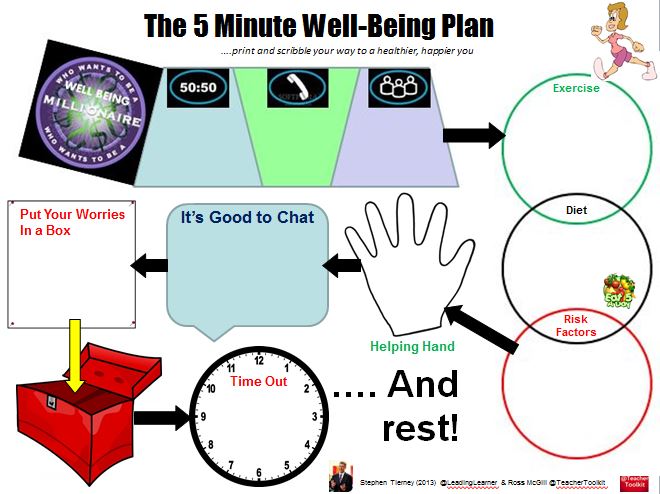
In recent years a number of schools have taken a lead on developing approaches to staff well-being. Whether you work in one of those schools or not there is a lot you can do for yourself.
The Well-Being Millionaire

50:50
Try to decide and plan how you will spend your time each week. If you’re not careful work can expand to fit every waking hour. The “To Do List” will never be done and it helps if you accept this. What time will be for school work and what time will not? Try to have fixed times each week where you close the school bag and think about things other than work. When might you give yourself a little treat each week?
Phone a Friend
Keep in touch with people who are nearest and dearest to you. It’s easy to keep putting off that phone call, text, skype session or letter whilst you just get the next job done. Who do you want to stay in touch with on a regular basis and who have you not made contact with in ages?
Ask the Audience
Family & friends can all too easily be forgotten, in particular, your partner can be someone who spends her/his life waiting for the next school holiday, just to get some of your attention. Why not plan a meal or night out, trip to the theatre or cinema etc. with family and friends. The break will do you good and you might even enjoy it.

It is sometimes a really great idea to book a weekend away in the middle of a half term. Three or four weeks in, a mini-break with a loved one can give you the boost you need to make it through the half term with a smile on your face. Try somewhere local – it reduces down on the travel hassles and means you can just book in for one night which keeps the cost down
Healthy Living
Exercise

Exercise is not only good for our bodies it is good for our minds. Exercise makes you feel happier alongside doing great things for your heart, general muscle tone and helping you remain/become a healthy weight. How and when are you going to exercise each week? You need to look after your body as it is the only one you’ll get.
Diet
We hopefully all know about 5 a day. There is a danger, when you are continually on the go, that you skip the odd meal or replace it with cakes & biscuits, snatched in a quick break. Do you ever find yourself lying awake at night on a “caffeine high” only to repeat the dose the following day because you feel tired? Think about you diet and pick one thing that you need to start or stop doing. Write it down and commit to making that change.
Risk Factors
Excessive alcohol, being overweight, stress, lack of sleep are all things that we know make us unwell. If we don’t deal with these issue early then you will become unwell. Not good for you, not good for your family and friends and not good for your students. Be honest with yourself – do you have any risk factors? What are you going to do about them?
Helping Hand
It’s an odd thing but helping others makes us feel better. Now that’s a “win-win”. There are so many ways to help but here are a few – take part in a sponsored walk/swim/run (also ticks the exercise box), go to a charity event, give some time up one evening or at the weekend to help a local charity (a change is as good as a rest), organise a charity event with your form, secretly surprise a colleague with a random act of kindness, take part in a Secret Santa … the list goes on. What would you like to do to make a difference to someone else’s life?
It’s Good to Chat
There are times when we need to talk through challenges or stresses that we are feeling. On occasion we want people to help us solve the problem and other times we just want someone to listen. It can also help us find a solution when we just verbalise the issues to someone. What do you need to chat about and who would be a good person to chat with. You may want to work with someone on a regular basis in a reciprocal arrangement. Good friends and good work colleagues can both make effective coaches.
Put Your Worries in a Box

There are some times when the job just simply gets too busy. There are other times we worry about things we can’t actually do very much about. Time to put your worries in a box. Make a list of your worries – this is to stop you worrying about forgetting them – write them down and put them in a box. If you are a bit OCD, why not put them in date order! Periodically get the box down and look at your list of worries – can you now throw it away? Deal with it? Put it back in the box for another day?
Time Out
Every now and then you do need to simply stop and reflect on how life is going. Are you walking in the direction of your dreams, doing things that are important to you? Are you in a velvet lined rut or maybe one that is a little less comfortable?
What is giving you joy and what do you need to change?

Let’s remember that we are human beings not human doings! It’s sometimes said that when we look back at our lives it will not be the jobs left undone that we regret but rather the relationships that are broken or the time we didn’t spend with loved ones.
The job needs to get done but we are more likely to achieve it if we look after our own well-being. Time to stop, time to refill the reservoir!
An example of the #5MinWellBeingPlan is below:

A copy of the #5MinWellBeingPlan is here: #5MinWellBeingPlan (PDF)
The plan was originally done in PowerPoint and can be edited or typed into: #5MinWellBeingPlan v1 (PowerPoint version)
Feel free to tweet us a copy of your #5MinWellBeingPlan and we will look to retweet a number of them.
Journeying to Great: 2. The Purple One
I’ve just invested £14 in an attempt to make a crucial point during our next INSET (In-Service Training) Day.

We are a good school but we are not yet great. We want to be and intend to be. My role is to help discern what we keep for the next stage of our journey, what we abandon and what we tweak. The first part of the “journey” can be found in the previous post, “Journeying to Great: 1. The St. Paulsing Way”.
Having visited two great schools in the last fortnight I’m wondering whether it’s all about the Purple One. To make sense of this I need to share two different conversations that have come together (in my head at least) and will hopefully help us on our journey.
Freedom, Responsibility & Interdependence
The first great school I visited was St. Paul’s Catholic College, in Burgess Hill. I was there as part of the SSAT (The Schools Network) Redesigning Schools Programme. In conversation with the Headteacher Rob Carter (@robcarter2012) we discussed the differences between good and great schools. I started scribbling down a simple table describing schools and their “Loose/Tight” features relating to the coherence and consistency found within them. It looked something like this:
|
School Description |
Vision & Values (Coherence) |
Systems & Consistency |
|
Not Good At All |
Loose |
Loose |
|
Good |
Tight |
Tight |
|
Great |
Tighter |
Loose |
Just as a quick aside, I have deliberately not used Ofsted gradings in this table as they sometimes miss the point and certainly the gradings will confuse things here.
Rob made it clear that the “Loose” in the Systems & Consistency column, in the table I drew, was not the same in “Great” Schools and those schools that are “Not Good at All”.
In schools that are “Not Good at All” the loose systems leads to a lack of consistency and huge variability. Senior leaders have failed to get a grip of what is going on and allow unacceptable variations that lead to poor outcomes for students.
However, the “loose” in great schools relates to the freedom middle leaders had to implement the school’s vision & values in order to produce very high value-added outcomes for students as part of a holistic education. This freedom is balanced with a responsibility for ensuring high quality systems are in place – for example, tracking students’ outcomes, ensuring great teaching & learning and the professional development of staff – that eliminate inconsistency and ensure students have a great education. Middle leaders are supportive of each other and hold themselves and each other to account, in essence, they made the vision and values explicit for staff and students every day, everywhere and in every way.
“We’ve Moved from Red to Blue but Probably Need a Bit of Purple”
Move on five days and I was in Milton Keynes for my first meeting as a member of the Teacher Development Trust’s National Teacher Enquiry Network. The meeting was at Shenley Brook End School and hosted by Chris Holmwood (@LTCSBE) the school’s Senior Deputy Headteacher.
Chris told the story of Shenley Brook End’s journey from good to outstanding. One of the slides he used was:

The original idea of red/blue appears in Mike Hughes’ “The Main Thing Is Learning” and the above is an adaptation of his diagram which Chris used as part of his presentation.
In talking about the move from the red to the purple, in a hugely engaging narrative, he said something along the lines of “but you probably need a bit of purple”.
The Purple One

My mind immediately made links with the conversation the previous week with Rob. The “Loose” in great schools is a purple one. It is not simply a balance of the blue and red, as the situation requires, but it is a shifting of the determination of the response to middle leaders. They have been given and accepted the freedom to make decisions, to really lead, and the responsibility for being accountable for the outcomes.
In a school stuck at good, is the former what senior leaders are not very good at doing (giving freedom) and the latter (accepting accountability and demonstrating peer accountability) what middle leaders are not very good at accepting?
Leadership Changes as Schools Move from Good to Great
The table below is a summary of my thinking thus far with a massive assist from Rob & Chris. The table is a bit of homespun theory. I offer it, not because it is necessarily right but, because I found it useful in shaping my thinking:
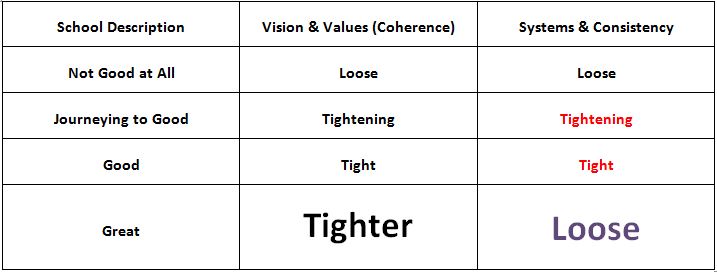
Not Good at All
In schools that are “Not Good at All” there is no underlying direction or way of operating to guide staff and students and their systems are inconsistent. In short, chaos rules and people seek survival either on their own, doing their own thing or by offering each other support against a common enemy – senior leaders, staff, students, parents, Ofsted – the list of “enemies” is endless. There is no compelling narrative that is inspiring, engaging and directing the school community. The tightening might be a response to inspection or fall in numbers or new headteacher, somewhere and somehow an impetus for change must be introduced.
Journeying to Good
There needs to be an engaging vision and direction of travel expressed by the headteacher. Some practices are now unacceptable and there is a bottom line introduced. There has to be a tightening of both the coherence and the consistency but both of these may be driven by the leader, you are in the red zone of autocratic leadership. I would suggest this is neither good nor bad, it is just what is needed at this stage. Heroic leaders can be parachuted in to save the day but on their own they will only ever get the school to good. There is the introduction or imposition of protocols for lessons and possibly learners, data is introduced and used to monitor outcomes and track students’ progress and professional development is focussed. Monitoring by senior staff is the order of the day.
Good
There is a coherence and consistency around good schools that can be very comfortable. Staff are aware of the vision & direction of travel and the strong systems produce a consistency of outcomes. Middle leaders are increasingly influential. The problem is what has taken these schools to good won’t make them great. I think this is where I am going wrong! Simply doing more good things isn’t the answer – the great schools I have visited made a decision to move on in a very deliberate way.
Final Thought
Leading is a little bit like moderating students’ work, you can go on all the courses you like but as soon as you start on the real scripts they are never the same as the ones you have just moderated. What is required is an underlying understanding to guide your marking. In leadership it is the vision & values, within a school, that produce coherence for the many different members. There is an explicit narrative that describes a way of thinking and operating that guides people, in short, there is a known Way. Middle leaders can not only explain and describe the story, they embody it in great schools.
The next part of the “Journeying to Great” series was envisioned after listening to Professor David Hopkins for the first time, after 26 years in education, don’t know what took me so long!
If you are interested in reading more about the “Shenley Brook End Way”, Chris wrote a chapter in the book “Sustainable School Transformation” which describes their journey:
http://www.bloomsbury.com/uk/sustainable-school-transformation-9781780937830/
Leadership: Being, Knowing, Doing (New Book)

Liminal Leadership

COPYRIGHT LICENCE

@LeadingLearner by Stephen Tierney is licensed under a Creative Commons Attribution-NonCommercial-NoDerivatives 4.0 International License.
Based on a work at www.leadinglearner.me.
 @LeadingLearner