@LeadingLearner
CPD
Lesson Study: 3 heads are better than 1
This is our first fully completed lesson study. A rather proud moment. Thanks to Abby, Helen, Rachel & Sarah for their great work on this. They are now the mentors for future lesson studies that are up and running. Continue reading
Best CPD Ever
#SLTchat is a source of endless blogging ideas. The question – about the best ever Continuing Professional Development you had experienced and why it was so great – had a real life root to it. Whilst I think the professional development we offer is very good we want and need it to be even better. Thanks to @andyphilipday for choosing the question and to the twitterati for their response. The ideas in the responses – all contained in the Storify below – will be used to help move us on.

When I tell people I work in Blackpool, they tend to put their head to one side and let out a sympathetic kind of noise and then tell me how brave I am or how they would never want to work there. In fairness, the town doesn’t have the best educational record or reputation but it is where I was called to work and where I continue to choose to work. Blackpool sits at the end of the M55 and has the sea on 180o of its perimeter. The Irish Sea isn’t that well populated and nor is it the best source of staff. If we want to be the best school we can be for our students then we need to attract the best staff and then retain them. Our CPD offer is a crucial part of this work.
We start with some real strengths, identified in our NTEN CPD Audit, including:
- The timetable is strategically designed to maximise CPD opportunities.
- All staff at all levels demonstrate a secure understanding of effective CPD.
- All teaching staff are aware of the need to develop general pedagogy, specialist pedagogy and subject knowledge.
The first strength identified is possibly the most critical as time is the issue raised again and again as one of the key challenges of implementing an effective CPD programme. From students finishing slightly early every Thursday to create a two hour CPD/meeting slot for teachers to the use of cover vouchers we strive to make time available – we commit this time as we recognise the importance of developing people.
It Made Me Think

Thanks to @Denbigh_TSA
One strand of the twitter responses linked to the level of challenge contained within CPD for staff. Whilst it needs to start from where each member of staff is it also needs to challenge each member of staff. In a teaching staff of 90+ then not everyone is in the same place so pitching CPD is a real issue.
This creates a challenge for us identified in our recent NTEN CPD Audit. There is a wide variety of voluntary CPD courses available to staff but within our directed time CPD time choice is limited.
What would be the impact of a more differentiated and challenging CPD? How could we achieve it? What would we lose? Would the benefits be greater than the costs?
It Met My Needs, It Met the School’s Needs
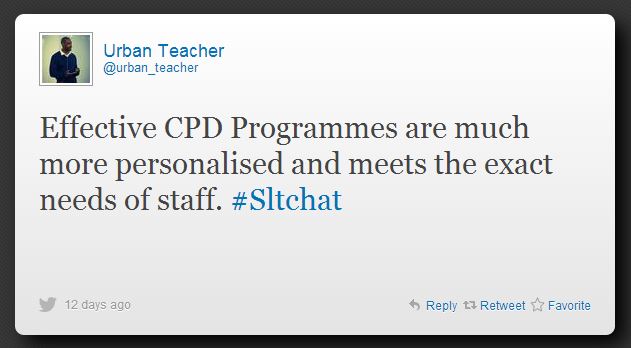
Thanks to @urban_teacher
This led neatly into another strand of tweets which encapsulates an ageless dilemma for those making decisions about the CPD offer in schools. To what extent should it be differentiated, in fact, personalised –I’ll be more engaged in CPD which interests or excites me – versus the benefits of whole school CPD – we can be mutually supportive of each other in terms of planning, implementation and evaluation.
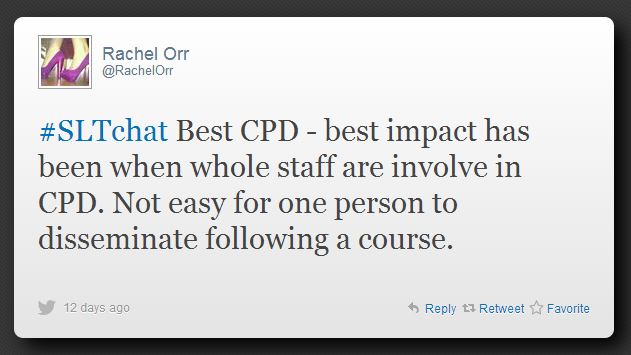
Thanks to @RachelOrr
There isn’t a good or a bad here just a tension to manage as there is only so much time available. I covered some of this ground in a post, The Jerusalem & Babylon of Professional Development. As a slight aside here, an interesting line of tweeting developed around the benefits of a school’s own staff delivering INSET, as part of their own professional development, to help up skill them.
Each year, during the Thursday afternoon slot, we have four or five sessions which tend to be one offs on a particular issue, for example, PSHE, ICT and a couple which teachers have in lieu of attending training from a variety of different sources – webinars, the Fylde Coast Teaching Schools’ CPD calendar or the voluntary training we offer on a Monday afternoon.
There is clearly the possibility to pull these sessions together and then utilise the time for staff to follow one particular strand in a more focussed way. This would also have the advantages of the learning being spaced and revisited over time by a group of staff all with a similar focus. There are also additional benefits here in terms of increased social capital. People often comment on some of the best learning going on in the breaks, lunches between sessions or the bar if it is a residential course – learning has a social dimension.
What would be the impact of a more differentiated, challenging and focussed CPD? How could we achieve it? What would we lose? Would the benefits be greater than the costs?
It Involved Other People, Other Schools

Thanks to @TeacherToolkit
The benefits of working with others within the same school and from other schools shouldn’t be under estimated. Coaching, mentoring, #TeachMeets all featured in many people’s tweets as did learning from practice in and from other schools.

Acknowledgement @informed_edu
The opportunities to engage in Professional Development have never been greater and social media – twitter, blogging, Facebook, webinars – has added greatly to these opportunities. Maybe moving forward the blend of CPD each member of staff engages in will become more and more varied – blended – as each person takes on a greater control of her/his professional development allowing for even greater personalisation.
What would be the impact of this more personalised, challenging, focussed and blended CPD offer? How could this be achieved? What would we lose? Would the benefits be greater than the costs?
It Was a Process Not an Event
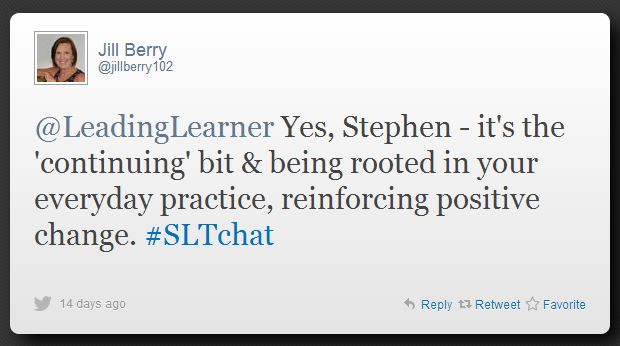
Thanks to @jillberry102
Should the continuing part of CPD take on a greater priority in terms of continuing with a particular element of practice that interests a colleague, in a way that gives her/him time to really practice and hone the application of the new learning? There is a real danger within our current frenetic education system that we do not give teachers time to develop a new practice before moving on to the next new thing. I know I’ve been guilty of this too often.
I wonder whether the issues at the heart of this is the failure to evaluate the impact of the CPD teachers undertake? This was one of the big areas for development, for us, following the NTEN CPD Audit last year. In fact as we were completing the audit this gap in our practice just screamed at us. This evaluation of impact would help us discern whether it is timely to move on or whether more time and work is required to embed a practice. Obviously it would also help us identify what doesn’t work and we should stop spending time on.
It Had an Impact

Thanks to @jillberry102
This is the crunch moment and question, What Impact?

Thanks to @compareschoolse
Professional development needs to have a positive impact. The use of lesson study has started to have an impact on how we look at professional development and in particular how we seek to measure its impact. There is still more work to be done on developing a simple, not overly bureaucratic system to follow up on the impact of the various in-house programmes and external courses staff take part in. The new development plan puts this work, with an idea for a Professional Development Department, at the core of a Multi Academy Trust we intend to form from the 1st September 2014.
In trying to set up the Best CPD Ever would the following be a basis for the success criteria against which the professional development would be evaluated?
CPD should … make me think … meets my needs and the needs of the school … be part of a process … involving other people and if appropriate other schools … that has an impact on me, my team and ultimately my students.
Thanks to everyone who contributed to the #SLTchat debate on the 18th May 2014 – sadly, far too many to quote and include everyone in a single post. Twitter, the Best CPD Ever?
It Needs a Balance

I sent the tweet out at some point during the #SLTchat session and it seemed to keep getting retweeted. If you are interested it comes from
which I have quoted from below:
The campfire… For thousands of years, storytelling was a mechanism for teaching. While it was not the onlymechanism, it was (and is) an important one. Through storytelling, the wisdom of elders waspassed to the next generation.
The watering hole… Just as campfires resonate deeply across space and time, watering holes have an equal statusin the pantheon of learning places. Virtually every hominid on the planet has, at one time inits historical existence, needed to gather at a central source for water. During these trips to thewatering hole, people shared information with their neighbors … The watering hole became a place where we learned from our peers
The cave… The learning community of the campfire brought us in contact with experts, and that of thewatering hole brought us in contact with peers. There is another primordial learningenvironment of great importance: the cave — where we came in contact with ourselves.
The final critical space is the Life Space which is where we apply our new learning.
If you want far more detailed look at CPD why not try out Perfect CPD by @shaun_allison (now on my reading list)
Related posts:
If you are interested in reading more about the changing face of professional development this is a post based on my presentation to NTEN ResearchEd, at Huntington School, York, in May 2014:
The Jerusalem and Babylon of Professional Development
If you are responsible for organising a professional development day or event then the #5MinCPD Plan I co-authored with @TeacherToolkit:
#5MinCPDPlan by @LeadingLearner and @TeacherToolkit
If you want to think about the impact your work is having in the class room the following may prove a useful starting point:
Lesson Planning: End At the Start
In the last post on titled Lesson Planning: Start at the End I likened the planning process to the design work of an architect, starting with a vision of the end product or concept for a building before passing it over to the builders for construction. Teachers are both architects and builders and this is part of what makes our professional lives so complex.

Photo Credit: World Bank Photo Collection via Compfight cc
Moving to the Lesson Plan
Having completed the lesson planning process through initially determining the best that has been thought or said or done within your subject, then defining what excellence would look like, how you would evidence it, determining the structure of the learning and eventually sequencing it you are ready to produce the plan.
Having done all this work it is easier than you think. You simply need to turn the planning process on its head, the lesson plan is the reverse of the planning process.
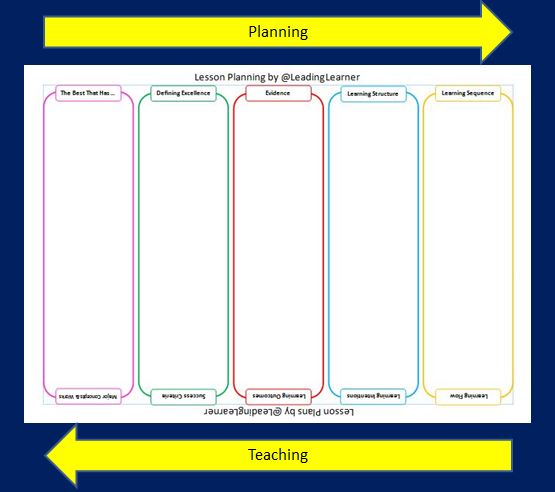
This is easier to see if you print off a copy of the sheet blow, having started by lesson planning with the end in mind – the key concepts and ideas of your subject – you need to actually write lesson plans and teach from the foundational factual knowledge that is required back towards the big concepts and ideas hence you end up back at the start.
A copy of this planner is available as a download here in PDF:
Lesson Planning and Plan – PDF
A publisher version you can type into is available via this Dropbox link.
The Connectives
The lesson planning process actually provides the connectives for the lesson plan as shown by the graphic below.

Adding the Connectives – Flow Diagram of Lesson Planning & Plans
Learning Flow
The first blog post of this series, Planning Lessons: To Plan or Not to Plan emphasised the need to plan the learning across a series of lessons.
A lesson cannot be planned in isolation from the lessons that have gone before or the lessons that will follow as the current learning has a root in previous learning and the fruit of future learning is dependent upon it. There is a sequence and structure required to the learning.
Developing this learning flow requires a view that sees the learning over time. It may also be found that students make faster progress in a lesson than expected and so the next stage of the learning needs to be ready rather than a task to keep them busy and quiet. Once you’ve planned a series of lessons you can follow the learner rather than following the plan.
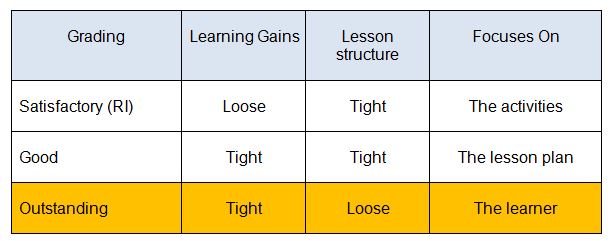
Keep the Learning Gains Tight and Lesson Structure Loose
#OutstandingIn10Plus10
Learning Intentions
This is where the structure of the learning becomes important. In the previous blog post I used the example of planning lessons around Particle Theory. One of the learning intentions (you may call them objectives) was:
Compare and contrast the physical properties of the three states of matter (Relational)
Thinking about the structure of the learning within the objective is very important. Which of the two tables below would you either use as a card sort or expect the students to produce?

The second table is arguably more powerful as it does actually compare and contrast the physical properties of solids, liquids and gases showing their similarities and differences. It provides the opportunity for students to understand
The similarity between solids and liquids in terms of the fixed volume and ease of compression explained by the proximity of particles to each other
Whilst noting the similarity between liquids and gases in terms of the ability to change shape and flow as the particles can move relative to each other and are not fixed in a rigid structure.
There is also a lot that can be thought about here around the development of students’ use and understanding of technical language and thinking about the possible questions that need to be asked to check students’ comprehension of what they are reading.
Learning Outcomes
This is essentially the assessment element of the planning and what vehicle will be best to assess students’ learning is one of the key decisions.
Students need to be able to evidence this learning and in this particular case I have found annotated diagrams very useful. In fact, it would be interesting to get students to start the scheme of learning with an annotated diagram, “What does s/he already know?” and then keep going back to the same task to develop and refine their explanation of Particle Theory.
The learning outcome can vary hugely from one subject to another and often within a subject. A performance in Drama, a picture in Art, a piece of writing in English, an artefact in Design Technology plus a whole mixture of different ideas.
The critical thing that needs planning is how can students best evidence the expected learning?

Comparison of Planning & Plans – Reverse Order
Success Criteria
“There are two parts in targeted learning: the first is being clear about what is to be learned from the lesson(s) (the learning intention); the second is having a way of knowing that the desired learning has been achieved (the success criteria). Targeted learning involves the teacher knowing where he or she is going with the lesson and ensuring that the students know where they are going. These pathways must be transparent for the students.”
Hattie (2012), Visible Learning for Teachers, p. 47
I’ve blogged about this more extensively in a post called When #SOLO Met Bloom Taxonomy. First, you have to be clear in your own mind what excellence looks like and then you have to communicate this with absolute clarity to your students. Great success criteria have three composite components. They are specific, extensive and challenging.
Specific – it’s important to be clear about the elements that are required for excellence. Clarity comes in part through specificity.
Extensive – this is linked to specificity but requires all the main elements of the excellent answer to be included. The issue of balance is raised here as students won’t necessarily be helped by a long tick list, what are the main elements that are key to excellence?
Challenging – keep asking yourself, “Would this produce an A* answer at GCSE?” There is a real danger that we do not ask enough of our students.
Major Concepts & Works
Throughout this series of lessons, I know where I am going as I put in place the factual bedrock that builds towards the greater understanding of Particle Theory. With an understanding of Particle Theory students can begin to explain the World around them.
Have you ever wondered why seagulls find it easier to fly through the air than the water? Or why they can dive into the water but bounce of ice? I use to worry about these things a lot

Photo Credit: drpavloff via Compfight cc
Don’t Forget to Plan the Procedural & Metacognitive Knowledge
In focussing on factual and conceptual knowledge above I wouldn’t want to finish this post without adding in the importance of developing students’ procedural and metacognitive knowledge. We all have a particular way of working in our subjects that we need to explicitly teach to students and then give them the opportunity to practise and develop their skills.
Scientists work through experimentation to test hypothesis. The focus is on control variable of variables after determining the independent and dependent variable and metrics to test a hypothesis.
Metacognitive knowledge is about developing the learner. Expectation of a student’s ability to plan in Year 7 and Sixth Form are different but too often we are not explicit enough. Sixth formers who I tutor for the Extended Project qualifications are shown the use of a GANTT chart, Diigo and Harvard Referencing via Neilstoolbox. Planning over months with a major outcome.
Other posts in this series:
Lesson Planning: To Plan or Not To Plan
Lesson Planning: Start At the End
Postscript & Acknowledgement
The idea for producing the connectives between the lesson plans phases was inspired by Zoe Elder (@fullonlearning). She produced a series of posts around “Marginal Gains” including one focused on “constructing learning outcomes and/or objectives” titled Constructing Learning SO THAT it is Meaningful & Purposeful with this really useful graphic.

Credit: Zoe Elder
I really liked the idea and so adopted it above. Interestingly, I’m not fully convinced that are definitions are totally the same. This isn’t an argument about who’s right or wrong but a word of caution about the need to have agreed definitions of learning intentions, learning outcomes and success criteria within a school so we can communicate with each other clearly.
Hattie, J (2012). Visible Learning for Teachers. London: Routledge
Robinson, M (2013) Trivium 21c Preparing Young People for the Future with Lessons from the Past, Independent Thinking Press
Leadership: Being, Knowing, Doing (New Book)

Liminal Leadership

COPYRIGHT LICENCE

@LeadingLearner by Stephen Tierney is licensed under a Creative Commons Attribution-NonCommercial-NoDerivatives 4.0 International License.
Based on a work at www.leadinglearner.me.
 @LeadingLearner