@LeadingLearner
OFSTED
Becoming a Self Regulating Profession
The issue of lesson grading seems to have been given a good airing this week on a whole series of blogs. The most popular view seems to be that we should stop grading lessons. What I’m less certain of, having read these blogs, is what we are actually going to use as “quality measures” within the Education System. Let’s not be naïve nor lack a strategic dimension to our thinking, with £88 billion pounds of public money used to fund education it is simply unrealistic to expect zero accountability, in fact it is unhelpful. Continue reading
Ofsted Get it Right for Once … Oh No They Didn’t
There was a real sense of delight in Andrew Old (@oldandrewuk) blog post, just before Christmas, “A Christmas Miracle – Ofsted Get it Right for Once”
I hope I’m right in inferring from the various twitter conversations that Andrew has long been campaigning for appropriate recognition, within the Ofsted framework, of high quality lessons that are teacher led and more “traditional” in nature. I’ve read a number of his posts based on Ofsted reports promoting the alternative view.

Ofsted Subsidiary Guidance p.18 & 19 – January 2014
The amendment seems eminently sensible but this is not simply about teachers talking more but how teachers can enhance students’ learning through strategies such as direct instruction and better mediate students’ understanding through high quality input and questioning.

I wondered about whether to write this post or not as there is the real danger of appearing as the pantomime villain. In no way do I want to denigrate the work that Andrew Old and other colleagues have done in securing the amendment within the Subsidiary Guidance but I simply don’t think Ofsted have got it right yet.
Why Have All These Different Grades?
The table below was produced from data presented at a recent ASCL Conference summarising the inspection of one in seven secondary schools for Summer Term 2013. This is a huge number of inspections and a very substantive database. Note the almost identical percentages for overall effectiveness, achievement and the quality of teaching, now taken as over time which effectively equates to examination results as a proxy for achievement.

The much more positive gradings for Behaviour & Safety have been met with the following response from Ofsted in the latest Subsidiary Guidance (highlighting obviously mine):

Ofsted Subsidiary Guidance p.19 – January 2014
I read this quite simply as make sure the Behaviour & Safety grade is the same as the rest, Leadership & Management will surely follow. The one interesting thing for the future is that inspectors are now expected to comment separately on behaviour and safety with the lower grade dictating the overall grade for the section. For example, safeguarding is good but behaviour requires improvement produces a “requires improvement” grade overall.
You have to question why five different grades appear in the report, when in essence the Achievement grade drives the whole process and there is now going to be even greater alignment of grades than ever before.
Outcomes Nationally, Safeguarding Locally
This post is not an argument for no accountability, in an earlier post, Reflections of an Apprentice 2040 Visioner, I accepted that as an education system we had deserved Ofsted because we failed to accept fully our responsibilities for educating, to a sufficiently high standard, all young people. To mis-use a quote from Andy Hargreaves, the point at which we failed to accept our responsibilities as a profession was the point that Ofsted stepped in to hold us accountable. However, the perverse and now corrosive impact of Ofsted has long since stopped serving a purpose and a different Accountability framework is needed.
The new “Progress 8” measure in secondary schools and end of Key Stage 2 tests have the potential to spawn a whole new industry in “data dashboards”. Ofsted’s role should be limited to scrutiny of a school’s outcomes, which at a secondary level has already been given as: one grade above expectation in the Progress 8 measure meaning no inspection visit the following academic year and more than half a grade below expectation means prepare the room for the inspection team!
Safeguarding needs to be dealt with at a local level on an annual basis with a simple “effective safeguarding” or “not effective safeguarding” outcome. The latter would lead to a monitoring plan and on-going checks until safeguarding was judged effective.
Separate to the desktop exercise on Progress 8, we need regional teams, operating within a national framework, but separate from Ofsted composed of highly experienced and well regarded HMIs and Lay Inspectors who have two areas of responsibility:
- Ascertaining and reporting on the practices, systems and approaches in highly achieving schools as part of the knowledge network that seeks to capture and share the best our education system has to offer. The visit to a school may last a week to really get underneath what works with the “knowledge”, from across a number of schools, collated into reports and shared as suggested below.
- Working with schools who need to raise the achievement of their students. No judgements, no flying visits but a shared responsibility for helping ensure all students’ life chances are enhanced through a long term commitment to working together.
I would like to nominate @MaryMyatt and @Heatherleatt – their blogs show an immense amount of common sense and balance – to lead on this but I’m biased.
A national minimum benchmark needs to be set about what is acceptable and the system needs to work to ensure all schools reach this standard within a five to ten year time period, at which time the bar can be raised. Genuine improvements in learning and standards need to be reflected in improved examination outcomes – no artificial raising, lowering or maintaining of pass rates. Remember the 100 metres hasn’t got shorter, people are just running it faster and the same can be true in education.
When Will Ofsted Get it Right?

Oftsed will get it right when they stop inspecting teaching, behaviour and leadership & management. What amounts to a total of three days in a primary school (two inspectors for one and a half days) or about seven in a large secondary school doesn’t provide sufficient evidence to make far reaching conclusions that can sometimes damn or laud a school inappropriately. The idea that inspections produce typical behaviour, from school leaders, teachers or students, just isn’t right and the snapshot is too blunt an instrument in terms of teaching and behaviour to continue to be used.
Issues of teaching and behaviour are for determination by schools not Ofsted. A school’s approach to these will impact on Achievement which should be monitored nationally and schools held accountable. Don’t forget students and parents will make judgements about the quality of teaching & behaviour in a school every day so there isn’t exactly a shortage of accountability on these issues.
My 2014 advice to Ofsted is simple, “Oftsed when you are in a hole, stop digging!” It’s time for a new approach.
If you want a slightly more light-hearted perspective on Ofsted why not try Auld Land Syne #Ofsted Style by @TeacherToolkit and make sure you listen to the irrepressible @RachelOrr in fine voice.
Tom Sherrington’s view of Ofsted I wholeheartedly agree with and you can read it as part of his post, Taking Stock of the Education Agenda: Part 2.
However, if you are expecting that call someday soon there are some Ofsted Resources here that you might find useful, that is, until the revolution comes, brothers and sisters.
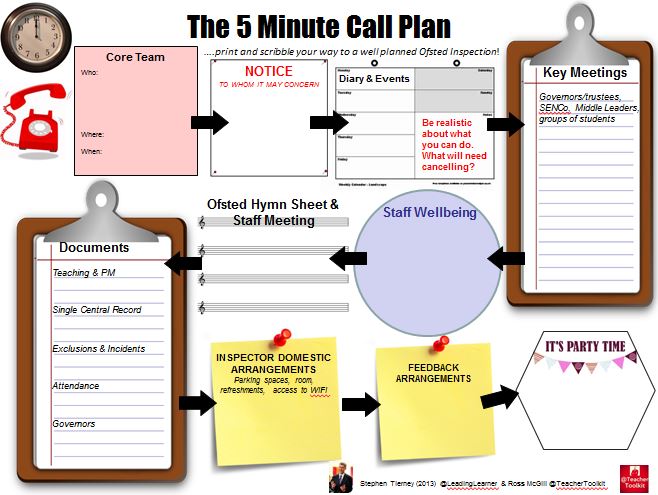
Heather Leatt’s blog is also a valuable source of information as is Clerk to Governors.
#OfstedSEFPlanner – Leadership and Management
This is one of a series of posts on producing an Ofsted Self Evaluation Form. First of all my disclaimer:
“I have no special insight beyond that gleaned from reading the School Inspection Handbook and Subsidiary Guidance. This is not by way of a disclaimer, although maybe it should be, but it is also to invite others to add comments and suggestions to this work and help improve it for others.”
In evaluating Leadership & Management there are a number of different elements that need consideration:
- Governance
- Performance Management
- Curriculum & Partnerships
- Use of Pupil Premium and Year 7 Catch-Up or Primary School Sport Funding
- Whether Pupils are Safe
Calling to Account – “So What Have You Done About It?”
This section seems to be a “calling to account” and whilst there are new elements in it, it clearly builds upon: Achievement of Student, Quality of Teaching and Behaviour & Safety. The Subsidiary Guidance and section in the School Inspection Handbook do little to raise a leader’s morale as there seems so many different elements to the judgement that you feel almost certain one will apply to the school.
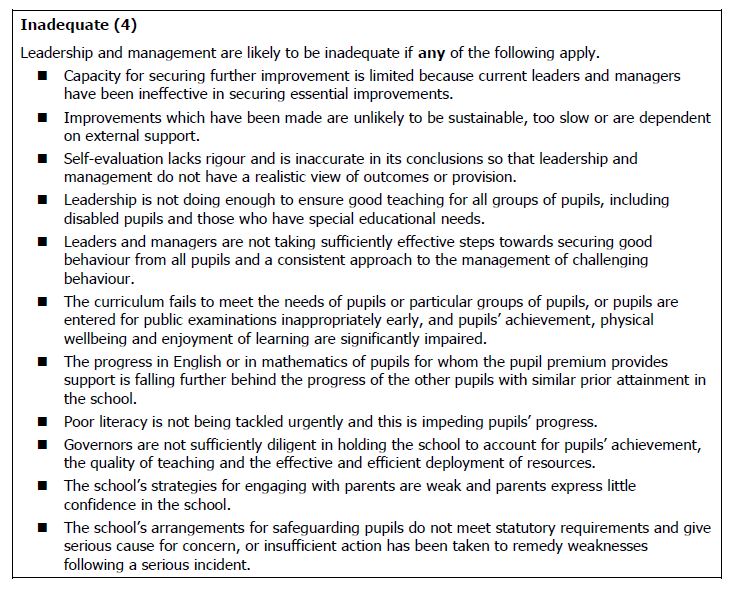
Taken from the School Inspection Handbook
In short the inspection team are testing how robust the school’s self-review and evaluation processes are and whether having identified an issue the school has done something about it. Impact not effort is the focus. It is important to cross reference this section to the other ones within the SEF and provide the most up to date impact information, as much of the data the inspection team has, prior to visiting the school, is historical.
Governance
Governance has, for the past decade or more, been seen as one of the key levers of school improvement. Sat underneath a whole array of structural changes within education in their various forms, around academies, free schools and Interim Executive Boards, is the fundamental belief that for schools to improve good governance is required. It is important to note that even if a school is deemed to “Require Improvement”, for Leadership & Management, the subsidiary guidance states that inspectors include an external review of governance as one of their recommendations.
Different inspection teams seem to take very diverse viewpoints on the role of governors, so here is what the Subsidiary Guidance states:
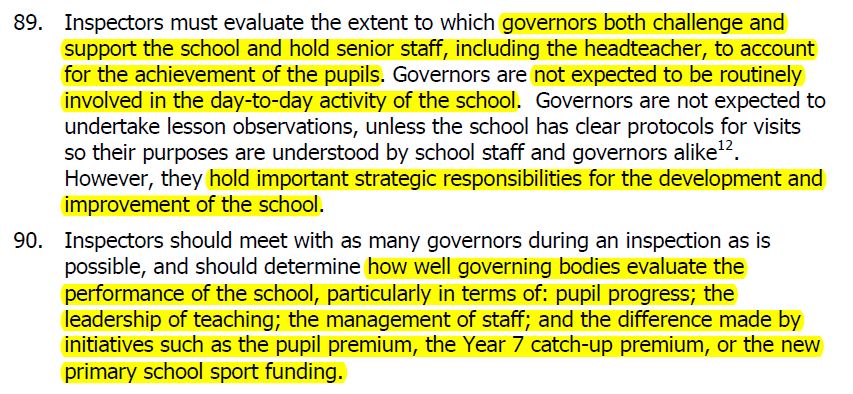
Taken from Subsidiary Guidance
Three things are important to note here:
- Firstly, “governors both challenge and support the school and hold …. to account for the achievement of pupils.” It is quite clear that the other sections within the Ofsted framework are increasingly subservient to pupils’ achievement.
- Secondly, governors are not expected to be routinely involved in the day-to-day activity of the school. Operational matters are for headteachers and senior staff to lead and manage.
- Thirdly, governors need to be well informed about key aspects of the school’s work.
“How Do You Know”
This is a very simple question that any inspection team would ask a Governing Body or their representatives. There is always a place to produce a last minute panic/briefing sheet for governors. Whilst this is useful it cannot replace a secure Quality Assurance dimension within governors’ work. It is difficult for all governors to balance their own demanding work schedules with their responsibilities as governors but here are some ways that leadership teams can help governors:
Write your “Report to Governors”, often presented at termly full Governing Body Meetings, in the style of a SEF with key information about the school under the headings: Achievement, Quality of Teaching, Behaviour & Safety and Leadership & Management.
Ensure you have external moderation, possibly from a trained Ofsted Inspector, of your lesson judgements and involve governors in the process. Whilst our school adviser has moderated my lesson judgements for a number of years, then I’ve moderated the judgements of senior leaders, this year we took a slightly different approach. We invited in the school adviser to help moderate the senior leaders’ judgements as a team activity and also invited in a number of governors to quality assure the process. The governors weren’t asked to judge the quality of the lessons, they were asked whether they were satisfied with our process.
Invite governors to quality assure the school’s self-review and evaluation processes. For a number of years, our governors have received the self-review and evaluation reports from departments. This year we will invite them in to observe the key meetings in the process of generating these reports. Again the question of whether they are satisfied with our processes will be crucial in fulfilling their role. They will also have the opportunity to hear first-hand about “strengths & weaknesses”.
Performance Management
Inspectors will expect anonymised evidence of how performance management has been used to differentially reward staff. With the new Pay Policies currently being implemented in schools this is likely to become an area of greater scrutiny. I might as well say it, if results are not up to scratch the expectation will be that staff won’t receive pay increases.
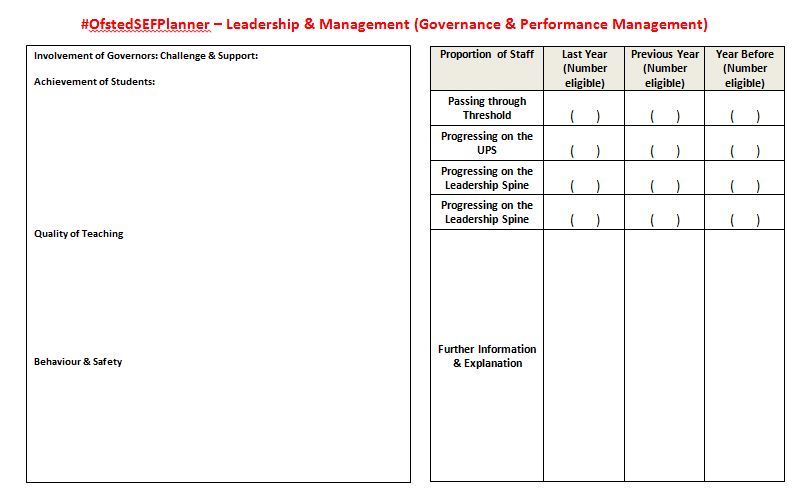
The data for inspectors that you could present would include, for the past three years:
- Proportion of staff who pass through threshold
- Proportion of staff who pass along the upper pay spine
- Proportion of staff who progress along the leadership spine
- And in future years the proportion of staff who progress along the main pay spine
A few notes linking the proportion of staff who have not progressed along the various spines linked to achievement or quality of teaching and learning, as long as individuals are not identified, will help inspectors. This information should not be sent to inspectors but retained on site. If you have completed the #OfstedSEFPlanner – Quality of Teaching you will have noticed there is a section that relates a school’s Quality of Teaching grades with Achievement. Anomalies need to be explained and actions linked to salary determinations and professional development for staff.
Curriculum & Partnerships
Inspectors will look for evidence that the curriculum is meeting the needs of students. Part of this will be found in achievement and progress data but part will also be found in progression rates onto further education or into employment with training against local and possibly national data. Any curriculum partnerships and their impact on students’ achievements need noting.

Where the curriculum does not match with key performance indicators, for example a school’s position on the E-Baccalaureate may be to insist students opt for it or not (Inspectors should note the E-Bacc is not compulsory, Subsidiary Guidance) should be agreed with the Governing Body.
Evidence of Spiritual, Moral, Social & Cultural Development will also be factored into this judgement. This is a thread that runs throughout the inspection. Evidence of this across the school should be collated for inspectors.
Use of Pupil Premium and Year 7 Catch-Up or Primary School Sport Funding
A lot of this information, particularly around progress of students entitled to Pupil Premium funding, will have been captured in the #OfstedSEFPlanner – Achievement of Students. Key additional information should be provided about the progress of students entitled to Pupil Premium funding still at the school and the progress of students who attracted Year 7 Catch-up Funding. Catch-up funding applies to students who did not achieve level 4 in either reading or mathematics at the end of Key Stage 2. These students attract additional funding and the impact of the curriculum, teaching and intervention programmes needs to be assessed via the progress they are making. This can be linked to the overall development of literacy at the school and across the curriculum.
The Primary School Sport Funding should be used to impact on pupil’s lifestyle and physical well-being through increased participation rates and access to various forms of sport and physical activity including competitive sports.
Remember that a lot of this information must be available on the school’s website and inspectors will expect it to be there. The #5MinOfstedPlan has more details about the information schools are required to publish on websites.
Whether Pupils are Safe
A lot of this section simply links back to the #OfstedSEFPlanner – Behaviour & Safety, in particular, the school’s work on addressing bullying particularly cyber-bullying. The views of students and parents through questionnaires and discussions with students during the inspection will help inform the judgement.
Inspectors will also check the Single Central Record and this must be up to date and accurate. The #5MinOfstedPlan identifies key groups inspectors usually target and a process of checking if you want a bit more detail.
Bringing It All Together
The tables below are taken from the School Inspection Handbook and will hopefully help you make your overall judgement for “Leadership & Management”.

In coming to a decision it is helpful to justify to yourself, senior leaders, governors and staff, as objectively as possible:
- Why you have graded the school at a certain level?
- What would you need to do to secure this grading?
- Why is it not the grade above or below?
It is worth noting “demonstrating the capacity to improve” in the Requires Improvement judgement and to note that this will differentiate between serious weakness and special measures in the Inadequate judgement.
You Can Download Versions of the #OfstedSEFPlanner – Leadership & Management Here:
#OfstedSEFPlanner – Leadership & Management (Word Version)
#OfstedSEFPlanner – Leadership & Management (PDF Version)
Other posts in the #OfstedSEFPlanner series include:
#OfstedSEFPlanner – Achievement of Students
#OfstedSEFPlanner – Quality of Teaching
#OfstedSEFPlanner – Behaviour & Safety
If you are looking for more assistance on preparing for Ofsted the following might be useful:
#5MinOfstedPlan by @LeadingLearner and @TeacherToolkit (getting organised for Ofsted)
#5MinCallPlan by @LeadingLearner and @TeacherToolkit (getting organised once you have the call)
Leadership: Being, Knowing, Doing (New Book)

Liminal Leadership

COPYRIGHT LICENCE

@LeadingLearner by Stephen Tierney is licensed under a Creative Commons Attribution-NonCommercial-NoDerivatives 4.0 International License.
Based on a work at www.leadinglearner.me.
 @LeadingLearner