@LeadingLearner
LeadingLearner
Posts Move, Goals Don’t

Many of us within the teaching profession would dearly love to see a period of stability and calm. I think we may need to learn to thrive in chaotic times (to misquote Tom Peters) as the pace of change is becoming exponential. To do this we need to be clear and consistent on the pursuit of our goals, posts may keep changing but our goals don’t (with thanks to Vivienne Porritt for coining this great phrase).

The alternative is to desperately try to cling to the posts and keep them from moving. In reality, we have to accept the positioning of certain posts is not within our determination as the final authority and decision-making lies with others.
Another great #SLT session, on the Great Education Debate, asked, “What is the purpose of education?” Not easy in 140 characters but lots of people made an attempt to answer and this was my offering:

The posts may be changing all around us but I don’t think our goals are.
I’ve not really changed my views much on the purpose of education or the core offering to young people. I’m not a “knowledge versus skills” debater. You need both. The current ascendency of the drive for a more knowledge based curriculum is seen by some as an antidote to the previous overemphasis on skills. I see it more as a reaction, as for every action there is always an equal and opposite reaction. What we need is to reach a point of equilibrium where, knowledge skills and the development of the learner are all interdependent and mutually supportive. Whenever an extreme position is taken that sees one of the trinity of the “knowledge dimensions” in education – knowledge & understanding, procedural skills and the development of the learner – as more important, to the exclusion or belittlement of the other elements, we end up down a cul-de-sac. At some point in the future we have to turn around, as we can’t go any further with one or other element on its own, and so the pendulum swings again.

“The World is Not Flat”
When Dylan Wiliam used “The World is not flat” phrase in a recent presentation it struck a chord. He went on to make the point that scientists have stopped investigating this particular issue. The World is not flat, scientists and people in general have agreed on this and moved on to other areas of research.
Whilst research doesn’t reveal absolute, universal truths the increasing amount of research data behind some ideas should make it difficult for us to ignore. John Hattie’s Visible Learning (2009) and Visible Learning for Teachers (2012) books are fascinating, encouraging and challenging all in equal measure.
If you are not familiar with Hattie’s work he took a whole series of educational activities and interventions and put their impact on achievement on to a single scale (d) for comparison purposes. A d=0.40 was average and then he ranked about one hundred and fifty of them in order.
![Atherton J S (2013) Learning and Teaching; What works best [On-line: UK] retrieved 21 November 2013 from http://www.learningandteaching.info/teaching/what_works.htm](https://leadinglearner.me/wp-content/uploads/2013/11/hattie-barometer-hinge-point.gif)
Atherton J S (2013) Learning and Teaching; What works best [On-line: UK] retrieved 21 November 2013 from http://www.learningandteaching.info/teaching/what_works.htm
When Harry Met Sally

The 1989 film “When Harry Met Sally” is a romantic comedy that looks at what happens when two different ideas about friendship clashed. A number of encounters and meetings over time, with some very funny moments thrown in, all ended in disaster. Harry and Sally keep going their different ways until one fateful New Year’s Eve.
Sometimes when two ideas meet, which may at first sight appear very different, you can create some wonderful things.
It got me thinking, what would happen:
When #SOLO Met Bloom Taxonomy?
When Strategic Met Operational?
#OfstedSEFPlanner – Leadership and Management
This is one of a series of posts on producing an Ofsted Self Evaluation Form. First of all my disclaimer:
“I have no special insight beyond that gleaned from reading the School Inspection Handbook and Subsidiary Guidance. This is not by way of a disclaimer, although maybe it should be, but it is also to invite others to add comments and suggestions to this work and help improve it for others.”
In evaluating Leadership & Management there are a number of different elements that need consideration:
- Governance
- Performance Management
- Curriculum & Partnerships
- Use of Pupil Premium and Year 7 Catch-Up or Primary School Sport Funding
- Whether Pupils are Safe
Calling to Account – “So What Have You Done About It?”
This section seems to be a “calling to account” and whilst there are new elements in it, it clearly builds upon: Achievement of Student, Quality of Teaching and Behaviour & Safety. The Subsidiary Guidance and section in the School Inspection Handbook do little to raise a leader’s morale as there seems so many different elements to the judgement that you feel almost certain one will apply to the school.
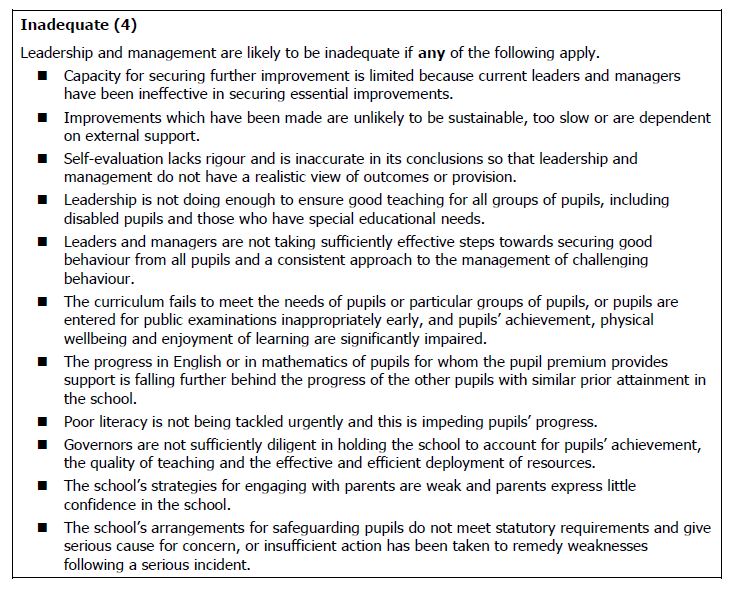
Taken from the School Inspection Handbook
In short the inspection team are testing how robust the school’s self-review and evaluation processes are and whether having identified an issue the school has done something about it. Impact not effort is the focus. It is important to cross reference this section to the other ones within the SEF and provide the most up to date impact information, as much of the data the inspection team has, prior to visiting the school, is historical.
Governance
Governance has, for the past decade or more, been seen as one of the key levers of school improvement. Sat underneath a whole array of structural changes within education in their various forms, around academies, free schools and Interim Executive Boards, is the fundamental belief that for schools to improve good governance is required. It is important to note that even if a school is deemed to “Require Improvement”, for Leadership & Management, the subsidiary guidance states that inspectors include an external review of governance as one of their recommendations.
Different inspection teams seem to take very diverse viewpoints on the role of governors, so here is what the Subsidiary Guidance states:
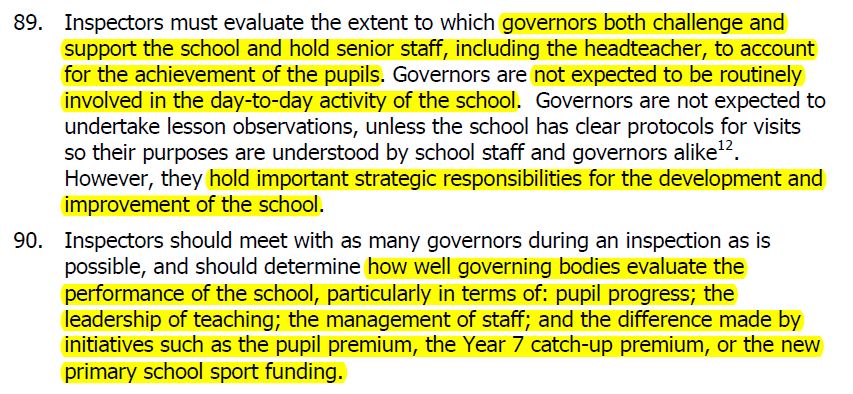
Taken from Subsidiary Guidance
Three things are important to note here:
- Firstly, “governors both challenge and support the school and hold …. to account for the achievement of pupils.” It is quite clear that the other sections within the Ofsted framework are increasingly subservient to pupils’ achievement.
- Secondly, governors are not expected to be routinely involved in the day-to-day activity of the school. Operational matters are for headteachers and senior staff to lead and manage.
- Thirdly, governors need to be well informed about key aspects of the school’s work.
“How Do You Know”
This is a very simple question that any inspection team would ask a Governing Body or their representatives. There is always a place to produce a last minute panic/briefing sheet for governors. Whilst this is useful it cannot replace a secure Quality Assurance dimension within governors’ work. It is difficult for all governors to balance their own demanding work schedules with their responsibilities as governors but here are some ways that leadership teams can help governors:
Write your “Report to Governors”, often presented at termly full Governing Body Meetings, in the style of a SEF with key information about the school under the headings: Achievement, Quality of Teaching, Behaviour & Safety and Leadership & Management.
Ensure you have external moderation, possibly from a trained Ofsted Inspector, of your lesson judgements and involve governors in the process. Whilst our school adviser has moderated my lesson judgements for a number of years, then I’ve moderated the judgements of senior leaders, this year we took a slightly different approach. We invited in the school adviser to help moderate the senior leaders’ judgements as a team activity and also invited in a number of governors to quality assure the process. The governors weren’t asked to judge the quality of the lessons, they were asked whether they were satisfied with our process.
Invite governors to quality assure the school’s self-review and evaluation processes. For a number of years, our governors have received the self-review and evaluation reports from departments. This year we will invite them in to observe the key meetings in the process of generating these reports. Again the question of whether they are satisfied with our processes will be crucial in fulfilling their role. They will also have the opportunity to hear first-hand about “strengths & weaknesses”.
Performance Management
Inspectors will expect anonymised evidence of how performance management has been used to differentially reward staff. With the new Pay Policies currently being implemented in schools this is likely to become an area of greater scrutiny. I might as well say it, if results are not up to scratch the expectation will be that staff won’t receive pay increases.
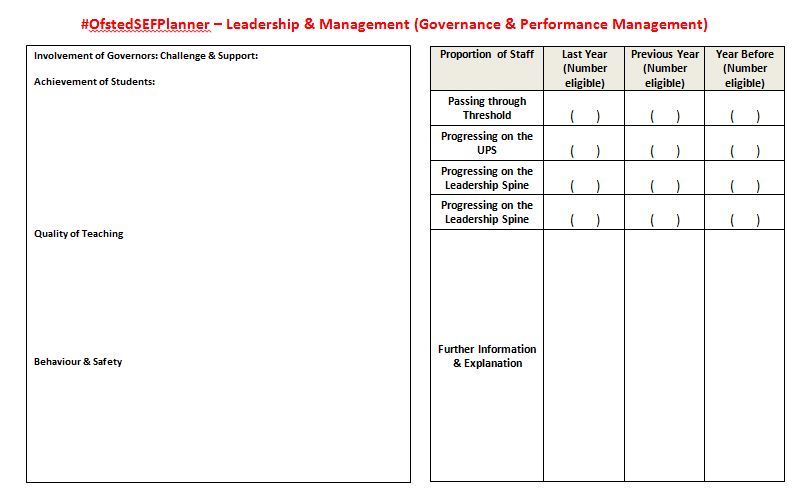
The data for inspectors that you could present would include, for the past three years:
- Proportion of staff who pass through threshold
- Proportion of staff who pass along the upper pay spine
- Proportion of staff who progress along the leadership spine
- And in future years the proportion of staff who progress along the main pay spine
A few notes linking the proportion of staff who have not progressed along the various spines linked to achievement or quality of teaching and learning, as long as individuals are not identified, will help inspectors. This information should not be sent to inspectors but retained on site. If you have completed the #OfstedSEFPlanner – Quality of Teaching you will have noticed there is a section that relates a school’s Quality of Teaching grades with Achievement. Anomalies need to be explained and actions linked to salary determinations and professional development for staff.
Curriculum & Partnerships
Inspectors will look for evidence that the curriculum is meeting the needs of students. Part of this will be found in achievement and progress data but part will also be found in progression rates onto further education or into employment with training against local and possibly national data. Any curriculum partnerships and their impact on students’ achievements need noting.

Where the curriculum does not match with key performance indicators, for example a school’s position on the E-Baccalaureate may be to insist students opt for it or not (Inspectors should note the E-Bacc is not compulsory, Subsidiary Guidance) should be agreed with the Governing Body.
Evidence of Spiritual, Moral, Social & Cultural Development will also be factored into this judgement. This is a thread that runs throughout the inspection. Evidence of this across the school should be collated for inspectors.
Use of Pupil Premium and Year 7 Catch-Up or Primary School Sport Funding
A lot of this information, particularly around progress of students entitled to Pupil Premium funding, will have been captured in the #OfstedSEFPlanner – Achievement of Students. Key additional information should be provided about the progress of students entitled to Pupil Premium funding still at the school and the progress of students who attracted Year 7 Catch-up Funding. Catch-up funding applies to students who did not achieve level 4 in either reading or mathematics at the end of Key Stage 2. These students attract additional funding and the impact of the curriculum, teaching and intervention programmes needs to be assessed via the progress they are making. This can be linked to the overall development of literacy at the school and across the curriculum.
The Primary School Sport Funding should be used to impact on pupil’s lifestyle and physical well-being through increased participation rates and access to various forms of sport and physical activity including competitive sports.
Remember that a lot of this information must be available on the school’s website and inspectors will expect it to be there. The #5MinOfstedPlan has more details about the information schools are required to publish on websites.
Whether Pupils are Safe
A lot of this section simply links back to the #OfstedSEFPlanner – Behaviour & Safety, in particular, the school’s work on addressing bullying particularly cyber-bullying. The views of students and parents through questionnaires and discussions with students during the inspection will help inform the judgement.
Inspectors will also check the Single Central Record and this must be up to date and accurate. The #5MinOfstedPlan identifies key groups inspectors usually target and a process of checking if you want a bit more detail.
Bringing It All Together
The tables below are taken from the School Inspection Handbook and will hopefully help you make your overall judgement for “Leadership & Management”.

In coming to a decision it is helpful to justify to yourself, senior leaders, governors and staff, as objectively as possible:
- Why you have graded the school at a certain level?
- What would you need to do to secure this grading?
- Why is it not the grade above or below?
It is worth noting “demonstrating the capacity to improve” in the Requires Improvement judgement and to note that this will differentiate between serious weakness and special measures in the Inadequate judgement.
You Can Download Versions of the #OfstedSEFPlanner – Leadership & Management Here:
#OfstedSEFPlanner – Leadership & Management (Word Version)
#OfstedSEFPlanner – Leadership & Management (PDF Version)
Other posts in the #OfstedSEFPlanner series include:
#OfstedSEFPlanner – Achievement of Students
#OfstedSEFPlanner – Quality of Teaching
#OfstedSEFPlanner – Behaviour & Safety
If you are looking for more assistance on preparing for Ofsted the following might be useful:
#5MinOfstedPlan by @LeadingLearner and @TeacherToolkit (getting organised for Ofsted)
#5MinCallPlan by @LeadingLearner and @TeacherToolkit (getting organised once you have the call)
#OfstedSEFPlanner – Behaviour and Safety
This is one of a series of posts on producing an Ofsted Self Evaluation Form. First of all, my disclaimer:
“I have no special insight beyond that gleaned from reading the School Inspection Handbook and Subsidiary Guidance. This is not by way of a disclaimer, although maybe it should be, but it is also to invite others to add comments and suggestions to this work and help improve it for others.”
In evaluating Behaviour & Safety there are a number of different elements that need consideration:
- Attendance & Punctuality of students
- Behaviour for learning in class and general behaviour around the school in terms of disruption/inappropriate behaviour
- Learning behaviours in class linked to “a thirst for knowledge and a love of learning” which have a strong impact on progress
- How safe students feel particularly with respect to bullying and e-safety
Attendance & Punctuality of Students
This is about “impact not effort”. Whilst this can be very frustrating for schools, particularly in challenging circumstances, who are quite literally doing everything they can, it is part of the increased demands of this framework.

Comparisons are made between the school’s data, taken from RAISE, and national averages – the median trend line for school’s FSM level doesn’t seem to get a look in. Data from the last three year’s including on persistent absence is analysed including sub-groups. The Subsidiary Guidance for 2013 gives a figure of 94.24% for primary schools and 92.61% for secondary schools as “consistently low” and anything below or approaching that should ring alarm bells (these are the figures below which a school would be in the bottom 10% of schools in terms of attendance).
Inspectors will be looking at whether any particular sub-group’s attendance – FSM Ever 6 (mostly your pupil premium students) and SEN in particular – is below national average and whether there is a link then to underachievement. Important to cross reference sub-groups attendance, also behaviour in terms of exclusion data, with level of achievement in part one of your SEF.
Attendance data in RAISE is based on the first two terms and two and a half terms for special schools so may be different from any whole school data you hold. During the inspection the team will want attendance data for the day and may look at the attendance so far that year compared to the same period the previous year.
Behaviour for Learning in Class and General Behaviour Around the School

This is all about preparing a positive climate for learning within the classroom and whether students behave appropriately and safely around the school at break, lunch and lesson change over. The key data is again in RAISE and needs looking at both as a whole school and for sub-groups. The data is a year behind in RAISE so inspectors won’t have access to the previous year’s exclusion data nor obviously the current year’s so you will need to include this in your analysis. Over time I’ve looked at exclusions in various ways but these are the measures used by Ofsted. The measures used mean that a lot of short term exclusions, a day or two, will produce a much higher figure for a school than fewer long term absences even though the total number of days of exclusion might be the same. There doesn’t seem to be a test of “statistical significance” within RAISE so this might be worth looking at if your data is a bit higher than average. This might be particularly so for permanent exclusions where one in an academic year would take you above the national average in a medium sized secondary school.
Exclusion Measure = (a/b) x 100
|
Measure |
||
| Fixed term exclusions as a percentage of the total school roll/sub- group | Number of fixed term exclusion episodes | Total number of students on roll/in sub- group |
| Percentage of students with 1 or more fixed term exclusions | Number of students during the year with 1 or more fixed term exclusions, including those enrolled during the academic year | Total number of students on roll/in sub-group |
| Permanent exclusions as a percentage of the total school roll/sub-group | Number of students with permanent exclusion | Total number of students on roll/in sub-group |
“High exclusion figures, and particularly for repeated exclusion of the same pupils, are not consistent with good behaviour … High exclusions, overall or of a particular group of pupils, are likely to indicate ineffective systems and structures to support pupils, including basic behaviour management to prevent low-level disruption.”
Ofsted Subsidiary Guidance
Whilst I have no particular angst or argument with the inference above, my concern is that, it is only one of a number of valid inferences that could be drawn from relatively high exclusion data. What is your school’s response to a student hitting another student or swearing at a member of staff – exclusion in one school versus a detention in another? If a school repeatedly exclude a student for unacceptable behaviour but kept going with them as opposed to another school that rather too quickly moved a difficult student on, should the former be penalised? Whilst a balanced view from a lead inspector of one team may look at the nuances within the data another team may stick to the clear line taken in the Subsidiary Guidance. It is best to be forewarned.

In addition to the data from RAISE inspectors will be looking for your analysis of rewards, detentions, on-call systems and internal exclusions. They may also request data on students taken off role and reasons for them leaving. I’ve included a “points lost per student” section as we, like many schools, use a points system to both log inappropriate behaviour and reward good alongside other aspects of a rewards programme. It is useful to compare data for both Pupil Premium students and SEN against whole school data – is there a gap you need to close?
The inspectors will try to make a judgement on behaviour over time. Staff, student & parent voice all play a strong part in coming to this decision so you need to include this supporting data in your SEF.
Learning Behaviours in Class
This is an element that often catches teachers, leaders and schools out. What are the learning behaviours of your students in class like? This is linked to their “thirst for knowledge and a love of learning” which has a strong impact on progress. This judgement is taken across into the quality of teaching judgement. If you look at the first couple of bullet points (note they are put first in the lists) in the outstanding and good descriptors for Behaviour & Safety below you can see that learning behaviours are differentiated from behaviour for learning and behaviour around school because they are different distinct elements.
Our school’s learning behaviours would be categorised under the 5Rs – Responsible, Resilient, Resourceful, Reasoning & Reflective learners but we are poor at collecting this data. Inspectors will make this judgement as part of lesson observations and learning walks. How would you describe the learning atmosphere in your classes – dynamic or passive? Much has been said about inspectors not looking for a particular style of teaching, the descriptors mention independent, group and whole class work, but it is not too difficult to envisage:
- A teacher centric lesson being seen as passive and
- Recognising in group or independent work a student having to employ a greater range of different learning behaviours.
This is borne out in comments in a number of inspection reports around where they see outstanding teaching.
Schools and teachers need to think about including high quality collaborative work into the direct instruction framework and high quality challenge and clear direction into group and independent work irrespective of Ofsted. These are a few of my favourite things that I will blog about another time.
How Safe Students Feel Particularly with Respect to Bullying and E-safety

Schools are expected to keep records of bullying incidents and their responses over time including adaptations to PSHE, additional training for staff and potentially changes to systems and processes, Staff, parent and student voice in particular can be used to identify and address issues or evidence how safe students feel.
“This includes cyber-bullying and prejudice-based bullying related to special educational need, sexual orientation, sex, race, religion and belief, gender reassignment or disability.”
Ofsted Subsidiary Guidance
Spiritual, Moral, Social & Cultural
This section can be a rich source of data in so many ways for yourself, and inspectors, to gather evidence of the Spiritual, Moral, Social & Cultural development of the students. You are far more able to gather data over time than an inspection team can in two days so make sure you highlight it in this section of the SEF.
Success Stories
As part of the gathering of data inspectors request a series of short written accounts about the successes of individual students who are a member of a sub-group. Whilst these sit beyond the SEF it is important to have these ready.
Making Judgements

Taken from the School Inspection Handbook

Taken from The School Inspection Handbook
In coming to a decision it is helpful to justify to yourself, senior leaders, governors and staff, as objectively as possible:
- Why you have graded the school at a certain level?
- What would you need to do to secure this grading?
- Why is it not the grade above or below?
You Can Download Versions of the #Ofsted SEFPlanner – Behaviour & Safety below:
#OfstedSEFPlanner – Behaviour & Safety (Word Version)
#OfstedSEFPlanner – Behaviour & Safety (PDF Version)
Other posts in the #OfstedSEFPlanner series include:
#OfstedSEFPlanner – Achievement of Students
#OfstedSEFPlanner – Quality of Teaching
#OfstedSEFPlanner – Leadership & Management
If you are looking for more assistance on preparing for Ofsted the following might be useful:
#5MinOfstedPlan by @LeadingLearner and @TeacherToolkit (getting organised for Ofsted)
#5MinCallPlan by @LeadingLearner and @TeacherToolkit (getting organised once you have the call)
Leadership: Being, Knowing, Doing (New Book)

Liminal Leadership

COPYRIGHT LICENCE

@LeadingLearner by Stephen Tierney is licensed under a Creative Commons Attribution-NonCommercial-NoDerivatives 4.0 International License.
Based on a work at www.leadinglearner.me.
 @LeadingLearner