@LeadingLearner
LeadingLearner
Preparing and Applying for Your First Headship
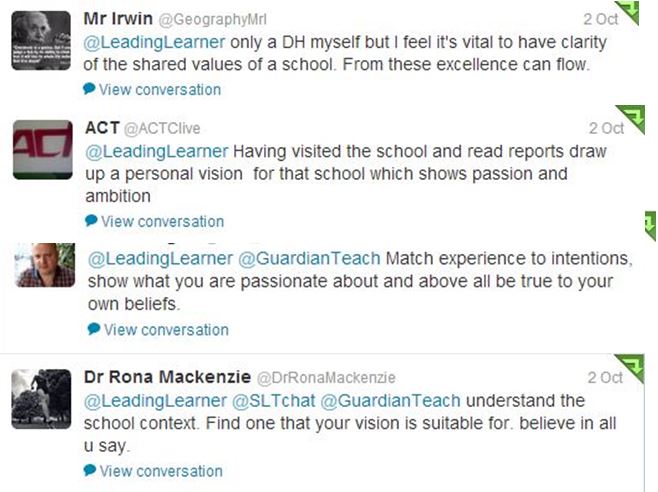
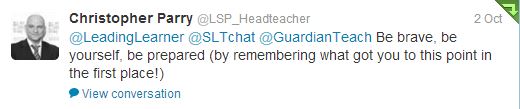
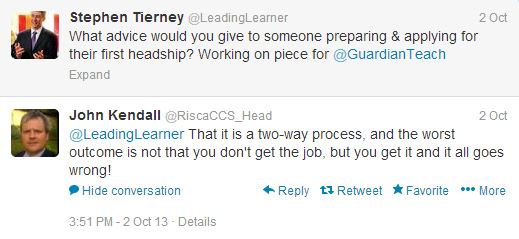
I wrote the following article for the Guardian. I have added a few of the tweets, I got when I used twitter to get some ideas, on what people thought was the best advice for applicants for their first headship.
Nineteen ninety nine seems a long time ago but it was then I made my first application for a headship. It was a bit of a false start as I actually withdrew the application having visited the school. This is no reflection on the school, which was excellent, but I hadn’t fully thought through uprooting my whole family and moving to a different part of the country. My next applications were more considered and after not getting through to the second day of the first post I was interviewed for I was the only person taken through to the second day at St. Mary’s Catholic College, where I have served as Headteacher for the last thirteen years.
The Need to Match the Visions
It’s interesting reflecting back on the only two experiences I have of being interviewed for headship. The feedback from the first school was that they thought I was far too radical in my thinking and not in touch with reality. They may have been right. At St. Mary’s they were looking for a leader who would help develop a new vision for the school and lead it into the 21st Century. This isn’t about good school/bad school or good applicant/bad applicant, this is about matching your vision and aspirations with those of the school and governors that you will be working with and for. If the visions don’t match the school, governors and headteacher are all in for a torrid time. Imagine being in a boat with everyone rowing in a different direction, that is conflicting visions for you. Governing bodies aren’t always confident or sure in articulating their vision but they know an engaging and inspiring vision when they hear one. This is a key area for any aspiring headteacher to consider. If you can’t articulate your vision to a friend or relative or yourself in the mirror you are not yet ready to lead a school.
Are You Ever Ready? You’ll learn.
With the exception of vision I think that you have to accept that there is no preparation for headship quite like actually being a headteacher. You need a good knowledge of: how schools work; structures and systems that ensure good order and high standards of teaching & learning; the ability to work with and influence people and an abundance of resilience.
What I knew about premises and finance, when I became a headteacher, you could write on the back of an envelope and a not very big one at that. Over the past thirteen years I have had overall responsibility for £30 million of capital building programmes and £80 million of recurrent funding. Another worry for applicants can be personnel issues that go beyond the difficult conversation into formal procedures. Outside of a few difficult meetings, where I had been alongside the headteacher as a “professional development opportunity”, again my experience was limited. Remember to follow the policy, make sure you have a good HR provider and be calm and balanced in your approach, you will grow in confidence with experience in time.
Headship is a Team Game
I hope we have eventually given up on the myth of the heroic headteacher who gallops in to save the day single handed. Headship is now more about the team than simply the individual. Make sure you meet the senior leadership team of the school you are applying for and consider whether this is a group you can work with. I would tend to keep it social and just get a feel for the group and start to build the relationships. Most of all be yourself, it is who you bring to genuine and authentic leadership, and it has already got you to deputy headship.
Fewer Better Applications
A few high quality applications are more likely to succeed that trying to send in a generic application for lots of headships. This is a major decision and you have to get it right. Research the school well, visit it prior to applying if you can and make sure the application is totally personalised to the school. We recently appointed three assistant headteachers at St. Mary’s. All of them, along with a number of other potential applicants, visited the school before applying and took the time to write highly personalised letters. These are the people you want working at your school, these are the type of people you want leading your school.
Interview Days
This is likely to be a pretty gruelling few days with a series of panel interviews, data tasks and presentations. I was successfully interviewed for the Executive Headship of St. Mary’s Catholic College and Christ the King Catholic Primary School, earlier this year, but I had no idea how many other candidates would be invited for interview. The poor governors may have to listen to presentations all afternoon. I wanted to make the point that if we wanted to be outstanding we were going to have to do something different and that the skills I had acquired as a secondary headteacher would be transferable to the Executive Headteacher role. The opening two minutes of my presentation was a card sort of the characteristics of outstanding primary and secondary schools taken from two Ofsted documents. It was only after they had sorted them into a couple of groups and noticed all the repetition that I explained where they had come from. Doing something different and my skills are transferable. Please don’t fall into the trap of gimmicks but look for the opportunity to let your light shine out from the crowd. If you’re not successful then maybe it just wasn’t the job for you. Remember to learn from each experience, keep a record of questions asked and tasks given and good luck, I hope the right school is out there for you.
If successful you may be interested in the post, “First Hundred Days of Headship”.
And here are a cryptic one (not sure what Dave Carter is up to – I can now reveal it was a reference to the early entry announcement and the challenges facing Headteachers.) and an out take:


Pupil Premium Analyser and Tracker
 The educational attainment of students entitled to free school meals and children looked after is below that of their more affluent peers. This is simply unacceptable and it is part of our collective moral purpose and “preferential option for the poor” to close this gap in attainment. Continue reading
Changing Flight Paths and Interventions
The previous post on Targets, Learning Gaps and Flight Paths looked at how targets should be used to generate “gaps in learning” between a student’s current attainment and future attainment. It develops a line of thought that targets need to be agile, flexible and adaptable to take account students different flight paths. Targets are not helpful as accountability measures.
I understand teachers’ concerns when they say that the problem with flight paths is children’s learning isn’t linear. It’s important to understand that the flight paths aren’t linear either; it is just the tables that are.
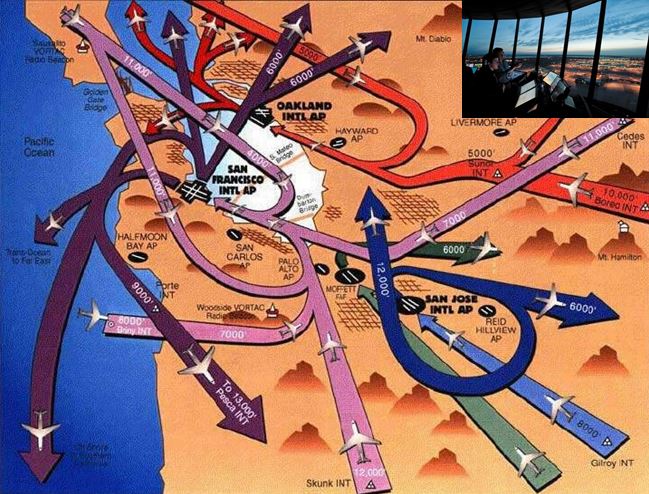
The tables take learning over an extended period of a year, key stage or whole school experience and break this up into convenient and often similar size chunks as a way of looking at expected or better than expected progress. However, children don’t always do what we expect and it is important to pick this up during the learning process and either intervene to close the gap in learning or extend the targets to re-create a gap in learning.
Changing Flight Paths – Secondary Ready?
The term “secondary ready” is often used to describe students who enter a secondary school with “a good level 4” namely a 4B. Expected progress for these students, if achieved, takes them to a relatively secure grade C at GCSE.
However, the conversion rate from a level 4C, at Key Stage 2, to a GCSE grade C is 49% for GCSE English and 55% for GCSE Mathematics (2012 national data)and the expected progress of three levels targets for students entering on a level 3 is a GCSE grade D which is not exactly aspirational or motivating.
Many schools are now looking to accelerate the learning of students in the first part of Year 7, that is deliberately change their flight path and trajectory, through targeted intervention. Our whole school “minimum” target setting based on ten sub-levels progress, two sub-levels in each year from Year 7 to Year 11, needs to be re-thought in terms of students making more accelerated progress much earlier.
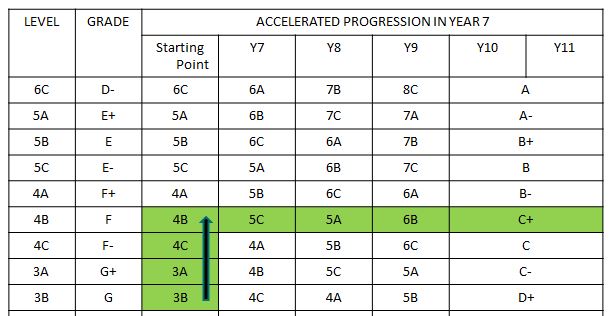
We need to intervene in Year 7, to change a student’s flight path, by deliberately seeking to address issues and gaps in learning, for those students who entering the College at levels 3B, 3A & 4C. This can help redirect them towards a flight path to achieve a 6B at the end of Year 9. Maybe 6B should be renamed the new “Key Stage 4 Ready” level as the conversion from a 6B at the end of Key Stage 3 to at least a GCSE Grade C is very high.
To achieve this we have introduced “Passport Maths” from the National Mathematics Partnership for students in the Christmas Term of Year 7, likewise with a new Literacy Intervention Programme. We wait to see what the impact will be. Due to “losing” our additional teaching capacity, an extra Mathematics teacher and English teacher, one to maternity leave and one to a late external promotion, we are looking to increase capacity with Numeracy & Literacy Intervention Supervisors who will be taking small groups (3/4 students) a few times a week to accelerate the students’ progress.
Building on the idea of “Passport Maths”, why not introduce Passport Science or RE or History or Geography as part of the teaching programme in the first term of Year 7 with a supporting focus on developing literacy, numeracy and learning skills.
We are working on this, we are not there yet.
Changing Flight Paths – More Able Students
We may also need to think again about flight paths for the more able as even our four levels progress that targets a student at level 5A on entry towards a GCSE A grade may not be sufficiently challenging or aspirational. What would it look like if we challenged these students to make an extra sub-levels progress per year by changing the Key Stage 3 Curriculum to increase the rate of expected learning and our aspirations for these academically able students.
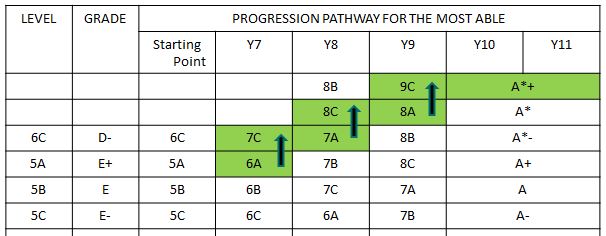
We are working on this, we are not there yet.
Changing Flight Paths – PE & Creative Subjects
Most of the e-mails and comments I have received on the previous blog post Targets, Learning Gaps and Flight Paths were from PE teachers who wanted to know how to approach flight paths for their subject using English or Maths Key Stage 2 scores as a baseline. Exactly the same issue was discussed at St. Mary’s last October when we discussed them during a CPD session. These were our thoughts:
The number of targets, at the various levels, at the end of the key stage should be identical for PE and the Creative subjects as they are for the academic subjects. Outcomes matter so no lowering of the bar.
PE and the creative subjects could produce their own baseline for students at the beginning of Year 7.
The subjects could then alter which students would be expected to achieve which end of key stage level to match the end of key stage profile expected of the other subjects.
We are working on this, we are not there yet.
If you’ve not read Chris Hildrew’s blog post on “Assessment in the New National Curriculum: What We’re Doing” it is well worth looking at but hopefully the idea flight paths are linear we can begin to put to one side.
Where to Now?
The new draft national curriculum lacks much of the national element that is associated with the current one, in particular the removal of levels though how national these were is a moot point anyway. This will create a different environment in which we operate but possibly provides an opportunity for us to develop an individualised curriculum for our students – Charles Handy suggested that this would be a better idea than a National Curriculum over twenty years ago. The thinking that underpins the flight paths, and good assessment generally, will become a critical part of our professional understanding in the years ahead:
- Where are you? This is the assessment that allows us to know where each student is starting their journey from.
- Where are you going? This needs to be considered in terms of the learning gains made over a period of time. What would be expected, what is beyond expectation and what is below? It also needs to be considered in terms of the actual knowledge, understanding, procedural skills, habits of mind and metacognitive strategies that are required for the student to move from current to future point of learning.
- Learning gap closed, target attained and so the process is repeated.
Changing Flight Paths – Getting Really Radical
I want to be clear about this – I’m only just thinking about thinking about the ideas below.
It’s all Joyce Matthews’ (@passionateaboot) fault as she set off a lining of thinking, at least I think it’s thinking rather than just plain madness.
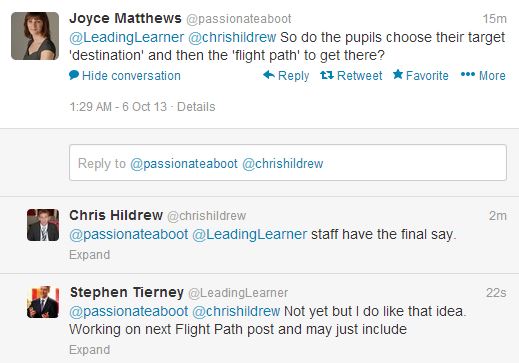
What would it look like if students took control of their target setting process having totally understood the idea of flight paths and had a good working knowledge of the flight paths available? Now this fascinates me as we are moving into the realm of metacognition and self-regulation which is the place where micro personalisation really occurs.
The previous post on flight paths proposed “agile and flexible” targets which operate at the classroom level and are negotiated by students and teachers. What would happen, if alongside the school’s computerised target setting system, students tracked their own progress against a certain flight path:
- Referring themselves for “intervention” if they fell behind?
- Sought additional support to change flight paths onto a trajectory that attained a higher grade that they aspired to
- Planned, reviewed and amended their own learning as they took greater and greater responsibility as learners.
We are entering a different World!
If your concerned that metacognition & self-regulation is scientific nonsense for tweed wearing enemies of promise, have a look at this:
Education Endowment Foundation Toolkit: Metacognition & Self-Regulation
If you are interested in personalisation there are a series of posts that develop the idea, from macro to micro-personalisation, below:
Vision 2040: Learners at the Centre I
Leadership: Being, Knowing, Doing (New Book)

Liminal Leadership

COPYRIGHT LICENCE

@LeadingLearner by Stephen Tierney is licensed under a Creative Commons Attribution-NonCommercial-NoDerivatives 4.0 International License.
Based on a work at www.leadinglearner.me.

