@LeadingLearner
LeadingLearner
#5MinCallPlan by @LeadingLearner and @TeacherToolkit
It’s just after midday, the phone rings and your sixth sense twitches. You’ve guessed right; an inspector calls.

Hopefully you are already well organised with the #5MinOfstedPlan by @LeadingLearner and @TeacherToolkit but the next few hours, whilst not determining the actual outcome of the inspection, will be critical in ensuring a smooth inspection.
We hope the #5MinCallPlan may just help edge things to a more favourable outcome for the school.
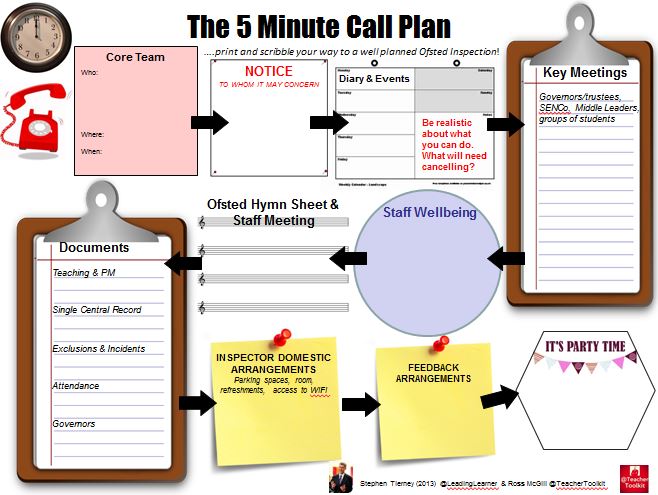
Core Team
A successful inspection is a team approach. Decide in advance which members of staff need to form part of the core team with responsibility for co-ordinating arrangements for the inspection. Think about where and when they will meet. For example, you may want a meeting as soon as possible after the call is received – the call from the inspector often seems to come just after midday Monday to Wednesday – so this could be at lunchtime, followed by a meeting after school and also at the end of the first day to gather information and possibly the morning of the second day. The Core Team are responsible for pulling together and implementing your #5MinCallPlan.
Notifications
Some thought needs giving to the best way to inform staff and students. For example it might be most efficient to send an e-mail to all staff, however, this may also come as quite a shock to them. If staff know in advance that an e-mail will be sent then this could help reduce the impact. Alternatively, calling staff together in the staff room to notify them at lunch time is a more personal way to receive the news and staff will be able to give each other a bit of support.
Briefing students so they know what to expect and be at their best is really useful. Many students have a real affinity for their school and will want to raise their game for the inspection days. In a small school an individual class briefing by a senior leader is possible, alternatively, holding an Ofsted Assembly for the last twenty minutes of the school day may be more convenient. Decision must be made in advance so staff and students know what procedures will be put into place.
Letters need to be handed out to parents about the inspection including information about the Parent View website and these can also be put onto the website.
There are a number of people who need contacting about the inspection including: Chair of Governors/Directors, local authority or Diocese (or other trustees possibly). This is a simple administrative task that can be sorted quickly by an efficient PA or secretary who can have an e-mail group or list of telephone numbers to call as soon as the call has come in. Don’t forget some of these people will also be required to meet inspectors.
Diary & Events

This will be an important decision about what you will allow to go ahead in terms of activities, whether there are training courses that will have to be cancelled and possibly appointments that can be rearranged. It’s going to be a pretty stressful couple of days and managing staff and students carefully will help ease the pressures. A good question might be, “Will this activity or event help support a positive inspection outcome or not”. A lot of lessons being covered, given the focus on observing lessons during an inspection, may be counter-productive. Make decisions and record them along with the name of person who will be auctioning them.
Key Meetings
Inspectors will want to meet, in the next few days, with:
- Governors, including the chair of governors,
- Middle leaders (Heads/Co-ordinators of English, Maths & Science are a pretty obvious group),
- The Special Education Needs Co-ordinator and
- Senior leaders – one of the senior leaders – in a primary school the expectation may be that it should be the headteacher – will need to be able to pull together data requests very rapidly. Use your #5MinOfstedPlan to ensure your self-evaluation form is rich with data including outcomes for students in receipt of pupil premium.
Think about what meetings might be requested, who will be in them, where they can be held and any last minute briefings. Remember to give this responsibility to a named person.
Staff Well-Being
The stress levels almost inevitably start rising and can sometimes go through the roof as the inspection process starts and then escalates. Our experience of Ofsted Inspections is that it can bring a staff together against the “common enemy” and staff teams are often at their best in the face of adversity.

There are two dimensions to think about:
- Emotional support for staff who may just need someone to chat to, ask a question of or have what they think or has actually been a bad moment. Who is available and where should they go?
- Energy boosts with some cakes, additional breakfast or fruit can all help keep the engine room of the school running. Be aware that many staff will want to get things just right and irrespective of what you say will use breaks and lunches to prepare for their next lessons. Equally a member of staff could be in conversations with inspectors for part of their break or lunch. The option of a quick refuelling station may be necessary and very well received.
Ofsted Hymn Sheet & Staff Meeting
Some schools will prepare a last minute briefing sheet for staff – keep it concise and only include key issues to focus on. For example, “make sure you know the data for your classes” – targets, current attainment, G&T, SEN, Pupil Premium students etc. A few bullet points related to the great work you have been doing on pedagogy can be prepared in advance – nothing new or glitzy it’s too late for that.

Staff might want to come together at the end of the day for a short briefing, to ask some questions and support each other. So a meeting time and place should be arranged. Be sensitive to staff who already have other commitments and can’t make it. Keep the briefing brief – the main focus now is on getting the lessons and learning right and trying to get a bit of sleep.
Document Preparation
In #5MinOfstedPlan by @LeadingLearner and @TeacherToolkit there are a number of key documents that need to already be collated in readiness to send to the lead inspector. There are some that will need to be at hand the following day for scrutiny, these include:
- The Single Central Record – always worth one last check that it is up to date and complete.
- Log of exclusions, pupils recently taken off role, racist incidents, incidents of bullying including homophobic bullying. Make sure that these are regularly collected and analysed for trends including looking at sub-groups.
- Up to date attendance information including the days of inspection as they become available
- Documents evidencing the work of governors, including how they have challenged the school where outcomes are below expectation, are required. It maybe useful to record “challenges” in meetings so these can be easily evidenced later if you don’t already routinely do so.
Domestic Arrangements for Inspectors
Whilst some inspection teams make easy guests and others are less welcomed or badly behaved it is important to have a professional approach to these visitors to your school. Car parking arranged for them can be helpful as well as WiFi access. There will need to be a room organised and cleaned with arrangements made for tea, coffee and meals. You might want to think about a meet and greet team – be warned inspectors tend to arrive early. A lead inspector wandering into and all over the school first thing doesn’t do your safeguarding rating a great deal of good. Equally you might consider it an appropriate way to welcome visitors to your school.
Feedback including Staff & Students
Senior staff, governors or trustees, the local authority and Diocese, if you are a faith school, will all be invited to the feedback by the inspectors. Who will communicate these arrangement? At the feedback often two different senior leaders are tasked with making notes on each section and one given the task of writing them up. This will be a useful aide memoir in the days ahead.
However, the staff and the students will also be desperate to know how things have gone. This is a careful balancing act as the outcomes of the inspection will need to be moderated prior to being made public so you will need to think carefully about what is said. Plan a time to give feedback to the staff pretty soon after the inspection finishes. Students are often happy to be given a genuine thank you, for all their support and great work during the inspection, and an idea when the inspection report is released. At St. Mary’s Catholic College all students received a Mars bar along with the last inspection report. We considered this part of our healthy eating programme as they weren’t deep fried!
Staff Celebrations & Party

At the end of the inspection process many staff will want to come together for support and hopefully to celebrate a good or possibly outstanding couple of days. This is an important part of being a community. Give one person the lead for this – it is a job that possibly a support member of staff would happily take the lead on and do exceptionally well. It may be you celebrate with a cup of tea or coffee and cakes at the end of the day. You may organise to go out for a drink a bit later on or organise a more formal celebration a week or two later once the report has been released. Or why not all three – the staff deserve it.
Here’s an early version of the #5MinCallPlan completed in five minutes:
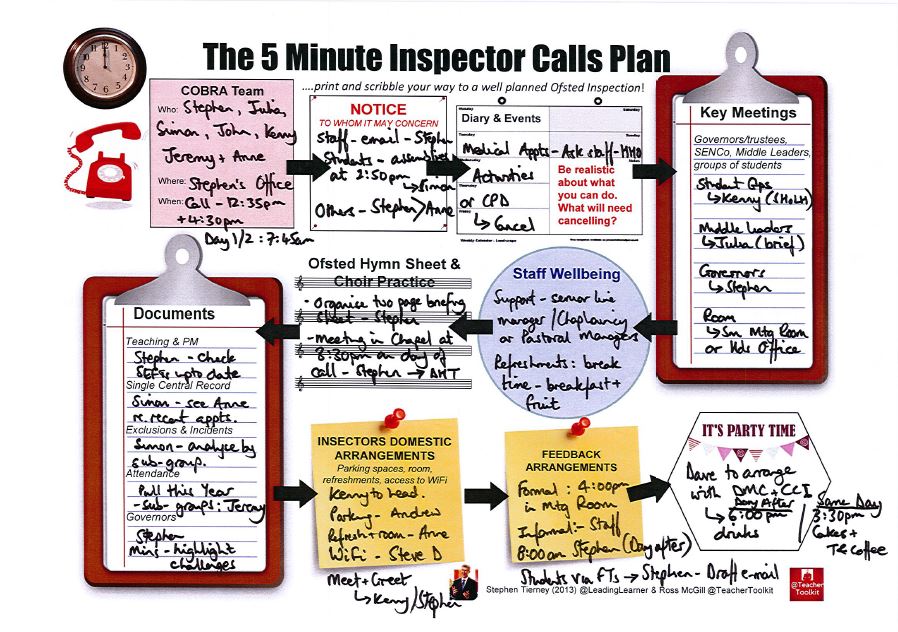
We hope you find the #5MinCallPlan useful if you are preparing for an Ofsted visit.
#5MinInspectorCallsPlan v1.3 (PowerPoint)
Don’t be caught out at the last minute, time to plan for success. Good luck.
Please leave any feedback below as we will adapt and update the plan in the light of your comments.
#5MinOfstedPlan by @LeadingLearner and @TeacherToolkit
There is nothing quite like the O-word to send the shiver down the spine of a school or adrenaline pumping through its veins. Whilst the #5MinOfstedPlan can’t guarantee an outstanding outcome it can help ensure that you are well prepared for that phone call. Don’t fall foul of the old saying, “I didn’t plan to fail but I did fail to plan.” No school wants to get caught out. Continue reading
#WhatstheProblem
If “what works is good” (MW) then what doesn’t work must be bad.
I wonder how often, as leaders and teachers, we ask ourselves the simple question #WhatstheProblem – in my school or in my classroom – in a reflective and evidenced way?
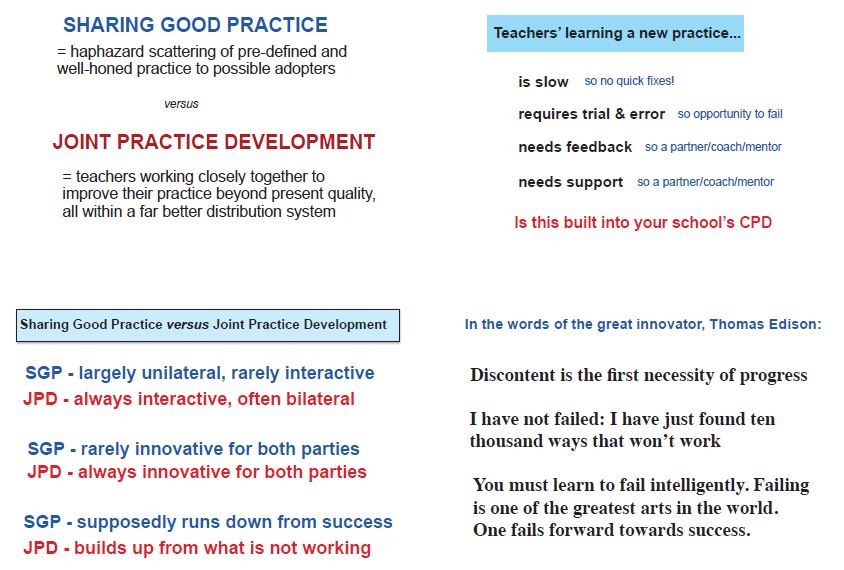
This stream of thought was set off last July by the irrepressible Professor David Hargreaves who was talking to a group of aspiring senior leaders on the SSAT Leadership Course. I’m the course leader hence my attendance at the event. His presentation was on the Self-Improving School System and at one point he was talking about the difference between Joint Practice Development (JPD) and Sharing Good Practice (SGP).
Listening to David I had one of those “light bulb, road to Damascus” moments but also a sinking feeling in the pit of my stomach. Have I spent the past thirteen years as a headteacher and before that as a senior/middle leader and classroom teacher essentially solving problems that didn’t exist or using the wrong solution for the rightly identified problem?
Sharing good practice – and let’s be honest, who hasn’t used this phrase over the past few years – isn’t a bad thing per se, however, too often the good practice hasn’t been exposed to the rigorous evaluation need to actual prove it is “good”. It becomes good practice simply because someone has decided it was “good practice” or examination results went up one year and someone has decided it was because of this particular “good practice”. We have become a system looking for silver bullet solutions. I’m as guilty as anyone, pressure and accountability makes us do some strange things.

Glynn Potts recently put this heartfelt comment on one of the blog posts I had written. I’m sure we are not both alone in looking back and wondering “what if I had done this … or that ..?” Possibly it’s time to re-think our approach to issues and school improvement. What would happen if we started from “what is not working” and our collective discontent about an issue as “the first necessity of progress”. Our question then changes from, “What is working in another context” (SGP) to “#WhatstheProblem?” (JPD).
I’ll blog another time about Professor David Hargreaves presentation but his suggested approach was disciplined, distributed and collaborative, not a simple free for all. It required high social capital, collective moral purpose and evaluation & challenge. As leaders we need to accept a responsibility for the progress of children beyond our own schools and build the trust required with other headteachers to work together for the benefit of all students. As teachers it’s about responsibility beyond our own classroom and the students in our classes. Our work must have a positive impact on all our students, all our classes and all our schools.
Cue the equally irrepressible Tom Sherrington’s (@headguruteacher) recent tweet:

But what’s the stuff we need to do “that’s going to be massively successful?”
I think a great starting point would be the right question, #WhatstheProblem? Once we know the problem that we need to address, we can start sharing thoughts, ideas, and strategies before determining a way forward.
Is this how #SLTChat works? A number of people suggest issues, we vote on the ones that are of greatest importance/urgency for us and then spend half an hour on a Sunday evening sharing ideas and thoughts.
I’m wondering whether to try #WhatstheProblem at a school level to:
- Revise or refine systems and processes
- Identify CPD Issues
- Determine future development plan objectives
- Sort the small irritating stuff out (usually pretty quickly)
Would it work with students as well as staff?
What would it look like as a collaborative process using twitter, Google docs, blogs etc?
One of our new Assistant Headteachers, Phil Brown (@AsstHead_SMCC), has devised a #5MinPlan to help solve #WhatstheProblem – I think it is really neat. His challenge is to solve the problems we are having with the further development and implementation of mobile technology. Please find below his work and a template for you to use:

Leadership: Being, Knowing, Doing (New Book)

Liminal Leadership

COPYRIGHT LICENCE

@LeadingLearner by Stephen Tierney is licensed under a Creative Commons Attribution-NonCommercial-NoDerivatives 4.0 International License.
Based on a work at www.leadinglearner.me.
 @LeadingLearner