@LeadingLearner
OFSTED
#OfstedSEFPlanner – Behaviour and Safety
This is one of a series of posts on producing an Ofsted Self Evaluation Form. First of all, my disclaimer:
“I have no special insight beyond that gleaned from reading the School Inspection Handbook and Subsidiary Guidance. This is not by way of a disclaimer, although maybe it should be, but it is also to invite others to add comments and suggestions to this work and help improve it for others.”
In evaluating Behaviour & Safety there are a number of different elements that need consideration:
- Attendance & Punctuality of students
- Behaviour for learning in class and general behaviour around the school in terms of disruption/inappropriate behaviour
- Learning behaviours in class linked to “a thirst for knowledge and a love of learning” which have a strong impact on progress
- How safe students feel particularly with respect to bullying and e-safety
Attendance & Punctuality of Students
This is about “impact not effort”. Whilst this can be very frustrating for schools, particularly in challenging circumstances, who are quite literally doing everything they can, it is part of the increased demands of this framework.

Comparisons are made between the school’s data, taken from RAISE, and national averages – the median trend line for school’s FSM level doesn’t seem to get a look in. Data from the last three year’s including on persistent absence is analysed including sub-groups. The Subsidiary Guidance for 2013 gives a figure of 94.24% for primary schools and 92.61% for secondary schools as “consistently low” and anything below or approaching that should ring alarm bells (these are the figures below which a school would be in the bottom 10% of schools in terms of attendance).
Inspectors will be looking at whether any particular sub-group’s attendance – FSM Ever 6 (mostly your pupil premium students) and SEN in particular – is below national average and whether there is a link then to underachievement. Important to cross reference sub-groups attendance, also behaviour in terms of exclusion data, with level of achievement in part one of your SEF.
Attendance data in RAISE is based on the first two terms and two and a half terms for special schools so may be different from any whole school data you hold. During the inspection the team will want attendance data for the day and may look at the attendance so far that year compared to the same period the previous year.
Behaviour for Learning in Class and General Behaviour Around the School

This is all about preparing a positive climate for learning within the classroom and whether students behave appropriately and safely around the school at break, lunch and lesson change over. The key data is again in RAISE and needs looking at both as a whole school and for sub-groups. The data is a year behind in RAISE so inspectors won’t have access to the previous year’s exclusion data nor obviously the current year’s so you will need to include this in your analysis. Over time I’ve looked at exclusions in various ways but these are the measures used by Ofsted. The measures used mean that a lot of short term exclusions, a day or two, will produce a much higher figure for a school than fewer long term absences even though the total number of days of exclusion might be the same. There doesn’t seem to be a test of “statistical significance” within RAISE so this might be worth looking at if your data is a bit higher than average. This might be particularly so for permanent exclusions where one in an academic year would take you above the national average in a medium sized secondary school.
Exclusion Measure = (a/b) x 100
|
Measure |
||
| Fixed term exclusions as a percentage of the total school roll/sub- group | Number of fixed term exclusion episodes | Total number of students on roll/in sub- group |
| Percentage of students with 1 or more fixed term exclusions | Number of students during the year with 1 or more fixed term exclusions, including those enrolled during the academic year | Total number of students on roll/in sub-group |
| Permanent exclusions as a percentage of the total school roll/sub-group | Number of students with permanent exclusion | Total number of students on roll/in sub-group |
“High exclusion figures, and particularly for repeated exclusion of the same pupils, are not consistent with good behaviour … High exclusions, overall or of a particular group of pupils, are likely to indicate ineffective systems and structures to support pupils, including basic behaviour management to prevent low-level disruption.”
Ofsted Subsidiary Guidance
Whilst I have no particular angst or argument with the inference above, my concern is that, it is only one of a number of valid inferences that could be drawn from relatively high exclusion data. What is your school’s response to a student hitting another student or swearing at a member of staff – exclusion in one school versus a detention in another? If a school repeatedly exclude a student for unacceptable behaviour but kept going with them as opposed to another school that rather too quickly moved a difficult student on, should the former be penalised? Whilst a balanced view from a lead inspector of one team may look at the nuances within the data another team may stick to the clear line taken in the Subsidiary Guidance. It is best to be forewarned.

In addition to the data from RAISE inspectors will be looking for your analysis of rewards, detentions, on-call systems and internal exclusions. They may also request data on students taken off role and reasons for them leaving. I’ve included a “points lost per student” section as we, like many schools, use a points system to both log inappropriate behaviour and reward good alongside other aspects of a rewards programme. It is useful to compare data for both Pupil Premium students and SEN against whole school data – is there a gap you need to close?
The inspectors will try to make a judgement on behaviour over time. Staff, student & parent voice all play a strong part in coming to this decision so you need to include this supporting data in your SEF.
Learning Behaviours in Class
This is an element that often catches teachers, leaders and schools out. What are the learning behaviours of your students in class like? This is linked to their “thirst for knowledge and a love of learning” which has a strong impact on progress. This judgement is taken across into the quality of teaching judgement. If you look at the first couple of bullet points (note they are put first in the lists) in the outstanding and good descriptors for Behaviour & Safety below you can see that learning behaviours are differentiated from behaviour for learning and behaviour around school because they are different distinct elements.
Our school’s learning behaviours would be categorised under the 5Rs – Responsible, Resilient, Resourceful, Reasoning & Reflective learners but we are poor at collecting this data. Inspectors will make this judgement as part of lesson observations and learning walks. How would you describe the learning atmosphere in your classes – dynamic or passive? Much has been said about inspectors not looking for a particular style of teaching, the descriptors mention independent, group and whole class work, but it is not too difficult to envisage:
- A teacher centric lesson being seen as passive and
- Recognising in group or independent work a student having to employ a greater range of different learning behaviours.
This is borne out in comments in a number of inspection reports around where they see outstanding teaching.
Schools and teachers need to think about including high quality collaborative work into the direct instruction framework and high quality challenge and clear direction into group and independent work irrespective of Ofsted. These are a few of my favourite things that I will blog about another time.
How Safe Students Feel Particularly with Respect to Bullying and E-safety

Schools are expected to keep records of bullying incidents and their responses over time including adaptations to PSHE, additional training for staff and potentially changes to systems and processes, Staff, parent and student voice in particular can be used to identify and address issues or evidence how safe students feel.
“This includes cyber-bullying and prejudice-based bullying related to special educational need, sexual orientation, sex, race, religion and belief, gender reassignment or disability.”
Ofsted Subsidiary Guidance
Spiritual, Moral, Social & Cultural
This section can be a rich source of data in so many ways for yourself, and inspectors, to gather evidence of the Spiritual, Moral, Social & Cultural development of the students. You are far more able to gather data over time than an inspection team can in two days so make sure you highlight it in this section of the SEF.
Success Stories
As part of the gathering of data inspectors request a series of short written accounts about the successes of individual students who are a member of a sub-group. Whilst these sit beyond the SEF it is important to have these ready.
Making Judgements

Taken from the School Inspection Handbook

Taken from The School Inspection Handbook
In coming to a decision it is helpful to justify to yourself, senior leaders, governors and staff, as objectively as possible:
- Why you have graded the school at a certain level?
- What would you need to do to secure this grading?
- Why is it not the grade above or below?
You Can Download Versions of the #Ofsted SEFPlanner – Behaviour & Safety below:
#OfstedSEFPlanner – Behaviour & Safety (Word Version)
#OfstedSEFPlanner – Behaviour & Safety (PDF Version)
Other posts in the #OfstedSEFPlanner series include:
#OfstedSEFPlanner – Achievement of Students
#OfstedSEFPlanner – Quality of Teaching
#OfstedSEFPlanner – Leadership & Management
If you are looking for more assistance on preparing for Ofsted the following might be useful:
#5MinOfstedPlan by @LeadingLearner and @TeacherToolkit (getting organised for Ofsted)
#5MinCallPlan by @LeadingLearner and @TeacherToolkit (getting organised once you have the call)
#OfstedSEFPlanner – Quality of Teaching
This blog post was first written in November 2013. I have updated it using the latest School Inspection Handbook and Subsidiary Guidance published in December 2013 which came into effect in January 2014. Amendments are in red and whilst there is a great deal of commonality between previous and new documents there are some key differences.
The first has been plastered all over twitter and commented on by many:
“Inspectors must not give the impression that Ofsted favours a particular teaching style. Moreover, they must not inspect or report in a way that is not stipulated in the framework, handbook or guidance. For example, they should not criticise teacher talk for being overlong or bemoan a lack of opportunity for different activities in lessons unless there is unequivocal evidence that this is slowing learning over time. It is unrealistic, too, for inspectors to necessarily expect that all work in all lessons is always matched to the specific needs of each individual. Do not expect to see ‘independent learning’ in all lessons and do not make the assumption that this is always necessary or desirable. On occasions, too, pupils are rightly passive rather than active recipients of learning. Do not criticise ‘passivity’ as a matter of course and certainly not unless it is evidently stopping pupils from learning new knowledge or gaining skills and understanding.”
The section on Quality of Teaching goes on to say:

Subsidiary Guidance on Quality of Teaching, January 2014
This has been seen as a break through by many teachers in instructing inspectors not to favour a particular style of teaching.
In evaluating the quality of teaching it is important to look at the impact of the teaching on the progress of students, including consistently high expectations of all students and differentiation within the class to meet individual needs, which can be seen in lessons and evidenced in students’ books. Beyond the classroom, intervention strategies by teachers, setting of homework and marking and feedback, which is used by the learner to help improve her/his performance, all need to be considered.
I would recommend you reading Mary Myatt’s blog on “Why Lesson Observations Only Count for So Much” and she has a number of links to some excellent blog posts on the subject.
It does rather beg the question why so much time is spent on observing lessons during an inspection or why an outstanding grade in Quality of Teaching is required to get an Outstanding overall – why not just defer both and look at the Achievement of Students?
If you look at the data below from Ofsted for inspection in secondary schools between April to June 2013 (448 schools in total) you do wonder about why there are two different grades for achievement & teaching quality:

There is very little information in the Subsidiary Guidance on the Quality of Teaching. Maybe the observation of teaching and internal assessment data provided by the school gives the most current information about student achievement?
Just to note at the moment, inspectors will also make a judgement within lessons that affects the grade for “Behaviour & Safety” linked to whether students show a thirst and passion for learning or are too passive – the latter for many of us can look like well-behaved students getting on with their work!
Gathering the Evidence
In a similar way to the #OfstedSEFPlanner – Achievement there is a need to collect data over time and the focus on the core subjects is unrelenting.

In terms of lesson observations during the Ofsted Inspection senior leaders should expect to do a number of paired observations with inspectors and have their judgements tested. In past years I have had my lesson observation judgements moderated by a trained Ofsted Inspector. However, this year I involved senior leaders alongside myself and the trained Ofsted Inspector in moderating lesson judgements and invited in a number of governors to quality assure the whole process. I think it was really worthwhile.
When observing lessons remember, “What works, is good” and this is now enshrined in the School Inspection Handbook:

Taken from the School Inspection Handbook
Once the lesson observation data is collected it is important to join the dots.
Connecting the Dots – Achievement & Quality of Teaching
One of the most substantial changes to the current Ofsted Framework is the introduction of the impact of teaching over time. This links the judgement on teaching and learning with that on achievement. If “the most important purpose of teaching is to raise pupils’ achievement” then it is difficult to see how it could be any other way. It is critical when writing the SEF to look at where there is a discrepancy between achievement data and quality of teaching information. There may be a valid reason that can be offered or crucially a mis-match between the data that will raise the question about whether the lesson being viewed is representative of what is being delivered over time. This cuts both ways – a bad lesson or day when an inspector visits can be seen in the light of excellent results over time but also vice versa.

Either way it is important to compare and categorise the achievement of students and the quality of teaching judgements. In the red and amber zones, particularly the amber one where achievement requires improvement or is inadequate, there will be an expectation that leaders have taken action. Put simply, if outcomes are not good or better how has this been reflected in performance management, salary determinations and in terms of specific and targeted professional development programmes? This isn’t particularly pleasant work but inspectors are asking, “If things aren’t right for students what have you done about it?” It is far better and expected of leaders to help staff. Don’t leave them struggling, that isn’t fair on anyone. Just an additional note her, governors need to know this information as it is a question that may well be asked of them. I wonder whether a briefing sheet for governors with key information as well as regular sight of the SEF would be very useful.
Make sure that “work scrutiny” is regularly conducted and in particular look for evidence of where students have responded to feedback to improve the quality of their work. This has a significant impact on levels of achievement and so is something all schools, teachers and students should be aiming for.
Spiritual, Moral, Social & Cultural
Gathering evidence on this can be extremely helpful in presenting your SEF to inspectors. It cuts across a number of the judgements and lesson observations can be a rich source of evidence of the spiritual, moral, social and cultural development of students.
Bringing It All Together
The tables below are taken from the School Inspection Handbook and will hopefully help you make your overall judgement for “Quality of Teaching”.
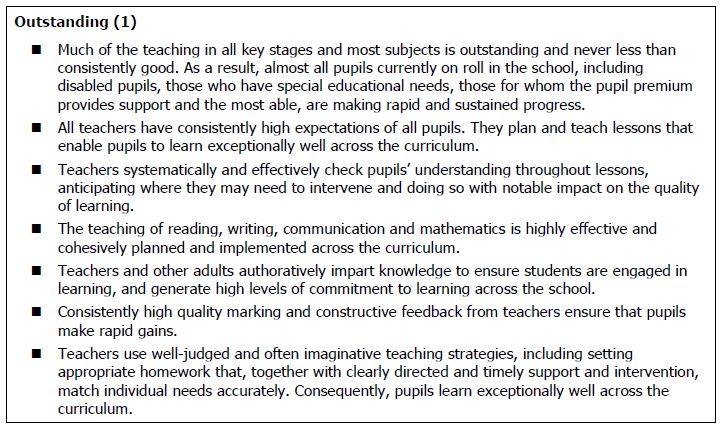
Taken from the School Inspection Handbook
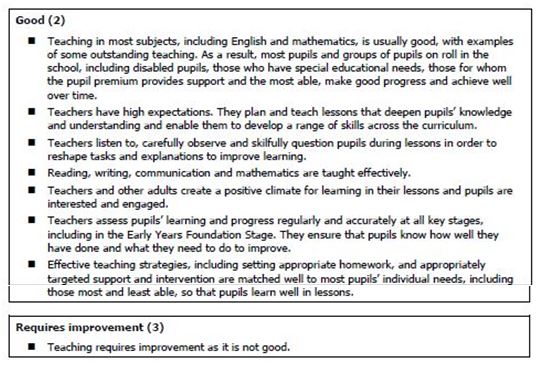
Taken from the School Inspection Handbook
In coming to a decision it is helpful to justify to yourself, senior leaders, governors and staff, as objectively as possible:
Why you have graded the school at a certain level?
What would you need to do to secure this grading?
Why is it not the grade above or below?
You Can Download Versions of the #OfstedSEFPlanner – Quality of Teaching here:
#OfstedSEFPlanner – Quality of Teaching (Word Version)
#OfstedSEFPlanner – Quality of Teaching (PDF Version)
Other posts in the #OfstedSEFPlanner series include:
#OfstedSEFPlanner – Achievement of Students
#OfstedSEFPlanner – Behaviour & Safety
#OfstedSEFPlanner – Leadership & Management
If you are looking for more assistance on preparing for Ofsted the following might be useful:
- #5MinOfstedPlan by @LeadingLearner and @TeacherToolkit (getting organised for Ofsted)
- #5MinCallPlan by @LeadingLearner and @TeacherToolkit (getting organised once you have the call)
- Pupil Premium Analyser and Tracker
This is one of a series of posts on producing an Ofsted Self Evaluation Form. It is part of my current workload and as I stated in the last post:
“I have no special insight beyond that gleaned from reading the School Inspection Handbook and Subsidiary Guidance. This is not by way of a disclaimer, although maybe it should be, but it is also to invite others to add comments and suggestions to this work and help improve it for others.”
#OfstedSEFPlanner – Achievement of Students
This blog post was first written in November 2013. I have updated it using the latest School Inspection Handbook and Subsidiary Guidance published in December 2013 which came into effect in January 2014. Amendments are in red and whilst there is a great deal of commonality between previous and new documents, three things to note are:
- An increased emphasis on the achievements of pupils currently at the school
- Less emphasis on the previous three years of data particularly where a school has become and academy – the distinction between a converter and sponsored academy seems to have been removed.
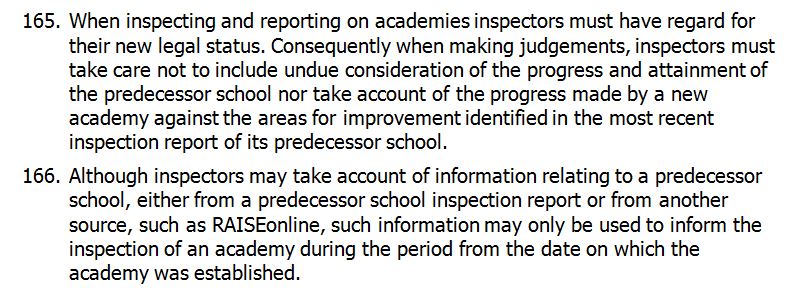
Ofsted Subsidiary Guidance – January 2014 p. 40

Ofsted Subsidiary Guidance – January 2014 p. 40
- A number of changes to judgements around achievement in Early Years Foundation Stage & Key Stage 1 and Sixth Form which need to be checked using the Subsidiary Guidance in particular.
I have no special insight beyond that gleaned from reading the School Inspection Handbook and Subsidiary Guidance. This is not by way of a disclaimer, although maybe it should be, but it is also to invite others to add comments and suggestions to this work and help improve it for others. This on-going process of self-evaluation is seen as key by Ofsted but I would also suggest is key for the health of a school.

Taken from The Framework for School Inspection
If you are “number adverse” you may want to look away now. The Ofsted Inspection process is data driven and inspectors are used to interrogating a school’s achievement data and pursuing certain lines of enquiry revealed by the information.

Taken from the School Inspection Handbook
The challenge in producing this first section of the Self-Evaluation Form is to take a very large amount of information and tell the story about the successes of your students and school whilst still having an analytical perspective on the improvements that need to be made. I’ve always thought that this is the section that drives the whole inspection process – everything else is subservient to the achievement of students and judgements flow from it. This doesn’t mean I’m right, it’s just what I think. The current inspection requirement to look at the quality of teaching over time, as shown by results, has only reinforced this perspective.
Students’ Progress & Attainment in the Last Three Years
Progress and attainment are now looked at over time. The data below can be taken from the school’s RAISE document with unvalidated data from the school’s own Management Information System. It will hopefully provide a useful summary page to allow trends, positive achievements and potential areas that need addressing to be identified.

Key attainment measures currently used are 5+A*-CEM, which may need to be considered alongside floor standards for some schools, percentage A*-C in English & Maths and point scores – total, capped and for English & Maths. Over recent years the English & Maths results have been pretty static at a national level but hugely variable within some schools. You may need to prepare a narrative on this for inspectors for your own school.
The progress measures of three plus levels progress, expected progress Key Stage 2 to 4, or four plus levels progress, better than expected, alongside the value added data can help support a powerful dialogue with inspectors about the impact of the school on students’ achievement.
Grade descriptors for Outstanding and Good Achievement have both been changed to include expected progress and exceeding expected progress, in English and Maths with separate judgements being made about progress in reading and writing at the end of Key Stage 2. Good requires figures to be ” close to or above national figures” whereas outstanding states outcomes must be “high compared with national figures”.
It’s very important that you have looked at the “Expected Progress” grids in RAISE, for English and Maths, including the ones that show progress at a sub-level. These grids also have data for “Achieving More than Expected Progress”.
The analysis table is provided to allow you to make notes and will be useful when coming to an overall judgement for this section. Where you identify outstanding or good achievement a note about why this has happened is useful. Conversely for things you judge as requiring improvement or inadequate but avoid long sets of prose. A simple point, impact and evidence as a series of bullet points is best.
There is additional subject specific data in RAISE that you may also want to include in your analysis.
Closing the Gap & Challenging the Most Able – Achievement of Students (sub-groups)
Throughout the Handbook for Inspection and Subsidiary Guidance there is continual reference to the progress of various sub-groups. My “good read” rather than a detailed analysis suggests that students entitled to Pupil Premium funding, SEN & disabled students and the more able are the most frequently mentioned groups. It’s worth noting the change from a focus on free school meals (FSM) to Pupil Premium which includes those students entitled to free school meals in the past six years – a much bigger group in many schools. You should also check out the achievement of Children Looked After, those with English as an Additional Language and Service Children particularly if there are a significant number in your school. The subsidiary guidance suggests 20% of a cohort but there is a lot discretion for inspectors around this 20% figure.

Again a lot of this data is in RAISE and the performance tables. Inspectors drive hard on this sub-group data so there is no gap or it is rapidly closing celebrate it. If not intervention is needed for the sake of the students, never mind Ofsted. The inspectors will also expect a few case studies on individual students as part of the evidence base so don’t forget to write a few.
The Pupil Premium Analyser and Tracker has just been introduced at the school to help us monitor more closely the progress of these students.
Learning & Progress of Students Currently on Role
This is often the forgotten element of the Self Evaluation Form. The data provided and analysed so far is about students who have left the school or moved on to the Sixth Form. What about the progress and learning of the students who are currently being taught? This has become even more important given the January 2014 changes to the School Inspection Handbook. You will need to have attainment data for current cohorts ready at hand for when you get that call.
“Inspectors will balance evidence about previous cohorts with evidence about the progress being made by the pupils currently being taught in the school.”
School Inspection Handbook – January 2014, p. 35
This analysis needs to be on-going, possibly revising this section of the SEF at the mid-point and end of the year. It is very challenging in the middle of an inspection to suddenly pull together and analyse progress data for year groups and sub-groups hence the inclusion in the SEF. There is always a time lag between any actions you have taken to improve things and improved outcomes. They will most likely appear in your internal data first and this is also key to monitoring the effectiveness of any changed that has been introduced.

Again there is a big focus on the key indicators used by Ofsted and the issue of measuring progress between Key Stage 2 and 4 is going to be crucial. For the moment, until something better is established, we will stay with levels and look to break down the new national curriculum documents into a series of “level milestones”. It is equally valid for a school to decide to move away from levels but the same issue of measuring progress remains.
Additional Thoughts
If any of the elements of your initial analysis leads to you considering that a particular area requires improvement or is just simply inadequate there is a need to analyse it more carefully.
- Whilst this will be a declining issue in many secondary schools after the November 2013 early entry debacle, what impact has early entry had on results? Look particularly at the progress of the more able, students coming in on a level 5, from Key Stage 2, would be expected to make four or possibly five levels progress to attain an A or A* grade rather than the “expected” three.
- The progress matrices, for English & Maths, in RAISE are worth careful scrutiny. Are there any particular strengths shown or areas that need significant improvement. For example, three levels progress looks fine but the average point score is low you may look to see what percentage of students are making better than expected progress or if students are not making three levels progress do they make two or much, much less?
- Is lack of progress in one of the core subjects or key sub-groups having an impact on the data for each indicator that allows you to identify a more precise intervention – more able students’ attainment in Maths, students’ progress who are entitled to pupil premium in English.
Data is not always good at answering questions but can ask some very interesting questions of the achievement of students within a school.
Bringing It All Together
The tables below are taken from the School Inspection Handbook and will hopefully help you make your overall judgement for “Achievement of Pupils”.
In coming to a decision it is helpful to justify to yourself, senior leaders, governors and staff, as objectively as possible:
- Why you have graded the school at a certain level?
- What would you need to do to secure this grading?
- Why is it not the grade above or below?
You can download versions of the #OfstedSEFPlanner – Achievement of Students below:
#OfstedSEFPlanner – Achievement of Students (Word Version)
#OfstedSEFPlanner – Achievement of Students (PDF Version)
Other posts in the #OfstedSEFPlanner series include:
#OfstedSEFPlanner – Quality of Teaching
#OfstedSEFPlanner – Behaviour & Safety
#OfstedSEFPlanner – Leadership & Management
If you are looking for more assistance on preparing for Ofsted the following might be useful:
- #5MinOfstedPlan by @LeadingLearner and @TeacherToolkit (getting organised for Ofsted)
- #5MinCallPlan by @LeadingLearner and @TeacherToolkit (getting organised once you have the call)
- Pupil Premium Analyser and Tracker
Leadership: Being, Knowing, Doing (New Book)

Liminal Leadership

COPYRIGHT LICENCE

@LeadingLearner by Stephen Tierney is licensed under a Creative Commons Attribution-NonCommercial-NoDerivatives 4.0 International License.
Based on a work at www.leadinglearner.me.
 @LeadingLearner