@LeadingLearner
Redesigning Classrooms
#Vis2040 – Power Shifts, Familiar Ground and Cul-de-Sacs. Reflections on #SSATNC13
I decided not to tweet out during this year’s SSAT as I would have probably filled up your time line. Instead I’ve put my thoughts and reflections into a post about #Vis2040 about where we may be going as a profession and as an education system.
The massive challenge of Vision 2040 is becoming more and more apparent to those of us who are engaging in it. It is almost impossible to predict, and maybe even imagine, the detail of education in 2040 but what is possible is to look and attempt to discern a direction of travel. It is more about identifying the main threads rather than seeing the whole picture in detail. One of the things I hope will change by 2040 is the clarity about the role and part to be played by central government, the newly emerging and much more diverse middle layer in education – academy chains, federations, multi-academy trusts, teaching school alliances, local authorities – and loose clusters of and individual schools.
Vision 2040 is an idea about how power may shift within the system, over the next twenty five years, what may stay the same so still be familiar ground to us in 2040 and what are the cul-de-sacs we are currently travelling along, leading no-where, that will require us to change direction.
Thanks to the people who presented especially Michael Fullan, Andy Hargreaves, Bill Lucas, Guy Claxton, Tim Oates and David Weston from whom I made the many random notes that this blog and my reflections are taken from.

From #SSATNC13 – Day 1 Summary
The New Professionalism will require some reimaging, some movement and some consolidation as we move to becoming a true profession:
Teaching as Moral Purpose
This will be a primary focus for those working in education. High levels of equity are achieved through high attainment for all students particularly those from disadvantaged backgrounds. Outcomes matter to young people and deeply affect their life chances. Young people matter to us teachers so outcomes matter to us because they give young people a belief in themselves and a passport to greater opportunities. This is familiar ground.
This moral purpose is advanced nationally as schools are judged purely on the value added measures with the system, system as a whole, judged on attainment measures. Schools in challenging circumstances can be considered good and outstanding as well as those in more privileged settings. Coasting is not allowed by students or schools; we need to eradicate it from the system both individually and collectively.
Ofsted in its current guise has long since gone. Ofsted is a cul-de-sac, it can’t take us any further and is now doing damage, we’ve hit the point of the sigmoid curve that means we need to change before decline begins. The main “control factor” has been built into the system early on- only the brightest, most talented and emotionally intelligent graduates are admitted to the profession. Support is provided for schools by schools, in a newly formed and diverse middle layer of education involving legally integrated schools at a governance level.
Teachers Possess a Body of Knowledge
The teaching profession has a body of knowledge that they “own” linked to curriculum, including assessment, and pedagogy.
The profession is seen as the recognised expert in these areas. The National Curriculum is considered a ridiculous concept. Society, via government, has defined an expansive, rich and inclusive view of the end point of education and what it means to be an educated person in the middle of the 21st Century. The knowledge – factual, conceptual, procedural and metacognitive – associated with becoming an educated person is trusted to the professionals – this is a power shift. The current knowledge versus skills debate is pointless it’s another is a cul-de-sac, it can’t take us any further and is now doing damage, we’ve hit the point of the sigmoid curve that means we need to change before decline begins.
Teachers as Researchers & Developers and Builders of Knowledge
The profession are laterally integrated with research and development and responsibility for growing the professional body of knowledge a core responsibility of all. Links with higher education institutions as part of Initial Teacher Training, early career development to a Masters level and on-going support and validation of research findings throughout a teacher’s career are expected and the norm.

From #SSATNC13 – Day 2
Power Shifts to the Learners
The pervasive use of technology will extend the learning day well beyond the school day in a way that we currently don’t have. The opportunity to learn, not just consolidating and reinforcing learning during homework, but accessing and engaging with others in new learning is now a reality for many young people. We just haven’t really tapped into this as schools yet. Technology is the enabler but it is the student who will increasingly be able to co-construct their learning with teachers and others that will see the balancing of the power dynamic in a learner’s life.
Directions of Travel
Certain dichotomies have been lost from the debate. The most corrosive are currently knowledge versus skills, university versus school based training and development for teachers and accountability versus responsibility.
We are moving towards a system where teachers and schools will be more responsible for the quality of education in a self-improving school system. Schools will increasingly be formally and legally linked at a governance level that embodies “we are more powerful together than apart” and “your pain is my pain, your gain is my gain” thinking and acting. System leaders and chartered teachers operate within local families and clusters of schools who are responsible for “all our children”. When working in localities we are more easily able to define and relate to who are children are. Networks collaborate with networks to capture, share and use knowledge to improve practice.
Familiar Ground
I still believe that schools will be physical buildings. The socialisation and social care of children and young people should and will form part of what we expect from schools and the education system. Modelling the building of right, enriching relationships is an expectation of the system and the ability of young people to do this is a required outcome.
The best way to predict the future is to invent it – that’s the challenge for schools & teachers, that’s the challenge for the profession and that’s the challenge of Vision 2040
Final thanks to Sue Williamson and the SSAT for organising the conference and leading the debate.
When Strategic Met Operational
The concept of strategic planning often gets confused with long term planning. Remember just because someone writes strategic in the heading or says it in a sentence doesn’t mean that their thinking or planning is strategic. The key difference is whether you take account of what is happening all around you, in the environment, in which you are working. The National Professional Qualification for Headship had two modules which put together made the compulsory core – SLAM (Strategic Leadership & Accountability Modules). The Strategic Leadership Module emphasised five factors to consider in strategic leadership and I’ve given an example for each one below:
- P – Political: increasing zero tolerance of educational failure linked to accountability measures
- E – Environmental: a new housing estate being built near the school
- S – Social: changes in family structures, reducing or increasing birth rates
- T – Technical: increased use of mobile technology by young people
- E – Economic: impact of increased austerity on school budgets, in particular, capital budgets
I was never sure why education was never included as a factor but maybe it was considered a “given”.
The Boiled Frog

Before I share this bit of wisdom I need to stress you must not try this at home! The story goes that if you put a frog in a pan of water and then put the pan on the stove the frog will sit there and slowly boil to death – it simply does not detect the gradual change in the environment around it. Schools, leaders and teachers can all sometimes suffer from a bit of the boiled frog syndrome if they are not continually alert.
Shift Happens
When I first pulled the school’s data on ability profile, for this year, I wasn’t expecting this:
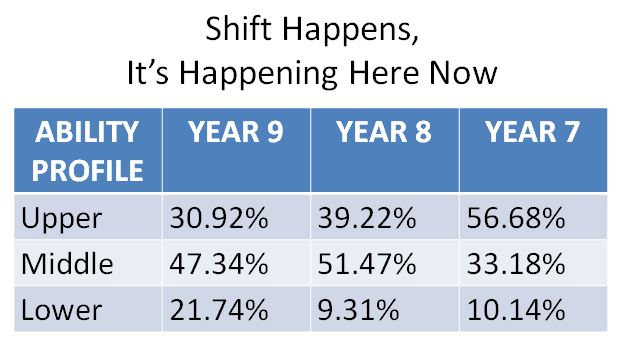 The percentage of students we have in current Year 7, in the upper ability band, looks like a bit of a trend but also possibly a blip. I think by next year it may definitely be a trend. Staff had noticed that our new Year 7 was “different” and the data supports it. Over twelve months ago we started looking at our Key Stage 3 curriculum, targeted levels of progress and collectively agreed they were just not challenging enough – we were faffing about in Key Stage 3 and then going like the clappers in Key Stage 4. Please note this is not an approach I am recommending!
Our challenge now is to develop a curriculum, taking into account the new National Curriculum and content of qualifications, at Key Stage 3. I’ve set the expectation of three differentiated schemes of work. This will then need further differentiation by teachers within the classroom. The strategic and the operational are beginning to merge as part of a continuum from assessing external changes and their potential impact to responding to them.
Scheme of Work to Challenge the Most Able

Put simply don’t reteach the Year 7 students what they already know, get a move on in Year 7 and take their learning on at pace and in depth. I think it is with the most able that we waste the greatest time in Key Stage 3. Our school’s new ability profile data will really challenge our mindset and expectations. In Year 7 we now have two classes, about sixty students, outside our top ability band, that would have previously been in it.
Scheme of Work for the Middle Ability Students

Here there is a need to balance consolidation and challenge but to be honest we are better at consolidating than challenging these students. We need more challenge particularly in Year 9 where students can opt to follow a reduced number of foundation subjects with each occupying ten percent of curriculum time instead of the usual five percent. At the very least, students need to achieve a 6B (in what is now old money) by the end of Year – my new “Key Stage 4 Ready”.
Scheme of work for Lower Ability

What interventions can we put in place to help accelerate the learning of our least able students particularly at the beginning of Year 7? We need to passport these students towards greater success and not reinforce their educational disadvantage that they already have. The challenge is to accelerate these students learning so that they too will be “Key Stage 4 ready” by the end of Year 9. Literacy is often a key issue.
As part of my work for the SSAT (Schools Network) I came across a piece of work by Fiona Hope from Pleckgate in Blackburn. She produced this work as part of a whole school drive to improve literacy. The five objectives seemed great to me.

There is clearly a massive amount of work for teachers to do here at a very operational level and it is likely to be a task that takes a number of years to fully complete and embed particularly with the new Key Stage 3 National Curriculum and the release of new GCSE specifications with only GCSE English and GCSE Mathematics currently available.
Full Circle Back to the Strategic
In some very interesting conversations with staff we discussed how we might sequence the expected learning for the different schemes of work. If this makes sense (and I realise levels are old money now) imagine sequencing all the learning expected to take a student from level 3 to level 7/8 in one single continuum. If you take that continuum of learning you now have a learning sequence that the different ability groups may enter in different places. For example, the most able students enter at level 5 and move towards level 8. Whereas, the least able would enter at level 3 and be looking to move towards level 6. The level 5 work would be the same for both groups of students; it is just that some students would complete it at the start of Year 7 and others at the end of Year 8 or start of Year 9.
Once the continuum of learning has been created, teachers can then start to use it to differentiate work in the classroom as no amount of banding or setting ever produces a homogeneous class of students. The first role of the teacher will be to assess where students are on the continuum and where they should be taken over a certain timescale. The scheme of work devised in a school will be more critical than ever in embodying the curriculum and first level of clarity and differentiation, to assist teachers, in matching and meeting the needs of all students. What schools now believe a curriculum should contain will be of paramount importance to the education it provides. For nearly twenty five years this has been largely dictated from outside schools.
Increasingly the main curriculum developers will be found in schools not Whitehall as the role of informed prescription has come and possibly gone for some time. The initial challenge will be to weave the Key Stage 3 National Curriculum & programmes of study at Key Stage 4 into a seamless whole with links into what has gone before and will come after. In essence Key Stages 3 & 4 will become non-events as there is just a continuum and continuity of learning. The more strategic challenge will be to work across phase – imagine producing a continuum of learning, for schools, teachers and students to use, with children and young people from 3 to 19 years old.
I’ve read some very good blogs recently on the curriculum and would recommend having a look at Alex Quigley’s (@HuntingEnglish) “A New English Curriculum” to see how some people are beginning to think about and use the new curriculum flexibilities, which are appearing in school . The strategic issue is how to link beyond the particular phase of schooling we work in to look across all key stages. Children experience the phases and key stages across schools in a sequential manner. However, the learning across, and often within, them is anything but sequential in nature at the moment.
Devising a continuum of learning from Key Stage 1 to 5, across primary schools, secondary schools and Sixth Forms, is possibly another “When Harry Met Sally” (explained in an earlier post) moment. Different Worlds and philosophies colliding to create something much stronger together than we can apart. The implications for re-imagining education are immense – the whole examination system and professional structure for teachers would need to be re-thought. These thoughts are more Vision 2040 than “Harry Met Sally” and so I’ll blog these out as part of the follow up to this year’s SSAT Conference at the beginning of December.
If you’re interested in other “When Harry Met Sally” Moments, why not try:
When Didactic Met Co-operative
If you are interested in the Flight Path graphic the posts are here:
When #SOLO Met Bloom Taxonomy
If you are interested in the thinking (thinking might be too strong a term for what I was actually doing) that brought me to explore this relationship you might want to look at a previous post, “Posts Move, Goals Don’t.”
Leadership: Being, Knowing, Doing (New Book)

Liminal Leadership

COPYRIGHT LICENCE

@LeadingLearner by Stephen Tierney is licensed under a Creative Commons Attribution-NonCommercial-NoDerivatives 4.0 International License.
Based on a work at www.leadinglearner.me.
 @LeadingLearner