@LeadingLearner
Education
Posts Move, Goals Don’t

Many of us within the teaching profession would dearly love to see a period of stability and calm. I think we may need to learn to thrive in chaotic times (to misquote Tom Peters) as the pace of change is becoming exponential. To do this we need to be clear and consistent on the pursuit of our goals, posts may keep changing but our goals don’t (with thanks to Vivienne Porritt for coining this great phrase).

The alternative is to desperately try to cling to the posts and keep them from moving. In reality, we have to accept the positioning of certain posts is not within our determination as the final authority and decision-making lies with others.
Another great #SLT session, on the Great Education Debate, asked, “What is the purpose of education?” Not easy in 140 characters but lots of people made an attempt to answer and this was my offering:

The posts may be changing all around us but I don’t think our goals are.
I’ve not really changed my views much on the purpose of education or the core offering to young people. I’m not a “knowledge versus skills” debater. You need both. The current ascendency of the drive for a more knowledge based curriculum is seen by some as an antidote to the previous overemphasis on skills. I see it more as a reaction, as for every action there is always an equal and opposite reaction. What we need is to reach a point of equilibrium where, knowledge skills and the development of the learner are all interdependent and mutually supportive. Whenever an extreme position is taken that sees one of the trinity of the “knowledge dimensions” in education – knowledge & understanding, procedural skills and the development of the learner – as more important, to the exclusion or belittlement of the other elements, we end up down a cul-de-sac. At some point in the future we have to turn around, as we can’t go any further with one or other element on its own, and so the pendulum swings again.

“The World is Not Flat”
When Dylan Wiliam used “The World is not flat” phrase in a recent presentation it struck a chord. He went on to make the point that scientists have stopped investigating this particular issue. The World is not flat, scientists and people in general have agreed on this and moved on to other areas of research.
Whilst research doesn’t reveal absolute, universal truths the increasing amount of research data behind some ideas should make it difficult for us to ignore. John Hattie’s Visible Learning (2009) and Visible Learning for Teachers (2012) books are fascinating, encouraging and challenging all in equal measure.
If you are not familiar with Hattie’s work he took a whole series of educational activities and interventions and put their impact on achievement on to a single scale (d) for comparison purposes. A d=0.40 was average and then he ranked about one hundred and fifty of them in order.
![Atherton J S (2013) Learning and Teaching; What works best [On-line: UK] retrieved 21 November 2013 from http://www.learningandteaching.info/teaching/what_works.htm](https://leadinglearner.me/wp-content/uploads/2013/11/hattie-barometer-hinge-point.gif)
Atherton J S (2013) Learning and Teaching; What works best [On-line: UK] retrieved 21 November 2013 from http://www.learningandteaching.info/teaching/what_works.htm
When Harry Met Sally

The 1989 film “When Harry Met Sally” is a romantic comedy that looks at what happens when two different ideas about friendship clashed. A number of encounters and meetings over time, with some very funny moments thrown in, all ended in disaster. Harry and Sally keep going their different ways until one fateful New Year’s Eve.
Sometimes when two ideas meet, which may at first sight appear very different, you can create some wonderful things.
It got me thinking, what would happen:
When #SOLO Met Bloom Taxonomy?
When Strategic Met Operational?
#5MinCPDPlan by @LeadingLearner and @TeacherToolkit
Continuing Professional Development (CPD) and in particular INSET Days can vary from the brilliant to the awful and often somewhere in between. The problem often lies in them: being standalone one off events; lacking a clarity in terms of the outcomes for either teachers or pupils and them being on totally the wrong thing, something for which there is limited or counter-evidence on the theme/focus having a positive impact on pupils’ learning. Continue reading
#5MinWellBeingPlan by @LeadingLearner and @TeacherToolkit

You may think it is with a certain sense of irony that @LeadingLearner and @TeacherToolkit have produced the #5MinWellBeingPlan. However, like many people working in education we need to get our lives back in some sort of order and balance. The “#GuiltyTeacher. Guilty as Charged! By @TeacherToolkit” post certainly struck a chord, with many teachers and support staff, about how we live our lives.
In schools we squash the equivalent of a full working year, and often more, into just thirty nine weeks. People outside of education see the “long holidays” but don’t often see the extended and sometimes gruelling hours we work during term time. Ask the partner of a teacher about evening and weekends during term time and they will tell a story of almost continuous work with not enough time for nights out or a bit of fun until the next holiday comes along.
It’s time to launch the #5MinWellBeingPlan:
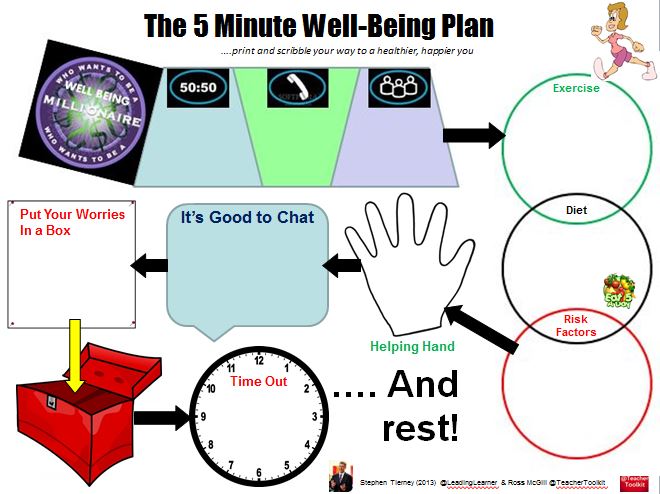
In recent years a number of schools have taken a lead on developing approaches to staff well-being. Whether you work in one of those schools or not there is a lot you can do for yourself.
The Well-Being Millionaire

50:50
Try to decide and plan how you will spend your time each week. If you’re not careful work can expand to fit every waking hour. The “To Do List” will never be done and it helps if you accept this. What time will be for school work and what time will not? Try to have fixed times each week where you close the school bag and think about things other than work. When might you give yourself a little treat each week?
Phone a Friend
Keep in touch with people who are nearest and dearest to you. It’s easy to keep putting off that phone call, text, skype session or letter whilst you just get the next job done. Who do you want to stay in touch with on a regular basis and who have you not made contact with in ages?
Ask the Audience
Family & friends can all too easily be forgotten, in particular, your partner can be someone who spends her/his life waiting for the next school holiday, just to get some of your attention. Why not plan a meal or night out, trip to the theatre or cinema etc. with family and friends. The break will do you good and you might even enjoy it.

It is sometimes a really great idea to book a weekend away in the middle of a half term. Three or four weeks in, a mini-break with a loved one can give you the boost you need to make it through the half term with a smile on your face. Try somewhere local – it reduces down on the travel hassles and means you can just book in for one night which keeps the cost down
Healthy Living
Exercise
Exercise is not only good for our bodies it is good for our minds. Exercise makes you feel happier alongside doing great things for your heart, general muscle tone and helping you remain/become a healthy weight. How and when are you going to exercise each week? You need to look after your body as it is the only one you’ll get.
Diet
We hopefully all know about 5 a day. There is a danger, when you are continually on the go, that you skip the odd meal or replace it with cakes & biscuits, snatched in a quick break. Do you ever find yourself lying awake at night on a “caffeine high” only to repeat the dose the following day because you feel tired? Think about you diet and pick one thing that you need to start or stop doing. Write it down and commit to making that change.
Risk Factors
Excessive alcohol, being overweight, stress, lack of sleep are all things that we know make us unwell. If we don’t deal with these issue early then you will become unwell. Not good for you, not good for your family and friends and not good for your students. Be honest with yourself – do you have any risk factors? What are you going to do about them?
Helping Hand
It’s an odd thing but helping others makes us feel better. Now that’s a “win-win”. There are so many ways to help but here are a few – take part in a sponsored walk/swim/run (also ticks the exercise box), go to a charity event, give some time up one evening or at the weekend to help a local charity (a change is as good as a rest), organise a charity event with your form, secretly surprise a colleague with a random act of kindness, take part in a Secret Santa … the list goes on. What would you like to do to make a difference to someone else’s life?
It’s Good to Chat
There are times when we need to talk through challenges or stresses that we are feeling. On occasion we want people to help us solve the problem and other times we just want someone to listen. It can also help us find a solution when we just verbalise the issues to someone. What do you need to chat about and who would be a good person to chat with. You may want to work with someone on a regular basis in a reciprocal arrangement. Good friends and good work colleagues can both make effective coaches.
Put Your Worries in a Box

There are some times when the job just simply gets too busy. There are other times we worry about things we can’t actually do very much about. Time to put your worries in a box. Make a list of your worries – this is to stop you worrying about forgetting them – write them down and put them in a box. If you are a bit OCD, why not put them in date order! Periodically get the box down and look at your list of worries – can you now throw it away? Deal with it? Put it back in the box for another day?
Time Out
Every now and then you do need to simply stop and reflect on how life is going. Are you walking in the direction of your dreams, doing things that are important to you? Are you in a velvet lined rut or maybe one that is a little less comfortable?
What is giving you joy and what do you need to change?

Let’s remember that we are human beings not human doings! It’s sometimes said that when we look back at our lives it will not be the jobs left undone that we regret but rather the relationships that are broken or the time we didn’t spend with loved ones.
The job needs to get done but we are more likely to achieve it if we look after our own well-being. Time to stop, time to refill the reservoir!
An example of the #5MinWellBeingPlan is below:

A copy of the #5MinWellBeingPlan is here: #5MinWellBeingPlan (PDF)
The plan was originally done in PowerPoint and can be edited or typed into: #5MinWellBeingPlan v1 (PowerPoint version)
Feel free to tweet us a copy of your #5MinWellBeingPlan and we will look to retweet a number of them.
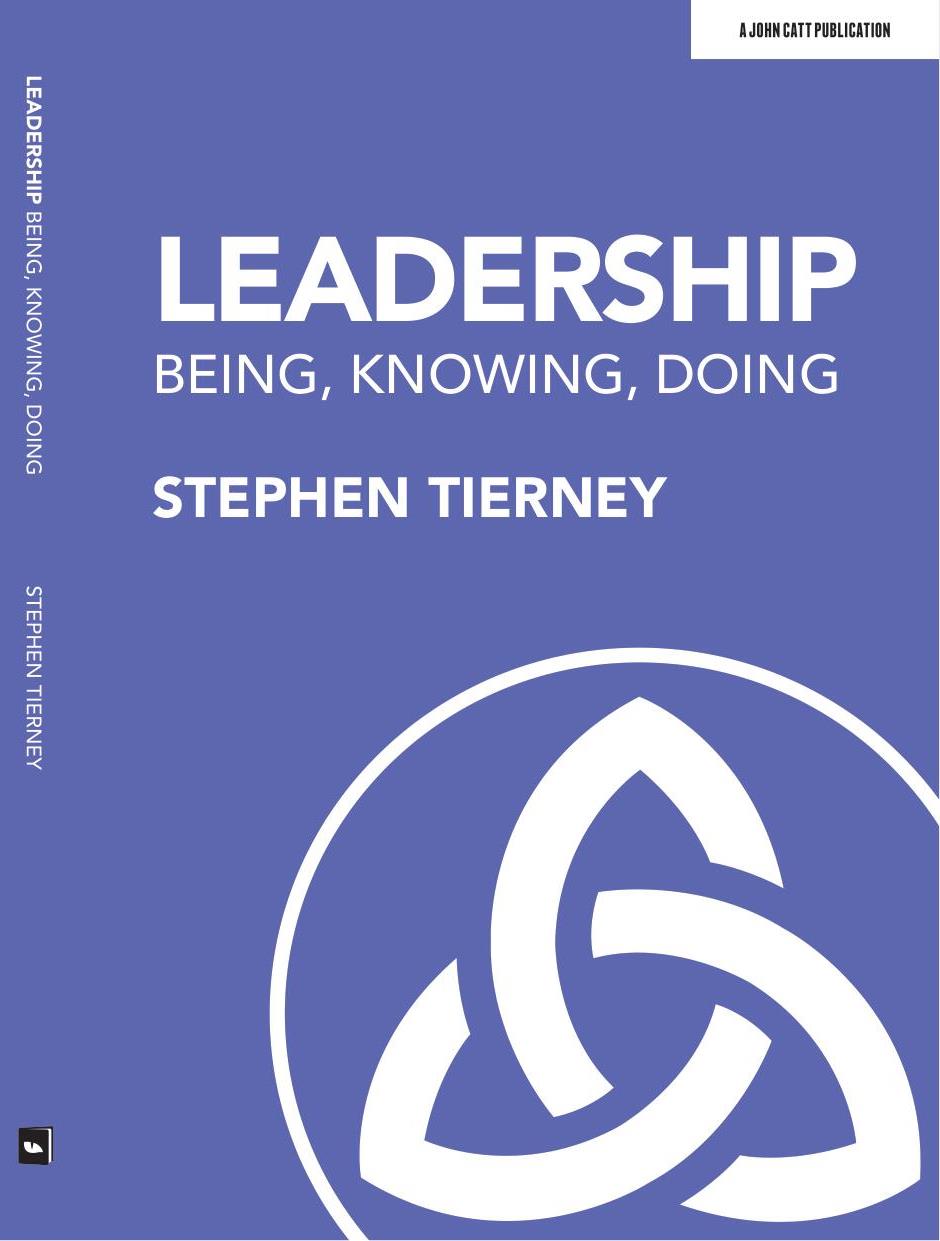
Leadership: Being, Knowing, Doing (New Book)

Liminal Leadership

COPYRIGHT LICENCE

@LeadingLearner by Stephen Tierney is licensed under a Creative Commons Attribution-NonCommercial-NoDerivatives 4.0 International License.
Based on a work at www.leadinglearner.me.
 @LeadingLearner