@LeadingLearner
LeadingLearner
#OfstedSEFPlanner – Achievement of Students
This blog post was first written in November 2013. I have updated it using the latest School Inspection Handbook and Subsidiary Guidance published in December 2013 which came into effect in January 2014. Amendments are in red and whilst there is a great deal of commonality between previous and new documents, three things to note are:
- An increased emphasis on the achievements of pupils currently at the school
- Less emphasis on the previous three years of data particularly where a school has become and academy – the distinction between a converter and sponsored academy seems to have been removed.
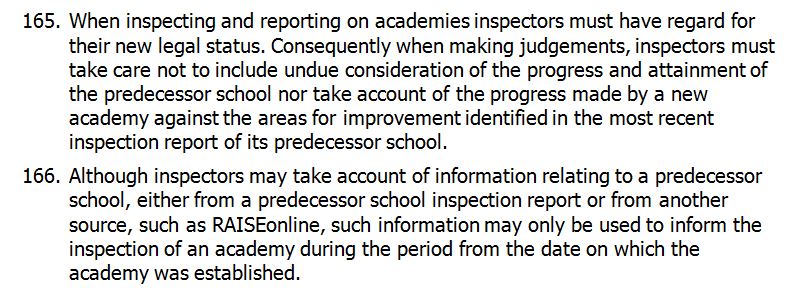
Ofsted Subsidiary Guidance – January 2014 p. 40

Ofsted Subsidiary Guidance – January 2014 p. 40
- A number of changes to judgements around achievement in Early Years Foundation Stage & Key Stage 1 and Sixth Form which need to be checked using the Subsidiary Guidance in particular.
I have no special insight beyond that gleaned from reading the School Inspection Handbook and Subsidiary Guidance. This is not by way of a disclaimer, although maybe it should be, but it is also to invite others to add comments and suggestions to this work and help improve it for others. This on-going process of self-evaluation is seen as key by Ofsted but I would also suggest is key for the health of a school.

Taken from The Framework for School Inspection
If you are “number adverse” you may want to look away now. The Ofsted Inspection process is data driven and inspectors are used to interrogating a school’s achievement data and pursuing certain lines of enquiry revealed by the information.

Taken from the School Inspection Handbook
The challenge in producing this first section of the Self-Evaluation Form is to take a very large amount of information and tell the story about the successes of your students and school whilst still having an analytical perspective on the improvements that need to be made. I’ve always thought that this is the section that drives the whole inspection process – everything else is subservient to the achievement of students and judgements flow from it. This doesn’t mean I’m right, it’s just what I think. The current inspection requirement to look at the quality of teaching over time, as shown by results, has only reinforced this perspective.
Students’ Progress & Attainment in the Last Three Years
Progress and attainment are now looked at over time. The data below can be taken from the school’s RAISE document with unvalidated data from the school’s own Management Information System. It will hopefully provide a useful summary page to allow trends, positive achievements and potential areas that need addressing to be identified.

Key attainment measures currently used are 5+A*-CEM, which may need to be considered alongside floor standards for some schools, percentage A*-C in English & Maths and point scores – total, capped and for English & Maths. Over recent years the English & Maths results have been pretty static at a national level but hugely variable within some schools. You may need to prepare a narrative on this for inspectors for your own school.
The progress measures of three plus levels progress, expected progress Key Stage 2 to 4, or four plus levels progress, better than expected, alongside the value added data can help support a powerful dialogue with inspectors about the impact of the school on students’ achievement.
Grade descriptors for Outstanding and Good Achievement have both been changed to include expected progress and exceeding expected progress, in English and Maths with separate judgements being made about progress in reading and writing at the end of Key Stage 2. Good requires figures to be ” close to or above national figures” whereas outstanding states outcomes must be “high compared with national figures”.
It’s very important that you have looked at the “Expected Progress” grids in RAISE, for English and Maths, including the ones that show progress at a sub-level. These grids also have data for “Achieving More than Expected Progress”.
The analysis table is provided to allow you to make notes and will be useful when coming to an overall judgement for this section. Where you identify outstanding or good achievement a note about why this has happened is useful. Conversely for things you judge as requiring improvement or inadequate but avoid long sets of prose. A simple point, impact and evidence as a series of bullet points is best.
There is additional subject specific data in RAISE that you may also want to include in your analysis.
Closing the Gap & Challenging the Most Able – Achievement of Students (sub-groups)
Throughout the Handbook for Inspection and Subsidiary Guidance there is continual reference to the progress of various sub-groups. My “good read” rather than a detailed analysis suggests that students entitled to Pupil Premium funding, SEN & disabled students and the more able are the most frequently mentioned groups. It’s worth noting the change from a focus on free school meals (FSM) to Pupil Premium which includes those students entitled to free school meals in the past six years – a much bigger group in many schools. You should also check out the achievement of Children Looked After, those with English as an Additional Language and Service Children particularly if there are a significant number in your school. The subsidiary guidance suggests 20% of a cohort but there is a lot discretion for inspectors around this 20% figure.

Again a lot of this data is in RAISE and the performance tables. Inspectors drive hard on this sub-group data so there is no gap or it is rapidly closing celebrate it. If not intervention is needed for the sake of the students, never mind Ofsted. The inspectors will also expect a few case studies on individual students as part of the evidence base so don’t forget to write a few.
The Pupil Premium Analyser and Tracker has just been introduced at the school to help us monitor more closely the progress of these students.
Learning & Progress of Students Currently on Role
This is often the forgotten element of the Self Evaluation Form. The data provided and analysed so far is about students who have left the school or moved on to the Sixth Form. What about the progress and learning of the students who are currently being taught? This has become even more important given the January 2014 changes to the School Inspection Handbook. You will need to have attainment data for current cohorts ready at hand for when you get that call.
“Inspectors will balance evidence about previous cohorts with evidence about the progress being made by the pupils currently being taught in the school.”
School Inspection Handbook – January 2014, p. 35
This analysis needs to be on-going, possibly revising this section of the SEF at the mid-point and end of the year. It is very challenging in the middle of an inspection to suddenly pull together and analyse progress data for year groups and sub-groups hence the inclusion in the SEF. There is always a time lag between any actions you have taken to improve things and improved outcomes. They will most likely appear in your internal data first and this is also key to monitoring the effectiveness of any changed that has been introduced.

Again there is a big focus on the key indicators used by Ofsted and the issue of measuring progress between Key Stage 2 and 4 is going to be crucial. For the moment, until something better is established, we will stay with levels and look to break down the new national curriculum documents into a series of “level milestones”. It is equally valid for a school to decide to move away from levels but the same issue of measuring progress remains.
Additional Thoughts
If any of the elements of your initial analysis leads to you considering that a particular area requires improvement or is just simply inadequate there is a need to analyse it more carefully.
- Whilst this will be a declining issue in many secondary schools after the November 2013 early entry debacle, what impact has early entry had on results? Look particularly at the progress of the more able, students coming in on a level 5, from Key Stage 2, would be expected to make four or possibly five levels progress to attain an A or A* grade rather than the “expected” three.
- The progress matrices, for English & Maths, in RAISE are worth careful scrutiny. Are there any particular strengths shown or areas that need significant improvement. For example, three levels progress looks fine but the average point score is low you may look to see what percentage of students are making better than expected progress or if students are not making three levels progress do they make two or much, much less?
- Is lack of progress in one of the core subjects or key sub-groups having an impact on the data for each indicator that allows you to identify a more precise intervention – more able students’ attainment in Maths, students’ progress who are entitled to pupil premium in English.
Data is not always good at answering questions but can ask some very interesting questions of the achievement of students within a school.
Bringing It All Together
The tables below are taken from the School Inspection Handbook and will hopefully help you make your overall judgement for “Achievement of Pupils”.
In coming to a decision it is helpful to justify to yourself, senior leaders, governors and staff, as objectively as possible:
- Why you have graded the school at a certain level?
- What would you need to do to secure this grading?
- Why is it not the grade above or below?
You can download versions of the #OfstedSEFPlanner – Achievement of Students below:
#OfstedSEFPlanner – Achievement of Students (Word Version)
#OfstedSEFPlanner – Achievement of Students (PDF Version)
Other posts in the #OfstedSEFPlanner series include:
#OfstedSEFPlanner – Quality of Teaching
#OfstedSEFPlanner – Behaviour & Safety
#OfstedSEFPlanner – Leadership & Management
If you are looking for more assistance on preparing for Ofsted the following might be useful:
- #5MinOfstedPlan by @LeadingLearner and @TeacherToolkit (getting organised for Ofsted)
- #5MinCallPlan by @LeadingLearner and @TeacherToolkit (getting organised once you have the call)
- Pupil Premium Analyser and Tracker
#5MinCPDPlan by @LeadingLearner and @TeacherToolkit
Continuing Professional Development (CPD) and in particular INSET Days can vary from the brilliant to the awful and often somewhere in between. The problem often lies in them: being standalone one off events; lacking a clarity in terms of the outcomes for either teachers or pupils and them being on totally the wrong thing, something for which there is limited or counter-evidence on the theme/focus having a positive impact on pupils’ learning. Continue reading
#5MinWellBeingPlan by @LeadingLearner and @TeacherToolkit

You may think it is with a certain sense of irony that @LeadingLearner and @TeacherToolkit have produced the #5MinWellBeingPlan. However, like many people working in education we need to get our lives back in some sort of order and balance. The “#GuiltyTeacher. Guilty as Charged! By @TeacherToolkit” post certainly struck a chord, with many teachers and support staff, about how we live our lives.
In schools we squash the equivalent of a full working year, and often more, into just thirty nine weeks. People outside of education see the “long holidays” but don’t often see the extended and sometimes gruelling hours we work during term time. Ask the partner of a teacher about evening and weekends during term time and they will tell a story of almost continuous work with not enough time for nights out or a bit of fun until the next holiday comes along.
It’s time to launch the #5MinWellBeingPlan:
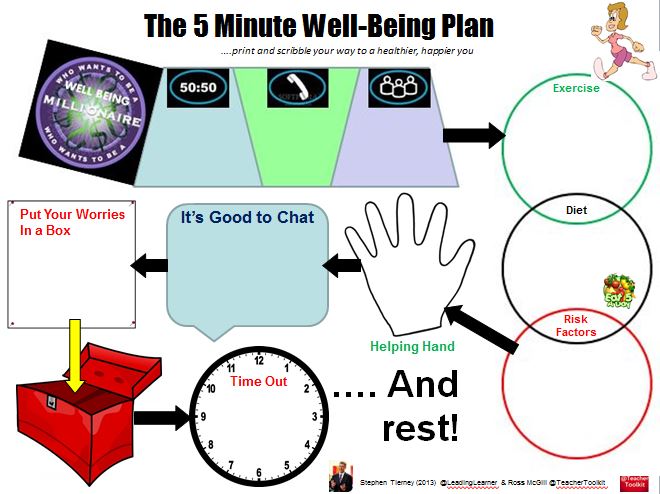
In recent years a number of schools have taken a lead on developing approaches to staff well-being. Whether you work in one of those schools or not there is a lot you can do for yourself.
The Well-Being Millionaire

50:50
Try to decide and plan how you will spend your time each week. If you’re not careful work can expand to fit every waking hour. The “To Do List” will never be done and it helps if you accept this. What time will be for school work and what time will not? Try to have fixed times each week where you close the school bag and think about things other than work. When might you give yourself a little treat each week?
Phone a Friend
Keep in touch with people who are nearest and dearest to you. It’s easy to keep putting off that phone call, text, skype session or letter whilst you just get the next job done. Who do you want to stay in touch with on a regular basis and who have you not made contact with in ages?
Ask the Audience
Family & friends can all too easily be forgotten, in particular, your partner can be someone who spends her/his life waiting for the next school holiday, just to get some of your attention. Why not plan a meal or night out, trip to the theatre or cinema etc. with family and friends. The break will do you good and you might even enjoy it.

It is sometimes a really great idea to book a weekend away in the middle of a half term. Three or four weeks in, a mini-break with a loved one can give you the boost you need to make it through the half term with a smile on your face. Try somewhere local – it reduces down on the travel hassles and means you can just book in for one night which keeps the cost down
Healthy Living
Exercise

Exercise is not only good for our bodies it is good for our minds. Exercise makes you feel happier alongside doing great things for your heart, general muscle tone and helping you remain/become a healthy weight. How and when are you going to exercise each week? You need to look after your body as it is the only one you’ll get.
Diet
We hopefully all know about 5 a day. There is a danger, when you are continually on the go, that you skip the odd meal or replace it with cakes & biscuits, snatched in a quick break. Do you ever find yourself lying awake at night on a “caffeine high” only to repeat the dose the following day because you feel tired? Think about you diet and pick one thing that you need to start or stop doing. Write it down and commit to making that change.
Risk Factors
Excessive alcohol, being overweight, stress, lack of sleep are all things that we know make us unwell. If we don’t deal with these issue early then you will become unwell. Not good for you, not good for your family and friends and not good for your students. Be honest with yourself – do you have any risk factors? What are you going to do about them?
Helping Hand
It’s an odd thing but helping others makes us feel better. Now that’s a “win-win”. There are so many ways to help but here are a few – take part in a sponsored walk/swim/run (also ticks the exercise box), go to a charity event, give some time up one evening or at the weekend to help a local charity (a change is as good as a rest), organise a charity event with your form, secretly surprise a colleague with a random act of kindness, take part in a Secret Santa … the list goes on. What would you like to do to make a difference to someone else’s life?
It’s Good to Chat
There are times when we need to talk through challenges or stresses that we are feeling. On occasion we want people to help us solve the problem and other times we just want someone to listen. It can also help us find a solution when we just verbalise the issues to someone. What do you need to chat about and who would be a good person to chat with. You may want to work with someone on a regular basis in a reciprocal arrangement. Good friends and good work colleagues can both make effective coaches.
Put Your Worries in a Box

There are some times when the job just simply gets too busy. There are other times we worry about things we can’t actually do very much about. Time to put your worries in a box. Make a list of your worries – this is to stop you worrying about forgetting them – write them down and put them in a box. If you are a bit OCD, why not put them in date order! Periodically get the box down and look at your list of worries – can you now throw it away? Deal with it? Put it back in the box for another day?
Time Out
Every now and then you do need to simply stop and reflect on how life is going. Are you walking in the direction of your dreams, doing things that are important to you? Are you in a velvet lined rut or maybe one that is a little less comfortable?
What is giving you joy and what do you need to change?

Let’s remember that we are human beings not human doings! It’s sometimes said that when we look back at our lives it will not be the jobs left undone that we regret but rather the relationships that are broken or the time we didn’t spend with loved ones.
The job needs to get done but we are more likely to achieve it if we look after our own well-being. Time to stop, time to refill the reservoir!
An example of the #5MinWellBeingPlan is below:

A copy of the #5MinWellBeingPlan is here: #5MinWellBeingPlan (PDF)
The plan was originally done in PowerPoint and can be edited or typed into: #5MinWellBeingPlan v1 (PowerPoint version)
Feel free to tweet us a copy of your #5MinWellBeingPlan and we will look to retweet a number of them.
Leadership: Being, Knowing, Doing (New Book)

Liminal Leadership

COPYRIGHT LICENCE

@LeadingLearner by Stephen Tierney is licensed under a Creative Commons Attribution-NonCommercial-NoDerivatives 4.0 International License.
Based on a work at www.leadinglearner.me.

